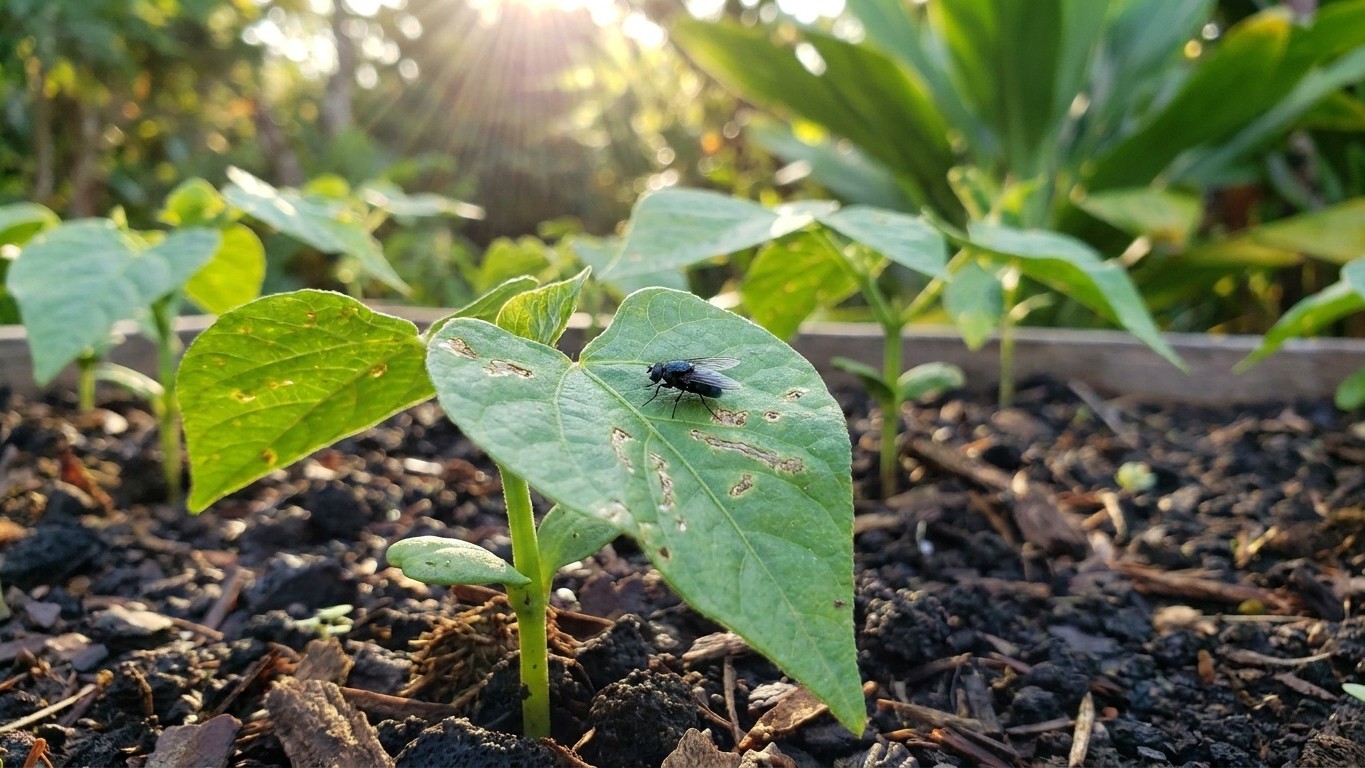

Bean fly shows up in Hawaii whenever beans, cowpea, or soybeans are actively growing, because the islands never get cold enough to shut down its breeding cycle. There’s no true off-season here. What stops it is a mix of early planting, physical barriers on young seedlings, and pulling infested plants before larvae finish feeding inside the stem.
The weeks to watch

There is no published seasonal window for bean fly from Hawaii’s local extension service, and that absence is itself informative: it reflects a pest that breeds continuously rather than in discrete, calendar-bound flights. The general pattern for warm, frost-free regions applies instead. Bean fly (commonly identified as Ophiomyia phaseoli in Pacific legume crops) produces overlapping generations all year, with adult flies, eggs, larvae, and pupae present simultaneously on any given planting.
Why there’s no discrete “generation one, generation two” calendar
In climates with a real winter, extension bulletins can name a first flight and a second flight because cold weather resets the population each year. Hawaii’s lowland growing areas don’t get that reset. A new bean planting can be attacked by flies emerging from a totally different, older planting nearby, at any point in the year. That’s why the practical answer to “when” isn’t a date range at all, it’s a condition: any time tender young bean seedlings are in the ground, the pest can find them within days.
The closest thing to a seasonal pattern gardeners report is a slight uptick in pressure during stretches of consistent warm, humid weather, which speeds up the insect’s development from egg to adult. Drier, cooler upland plantings sometimes see slightly less pressure, but that’s a matter of degree, not a true gap in the pest’s presence.
Reading the calendar from your last frost

This is the section where mainland gardening advice usually tells you to count backward or forward from your last spring frost date. In lowland Hawaii, that calculation doesn’t exist. NOAA’s climate data for the islands’ inhabited elevations shows no freeze occurs at all, not even a marginal one, in any given year. Frost only forms on the summits of Mauna Kea, Mauna Loa, and Haleakala, thousands of feet above where anyone is growing beans.
So the planning date that matters here isn’t a frost date. It’s soil warmth combined with rainfall timing, and how exposed a given garden is on the windward or leeward side of an island. Bean fly larvae respond to warm, consistently moist soil around the stem base, not to a seasonal cold snap. That means the insect’s activity tracks your local rainfall pattern and elevation more than any date on a calendar.
Here’s how a gardener actually plans around it, using conditions instead of a frost date:
- Identify your planting’s exposure: windward sides of the islands stay wetter and warmer through more of the year, which tends to keep bean fly active longer without a lull; leeward and higher-elevation plots see somewhat drier stretches that can slow larval development slightly.
- Watch the seedling stage closely for the first one to two weeks after emergence, since that’s typically when young, tender stems are most vulnerable to egg-laying and early larval mining, regardless of the month.
Because there’s no frost to protect against, covers for bean fly serve a different purpose in Hawaii: they go on at seedling emergence and come off once the stem has thickened past the vulnerable stage, not on any fixed calendar date.
What it attacks, and what the damage looks like

Most gardeners notice bean fly damage before they ever see the insect. The first sign is usually a young bean plant that suddenly wilts or yellows for no obvious reason, sometimes with a visible swelling or split at the base of the stem near the soil line. Pull that plant and you’ll often find dark, tunneled streaks running up through the stem tissue, sometimes packed with tiny white larvae or brown pupal cases. On older, established plants, the damage shows up as stunted growth and a general lack of vigor rather than outright death.
The larval stage does essentially all the damage that matters. Adult flies are small, shiny, and easy to overlook; it’s the maggot-like larvae tunneling through the stem and into the root crown that girdle young plants and cut off their water and nutrient flow. That distinction matters for treatment, because once larvae are established inside the stem, nothing sprayed on the leaf surface reaches them.
Crops at risk in Hawaii gardens include:
- Common green beans (bush and pole types)
- Long beans (yardlong bean)
- Cowpea
- Soybean
- Other legume relatives grown as cover crops or forage
Seedlings and young transplants take the worst hits. A mature, well-established bean plant with a thick stem can often outgrow moderate larval feeding, but a two-week-old seedling rarely survives a heavy attack at the stem base.
How Hawaii sits in this pest’s range

Bean fly is a pest across warm, humid legume-growing regions throughout the Pacific and Asia, and Hawaii’s climate puts it squarely inside that range rather than at some marginal edge. This isn’t a species pushing into new territory here; it’s established and behaves the way it does across most of its warm-climate range, meaning presence isn’t really in question. What differs from one growing region to another within that broad range is timing and intensity, not whether the pest shows up at all.
That’s a useful distinction for a home gardener. In places with a genuine cold season, the question is often “will it arrive this year, and when.” In Hawaii, the more useful question is “how much pressure will this planting face,” since the insect is present continuously and the variable is really how favorable local rainfall and humidity are to it at the moment seedlings are most vulnerable. Windward, consistently wet areas tend to sustain higher year-round populations than drier leeward plots, simply because the insect’s larvae and pupae develop faster in warm, moist soil conditions.
None of this means every Hawaii garden sees equally severe damage. It means the absence of a real winter removes the natural population crash that limits this pest elsewhere, so the burden of control shifts more heavily onto the gardener’s own timing and sanitation practices rather than on the calendar doing some of the work.
What actually works against it

Cheapest and easiest measures come first here, and they lose effectiveness fast once larvae are already tunneling inside a stem.
- Start seedlings under cover. A fine mesh or floating row cover placed over the bed at seeding, before adult flies can lay eggs on emerging leaves, physically blocks the egg-laying stage. This only works before larvae get in; once a stem is infested, a cover does nothing.
- Stagger and space plantings. Avoiding a single large block of bean seedlings all at the same tender stage reduces how much of a planting is vulnerable at once, since adult flies concentrate on the youngest, softest stems.
- Hand-pick and rogue infested seedlings early. Pulling and destroying a wilting young plant as soon as the base-stem swelling appears removes developing larvae before they mature into egg-laying adults, cutting off the next generation locally.
- Rotate away from legumes. Moving bean, cowpea, and soybean plantings to a different bed each cycle, and avoiding back-to-back legume crops in the same soil, reduces the odds that emerging adults find a host plant right where the last infested crop grew.
- Clear crop debris promptly. Removing and disposing of spent bean plants and stems right after harvest, rather than leaving them to decompose in place, denies late-stage larvae and pupae a place to finish development undisturbed.
Home remedies like copper tape around stem bases or ultrasonic repellent stakes circulate in gardening communities, but there’s no established mechanism showing either one affects bean fly behavior, and no conclusive trial data backing their use against this particular pest. If a gardener tries one, it’s worth treating it as an unproven add-on, not a substitute for covers, rotation, and prompt removal of infested plants.
Common questions
Does bean fly ever go away for part of the year in Hawaii?
Not in the way it does in colder climates. Without a freeze to interrupt its life cycle, populations persist continuously, though pressure can ease slightly during drier stretches or in higher, cooler upland gardens.
Can a bean plant recover once bean fly larvae are inside the stem?
Mature plants with thick, established stems sometimes tolerate moderate tunneling and keep producing. Young seedlings rarely recover once larvae reach the stem base, since the girdling damage cuts off water and nutrient flow before the plant can compensate.
Are all bean varieties equally at risk?
Young, tender seedlings of common green beans, long beans, cowpea, and soybean are all documented hosts. The vulnerable window is really the seedling stage itself rather than one variety being inherently safer than another.