
European corn borer shows up in Massachusetts corn patches by late May, and the state’s cooperative extension service tells gardeners to start checking for egg masses right around then, continuing into early June. What stops it has less to do with sprays and more to do with timing: once the larvae bore into a stalk, most home remedies stop working entirely.
The weeks to watch

UMass Extension recommends monitoring corn for European corn borer egg masses beginning in late May and running through early June. That’s the window the fact sheet actually names, and it’s tied to when the moths are laying eggs on the undersides of corn leaves near the whorl, not to a fixed calendar date that repeats the same way every year.
Late May into early June: the window that’s published
This is the period UMass Extension flags for scouting. Egg masses look like flat, overlapping clusters, almost like fish scales, laid in groups of 15 to 20 on the underside of leaves. Finding them during this window is the best chance to intervene before the caterpillars hatch and disappear into the plant.
A possible second generation, without a local window
European corn borer can produce a partial second generation in warmer parts of its range later in the summer. UMass Extension does not publish a separate monitoring window for a second flight in Massachusetts, so gardeners here are working with one confirmed window rather than two. If a second round of damage shows up in August, it’s worth checking new whorls and late-planted corn, but there’s no official date range to plan around beyond the late May to early June scouting period.
Reading the calendar from your last frost

The moths don’t check a calendar. They respond to soil and air warming enough to complete their life cycle, which is why an early spring or a cold, dragged-out one shifts everything by a week or two in either direction. The one date most Massachusetts gardeners actually track is the last spring frost, and it gives a rough anchor point for when corn goes in the ground and when the egg-laying window follows.
Across the state, the last spring frost typically falls between April 1 and April 8, based on NOAA’s 30-year climate normals for the Boston area. That reading comes from a waterfront station, the mildest spot in Massachusetts, so inland suburbs and the Berkshires often see frost linger later into spring.
- Start with your local last frost date, roughly April 1 to April 8 near Boston, later inland.
- Add about seven to nine weeks. That lands somewhere in the late May to early June range UMass Extension names for egg-mass scouting.
That math gives a range, not a single day, because the frost date itself is a range. If corn goes in right after the last frost, the plants are usually tall enough to have a whorl worth laying eggs in by the time the moths are active. Row covers, if used, need to come off before tasseling anyway, so the practical deadline is less about the moth’s exact arrival and more about when the corn plant stops being a good target.
What it attacks, and what the damage looks like

The giveaway is usually sawdust-like material, called frass, packed into the whorl of a young corn plant or piling up at a small entry hole partway up the stalk. Tassels can snap or look ragged, and older plants sometimes have stalks that break in a wind because the inside has been hollowed out. On ears, look for tunnels running from the tip down through the kernels, often with the same reddish-brown frass sitting right at the opening.
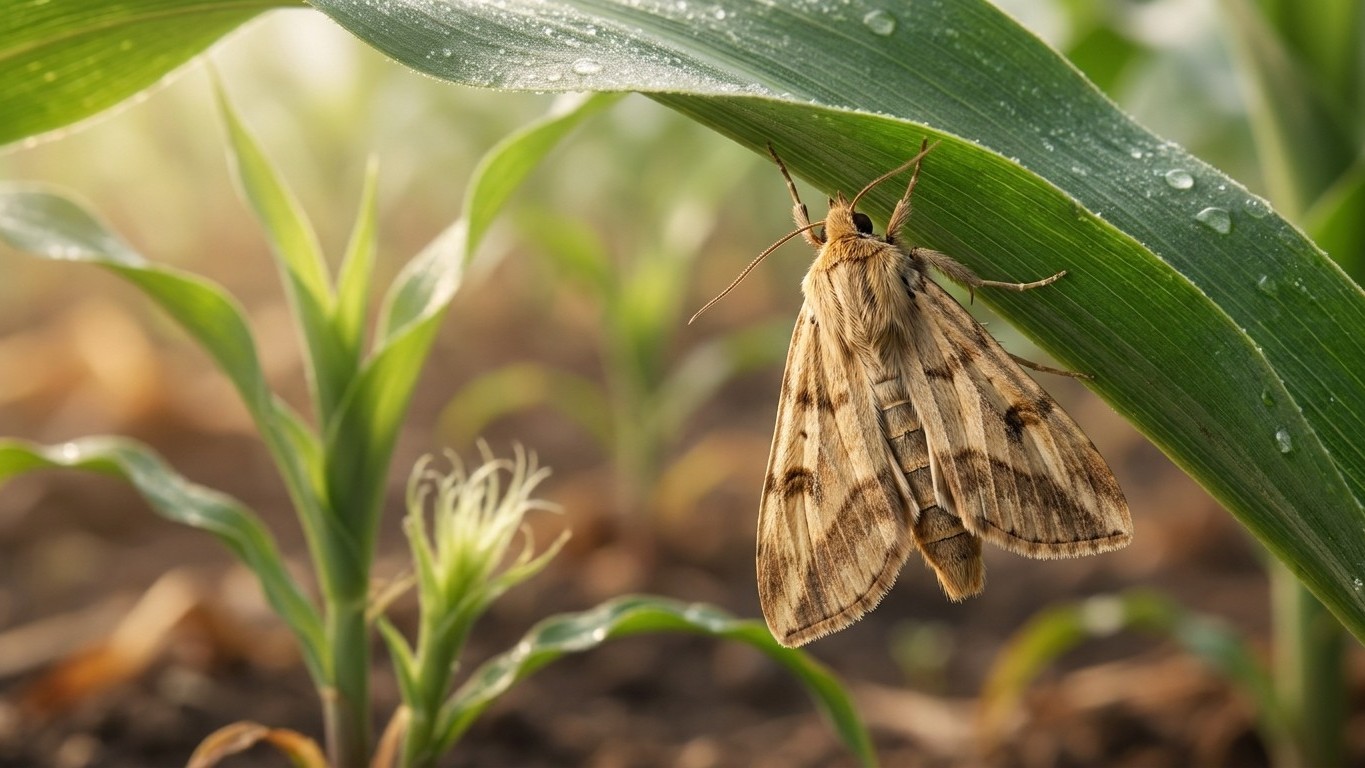
The caterpillar stage does all the damage. Adult moths are pale tan and do nothing but lay eggs; it’s the larvae that tunnel and feed, which matters because once they’re inside a stalk or ear, they’re physically out of reach of most treatments. Host plants include:
- Sweet corn and field corn (the primary host)
- Peppers, where larvae tunnel into stems and fruit
- Potatoes, entering through the stem near the soil line
- Snap beans and other legumes, less commonly than corn
- Gladiolus and other ornamentals grown near infested corn fields
Corn is by far the crop most Massachusetts gardeners will see it on, and it’s usually the whorl damage or the broken tassel that gets noticed first, well before anyone spots a moth or a caterpillar.
How Massachusetts sits in this pest’s range

Within this site’s coverage, Massachusetts is currently the only territory with a page addressing European corn borer, so there’s no other state’s data here to compare it against. That’s a statement about what’s been published so far, not about where the pest is more or less common. European corn borer is broadly established across the northeastern and midwestern United States, and its presence in Massachusetts corn fields is well documented by UMass Extension’s own monitoring guidance.
What that means practically is that a Massachusetts gardener can’t lean on a neighboring state’s fact sheet for a different local window, because none is cited here. The UMass Extension guidance stands on its own for this state, built around the state’s own growing season and the late May to early June scouting period described above. As more territories get added to this site, the picture may sharpen on how far north or south the pest’s timing shifts, but for now the local guidance is the only reference point.
What actually works against it

- Rotate corn away from last year’s plot. Larvae overwinter in old corn stalks and debris left in the field. Planting corn somewhere else the following year means the moths emerging nearby have to travel farther to find a host, cutting down on early infestation.
- Clear and destroy old stalks after harvest. This removes the overwintering site entirely. Chopping, tilling under, or hauling away stalks in fall works; leaving them standing over winter gives next year’s moths a head start.
- Time plantings to dodge the egg-laying window. Very early or very late corn plantings sometimes miss the peak of the late May to early June egg-laying period, though this shifts with the season and isn’t a guarantee.
- Scout for and hand-pick egg masses. Checking the underside of leaves near the whorl during the scouting window and crushing any egg clusters found stops that batch before it hatches. This only works before the eggs hatch.
- Cut out and destroy infested stalks once frass appears. If frass shows up at the whorl or a stem entry hole, the larvae are usually already inside. Slitting the stalk to remove the caterpillar can save an individual plant, but it won’t undo damage already done, and it’s labor-intensive if infestation is widespread.
Once larvae have tunneled deep into a stalk or an ear, there isn’t much left to do for that plant beyond removing and destroying it so it doesn’t feed next year’s population. Prevention and early scouting carry almost all the weight here.
Common questions
Does European corn borer only attack corn?
No. Corn is the main host, but peppers, potatoes, snap beans, and ornamentals like gladiolus can also be affected, since the larvae will tunnel into any stem thick enough to hide in.
How do I know if it’s European corn borer and not another stalk-boring pest?
Look for the sawdust-like frass at the entry point, paired with a broken or ragged tassel or a stalk that snaps easily. The egg masses themselves, flat and overlapping like fish scales on the underside of leaves, are one of the clearest identifying signs before any damage even appears.
Is there a second generation to worry about later in summer?
UMass Extension does not publish a specific monitoring window for a second flight in Massachusetts. A partial second generation is possible in warmer years, so checking late-planted corn again in August isn’t a bad idea, but there’s no official date range published locally to plan around.