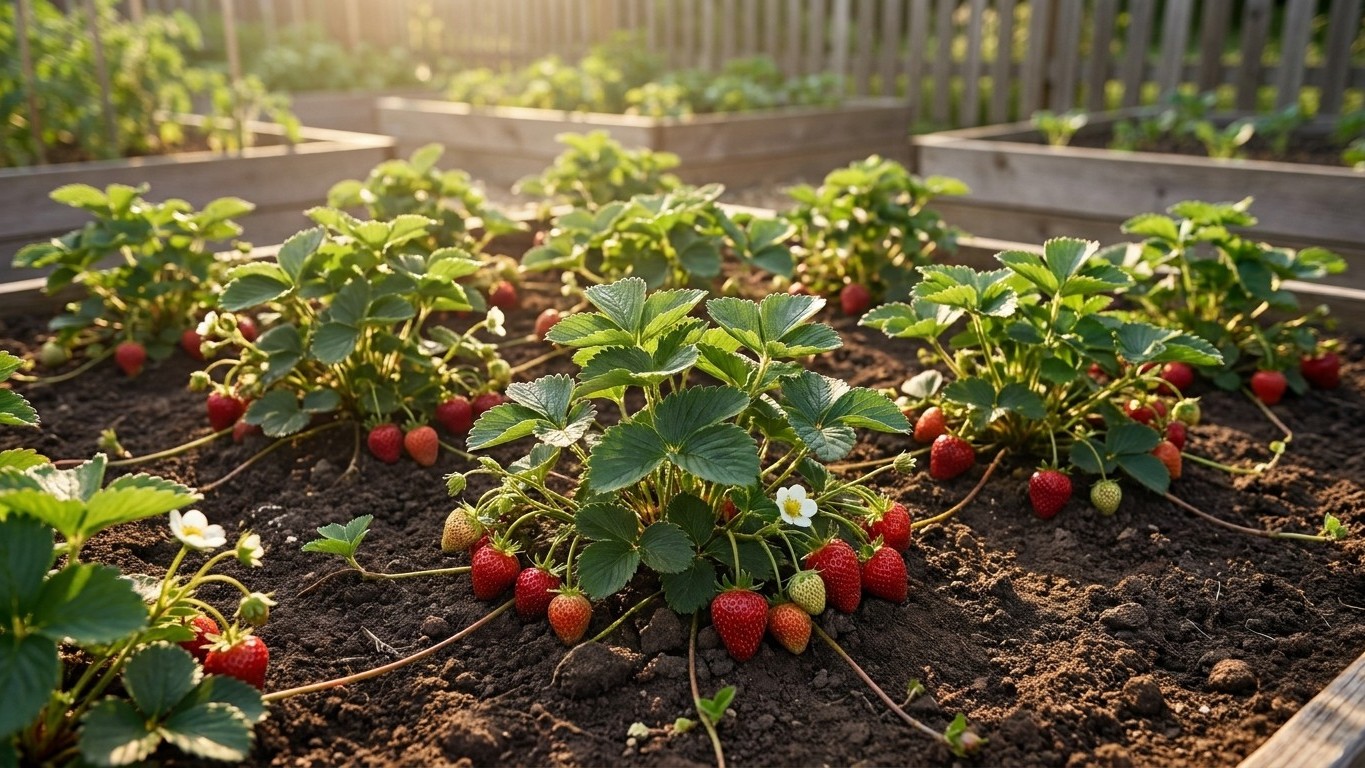

A strawberry bed built the right way stays productive for three to five years before Utah State University Extension recommends moving it. That’s the horizon the whole planting plan is built around: soil prep, spacing, and even where you put the bed all serve that multi-year payoff, not a single season’s harvest.
The short answer
Utah State University Extension is direct about the timeline: a matted row planting of June-bearing strawberries produces its first crop in the spring of the second growing season, not the first. That’s not a failure of planting technique. It’s by design. During that first year, blossoms and fruit are removed on purpose so the plant channels its energy into sending out runners instead of ripening berries. You’re trading one season of fruit for a bed that will keep bearing for years afterward.
Once that bed starts producing, the extension office puts a ceiling on how long you let it run: avoid keeping strawberry beds in the same spot for more than five years. Beyond that, disease pressure and declining vigor in the older, woody crowns start to outweigh what the bed still produces. That five-year cap is also tied to what grew there before. Planting into ground that recently held peppers, tomatoes, potatoes, eggplant, or okra is a mistake, because all of those crops harbor the Verticillium wilt pathogen, and strawberries are vulnerable to it the moment their roots hit contaminated soil.
So the “pays for three to five years” framing isn’t marketing shorthand. It’s the practical window between the season you finally get fruit and the season you’re supposed to have already started rotating the bed to new ground. Everything else, from siting to spacing to the annual renovation, is aimed at keeping that window as productive as possible before the clock runs out.
What actually decides it
Sun and soil come first
Strawberries require at least eight hours of full sun each day of the growing season to produce at their maximum capability. Skimp on light and you can do everything else right and still get a mediocre crop. Soil matters almost as much: loamy or sandy soils suit the plant’s shallow root system, while heavy clay reduces vigor and raises disease pressure. If clay is what you’ve got, a raised bed isn’t optional extra effort, it’s the fix for drainage that clay soil can’t provide on its own.
Why north-facing siting works against instinct
Strawberry blossoms are killed easily by late spring frost, and the flowers that open earliest also produce the largest berries. That’s the reason Extension recommends putting the bed on a north slope or the north side of a fence or building: the late winter shade delays bloom until the frost risk has passed. A bed with southern exposure blooms and crops earlier, but those early flowers, the ones that would have made the biggest fruit, are the ones most likely to freeze. You’re deliberately giving up earliness to protect fruit size. On any night blossoms are open and a frost is possible, covering the plants with tarps or blankets protects the flowers and developing fruit regardless of which way the bed faces.
Why the first year’s flowers get pinched off
Pulling blossoms off a young plant feels like sabotage, but the logic is about where the plant’s energy goes. A first-year strawberry plant that’s allowed to fruit spends its resources on that fruit instead of building the root system and runner network that will carry it through years two, three, and beyond. Remove the flowers, and the plant puts that energy into establishing itself instead.
Day length, not the seed catalog, decides the flowering type
June-bearers set flower buds under the short days of autumn, and those buds open the following spring, ripening into fruit in late spring. Everbearers set buds under long days and typically give a light spring crop and another in the fall. Day-neutrals set buds regardless of day length whenever temperatures sit below roughly 70 degrees. In practice, under most home garden conditions, everbearers and day-neutrals behave almost identically, and many varieties sold as “everbearing” are actually day-neutral by this definition. The label on the tag is less useful than knowing which photoperiod response you’re actually getting.
How to do it
- Choose a management system before you buy plants. Matted row suits June-bearers and lets runners fill in the bed; annual hill suits everbearers and day-neutrals and requires cutting off every runner so only the mother plants fruit.
- Pick a site with at least eight hours of daily sun, loamy or sandy soil (or a raised bed over clay), and ideally a north slope or north-facing exposure to delay bloom past frost risk.
- Confirm the ground hasn’t grown peppers, tomatoes, potatoes, eggplant, or okra recently, and clear all perennial weeds before planting, since strawberries compete poorly with weeds for water and nutrients.
- Buy dormant, bare-root, disease-free plants from a reputable nursery. Skip the temptation to dig transplants from an existing bed, since that’s the most common way to introduce viruses or root rot.
- Plant in a matted row at 18 to 24 inches apart within the row, rows three to four feet apart, or in an annual hill system at 12 to 15 inches apart with staggered rows 12 to 15 inches apart, two to four rows per bed. Containers follow the hill spacing logic, with frequent irrigation to keep roots cool and light-colored containers to avoid heat buildup.
- Set each plant so only the roots and the base of the crown sit below soil level, leaving as much of the crown exposed above ground as possible.
- Remove all first-season blossoms. In the hill system, remove the first flower cluster specifically to let the plant establish its root system before fruiting.
- Irrigate with drip or trickle lines on a three- to five-day cycle through summer heat, letting the soil dry somewhat between waterings to prevent root rot. If you must use sprinklers, run them only in the morning.
- Immediately after harvest, renovate the matted row: pull weeds, cultivate the row back down to 8 to 10 inches (up to 12 to 18 inches if that’s more practical), hand-pull the oldest woody crowns, and irrigate to promote new daughter plants. Apply 5 to 8 pounds of 10-10-10 fertilizer per 100 feet of row at this renovation.
- Apply an additional 3 pounds of 10-10-10 per 100 feet in August to set flower buds for next year’s crop.
- Spread clean straw or shredded tree leaves 3 to 6 inches deep over the bed in late November, and remove it in spring once new growth appears from the crown, watching for frost since the emerging buds are sensitive right after uncovering.
What goes wrong
- Transplanting from an old bed instead of buying certified stock. Once plants carry a virus, there is no treatment or cure. The only fix is prevention: start every new bed with disease-free plants from a reputable nursery, and remove old plantings once they stop showing adequate vigor.
- Letting weeds get ahead of the planting. Weeds are the most common limiting factor in a strawberry patch’s life, outcompeting the shallow-rooted plants for water and nutrients. Clear perennial weeds before planting, and lean on straw mulch in matted rows or plastic mulch in hill systems for partial control, backed by hand weeding.
- Reaching for a systemic herbicide near the bed. Products like RoundUp should never touch a strawberry planting, especially a matted row. The plants form an interconnected network through their runners, and herbicide absorbed by one daughter plant travels back through that network, killing or damaging plants well beyond the one you sprayed.
- Flood, furrow, or heavy sprinkler irrigation. Flood and furrow watering spread root-rotting pathogens, and frequent overhead sprinkling raises gray mold fruit rot. Switch to drip or trickle irrigation, and if sprinklers are the only option, run them in the morning so fruit and foliage dry out by afternoon.
- Salt buildup in the soil. Strawberries are highly sensitive to salt; levels above 1.8 ECe dS/m cause stunting, marginal leaf scorch, severe yield loss, and plant death. Test soil salinity before committing a site to a multi-year bed.
- Yellowing leaves in high-pH soil. Interveinal yellowing is iron chlorosis, the most common nutrient deficiency in Utah strawberry beds, tied specifically to alkaline soil rather than a universal strawberry problem.
- Burying the crown too deep. Only the roots and crown base should sit under soil. Cover the whole crown and the plant struggles to establish.
Common questions
Can strawberries be started from seed like tomatoes? No. Utah State University Extension describes planting dormant bare-root plants, not seed starting. Because the plants are dormant at planting, there’s no need to wait out a frost-date countdown the way you would with tender seedlings.
What’s the real difference between June-bearers, everbearers, and day-neutrals? It comes down to day length. June-bearers set buds under short autumn days and fruit the following late spring. Everbearers set buds under long days and crop lightly in spring and fall. Day-neutrals set buds whenever temperatures run below about 70 degrees, largely independent of day length.
Do I need to remove blossoms every year, or just the first? Just the first season for matted row June-bearers, so the plant builds runners and roots instead of fruit. In the annual hill system, only the very first flower cluster gets removed, again to let the root system establish before the plant is allowed to crop.
How do I know when it’s time to start over with a new bed? Extension sets the outer limit at five years in the same spot, but a bed showing weak vigor, poor renovation results, or virus symptoms earlier than that should be replaced sooner, always with fresh disease-free plants on ground that hasn’t recently grown peppers, tomatoes, potatoes, eggplant, or okra.