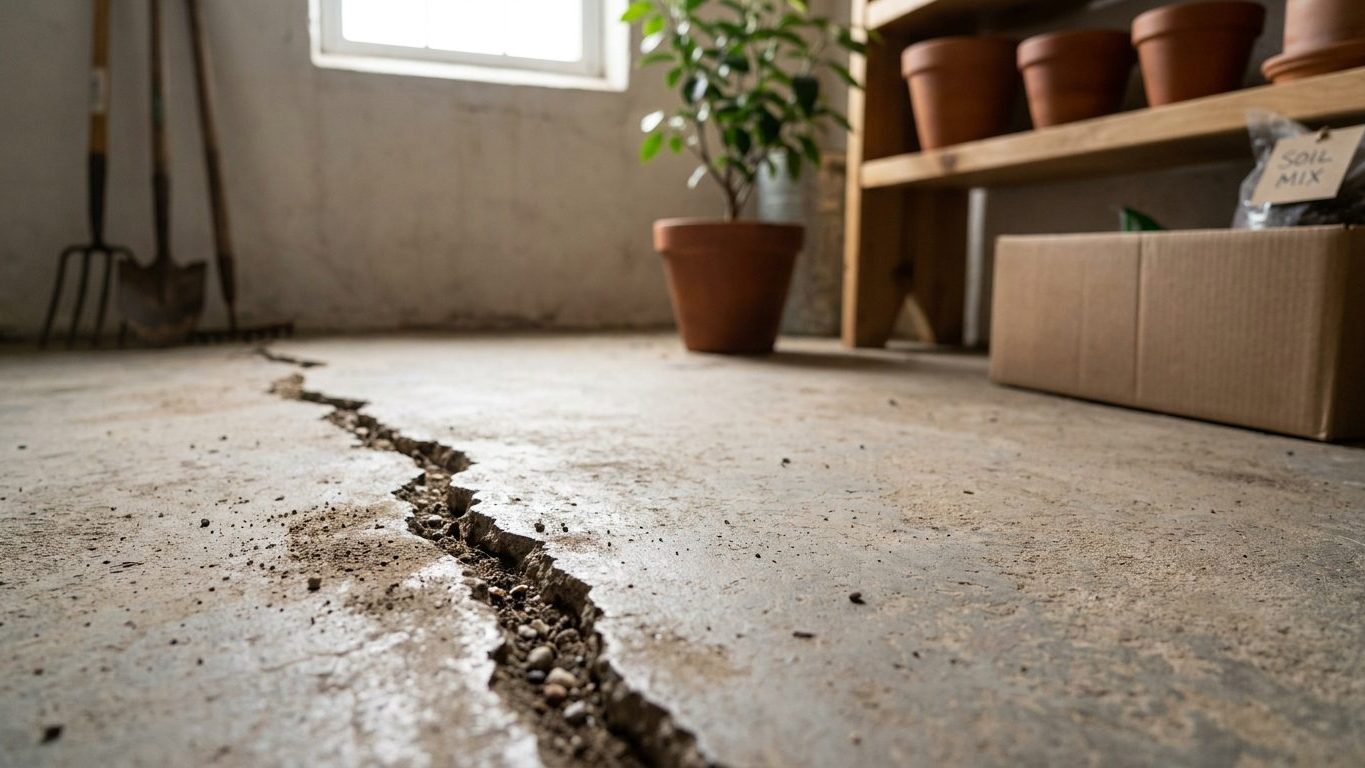

Cracks in a basement or garage floor almost never mean the foundation is failing, because that slab usually isn’t holding the house up in the first place. Look at where the crack runs and whether it has changed over the past year before deciding what it means. A crack that hasn’t moved and hasn’t widened is a different problem than one that has.
What is actually going on

A basement or garage floor is normally a non-structural slab: a layer of concrete poured over compacted soil or gravel, separate from the footings and walls that actually carry the weight of the house. It floats on the ground beneath it and carries only what sits on top, a car, a water heater, a stack of boxes. When the soil under that slab swells with moisture or contracts as it dries, the concrete flexes slightly and cracks. That’s the mechanism behind most of what shows up on a garage or basement floor, and it has nothing to do with whether the walls above are sound.
Why a slab cracks
Concrete shrinks a little as it cures, and a slab poured over ground that wasn’t perfectly compacted will settle unevenly in spots as the soil beneath adjusts to it. Add a freeze and thaw cycle, or a wet spring followed by a dry summer, and the slab has already moved before you ever notice a line in it. None of that is a defect in the house. It’s what happens to a rigid material sitting on a surface that isn’t rigid.
When it stops being cosmetic
A crack that stays hairline-thin, doesn’t step up or down across its length, and hasn’t spread since you first noticed it is telling you the slab settled once and stopped. A crack that keeps opening, that steps clearly (one side higher than the other), or that runs from the floor up into a foundation wall is a different signal. It can mean the ground beneath part of the foundation is still moving. Only a structural engineer can tell you which one you’re looking at, and no width or length on its own settles the question. Don’t fill or seal a crack you haven’t had assessed. Filling it hides the exact movement a professional would need to see.
Radon and the slab
Any crack, gap, or penetration in a basement or garage floor is also a path for soil gas to enter the house, and radon is the one you can’t see, smell, or guess at. The EPA and the U.S. Surgeon General recommend testing every home for radon, regardless of the age of the house, the type of foundation, or what a neighbor’s test showed. The action level is 4 pCi/L, and the EPA suggests considering action even between 2 and 4 pCi/L. Radon levels are usually highest in the lowest occupied level of a house, which makes a basement or a room over a garage slab exactly where you’d want to test first. No level of radon is known to be safe. A test kit tells you what’s happening in your house. Nothing else does.
What to look at, and in what order
Work from the cheapest, least invasive check to the most involved one. Each step either confirms what you already suspect or rules something out, and there’s no reason to call anyone in before you’ve done the ones you can do yourself.
The order to check them
| Check | What you’re looking for | What it suggests | What it rules out |
|---|---|---|---|
| Look at the shape of the crack | Straight and hairline, versus stepped or branching into several fine lines (map cracking) | A single straight crack usually points to normal shrinkage or minor settling. Map cracking often points to surface drying issues instead | Neither pattern alone rules out a foundation issue, but map cracking rarely relates to one |
| Check where the crack starts and ends | Whether it stops within the slab or continues up into a foundation wall | A crack that continues into the wall links the slab to something happening in the structure itself | A crack confined entirely to the slab rules out a wall connection, though not settlement below the slab |
| Set a straightedge or level across the slab | Whether one side of the crack sits higher than the other | A step of any noticeable height suggests the ground under one section has moved differently than the rest | A flat, even surface across the crack rules out that kind of differential movement, at least for now |
| Watch the crack after a heavy rain or snowmelt | Whether water appears at or near the crack within a day or two | Water coming up through a floor crack means water is reaching the slab from below or from the sides, not from a leak above | A dry crack after a wet spell rules out active groundwater intrusion at that spot, for now |
| Recheck the same crack over several months | Whether length, width, or step height has changed since your first look | Any measurable change over time is the strongest reason to bring in a structural engineer | No change over a full season across wet and dry conditions is the best evidence the slab has settled and stopped |
What a wet crack is telling you
Water appearing through a floor crack after rain means the water table or surface water around the foundation is reaching the slab, usually because grading, gutters, or a drain aren’t moving it away fast enough. This is a drainage problem before it’s anything else. Sealing that crack from the inside might stop the visible water for a while, but it does nothing about the pressure pushing water toward your foundation in the first place. It just moves the moisture somewhere you can’t see it, often into the slab itself or along its edges. This pattern of movement and water also shows up in Foundation Settlement: Old, or Still Happening, worth reading if the crack you’re looking at also steps or runs into a wall.
Watch it, or get someone in
Most floor cracks fall into the watch-it category. A single, stable, hairline crack with no step and no water is something you check twice a year and otherwise ignore. What follows is where readers usually mix up the two categories, and mixing them up is expensive in the wrong direction either way.
What you can monitor yourself
You can reasonably track a crack’s length, whether it stays dry through wet seasons, and whether a level laid across it still reads flat. Photograph it next to a tape measure or a coin every few months so you’re comparing the same thing each time, not your memory of it. None of this requires a professional, and none of it should be rushed into a repair. A crack you’re only watching is not a crack you should be filling, because filling it removes your ability to keep tracking it.
Who to call, and why the choice matters
If a crack has stepped, if it’s grown since you first measured it, or if it runs from the slab into a foundation wall, the next call is to a structural engineer, not a repair company. An engineer’s job is to assess the crack and tell you what’s causing it. They don’t sell foundation repair, so there’s no incentive to find a problem that isn’t there or to oversell one that is. A waterproofing or foundation repair company, by contrast, makes money from the fix it recommends, which doesn’t make its assessment wrong, but does mean it isn’t a neutral one.
If the issue is water coming up through a crack after rain, rather than a structural step or crack growth, the call is different. A drainage contractor who deals with grading, gutters, and exterior drains is the right call, since that’s where the water is coming from. Basement humidity that shows up as dampness or a musty smell without a visible crack or standing water is its own separate issue, covered in Controlling Humidity in a Basement. If radon testing turns up a result at or above the action level, the professional to call is a certified radon mitigation contractor, not a general contractor or a waterproofer.
What has to happen first
Fixing a floor crack out of order wastes money. The sequence that holds up regardless of what your particular crack turns out to be is water first, then structure, then finish.
Outside before inside
Water reaching a slab from outside is a grading and drainage problem before it’s a floor problem. Gutters that dump water at the foundation instead of carrying it away, and a sump pump that isn’t keeping up with groundwater, both need attention before anything gets done to the slab itself. Interior sealants and coatings manage humidity and hide staining, but they don’t stop water under pressure from outside; it finds another way in. That order is covered more fully in Foundations and Basements: Almost Everything Here Is Water, worth reading before you spend money on the floor itself.
What comes after
Once water is under control and any structural question has been answered by an engineer, the finish on top of the slab, epoxy, tile, or a floating floor system, is a separate decision from either of those steps. What goes down on a slab and how it’s installed also depends on whether moisture is still moving through the concrete, worth checking before committing to a finish. If a foundation wall is being insulated at the same time, that work interacts with how the slab handles moisture too, so it’s worth sequencing the whole basement rather than tackling the floor in isolation.
Common questions
Can I just fill the crack myself and be done with it?
Not before you know why it’s there. Filling a crack that hasn’t been checked for step height, water, or growth over time removes the evidence a structural engineer would need if it turns out to matter. If you’ve watched it through a full season with no change and no water, a cosmetic filler is a reasonable next step.
Is a crack in a garage floor less serious than one in a basement floor?
Not because of where it is. A garage slab and a basement slab are usually built the same way, non-structural and poured over compacted ground, so the same checks apply to both. A garage floor crack near a foundation wall gets the same attention as a basement one in the same spot.
What does it mean if the crack only shows up in winter?
It usually points to freeze and thaw movement in the soil beneath the slab rather than anything happening in the foundation itself. Track whether the same crack reopens at the same spot each winter or whether it keeps growing year over year. Repeated but stable movement is a different finding than a crack that’s a little longer each time you check it.
Do I need to test for radon if I don’t have any floor cracks?
Yes. Radon moves through any gap in a foundation, including ones too small to see, and a crack-free slab is not a tested slab. The EPA and Surgeon General recommend testing every home regardless of its condition, and a home with no visible cracks can still test above the action level.