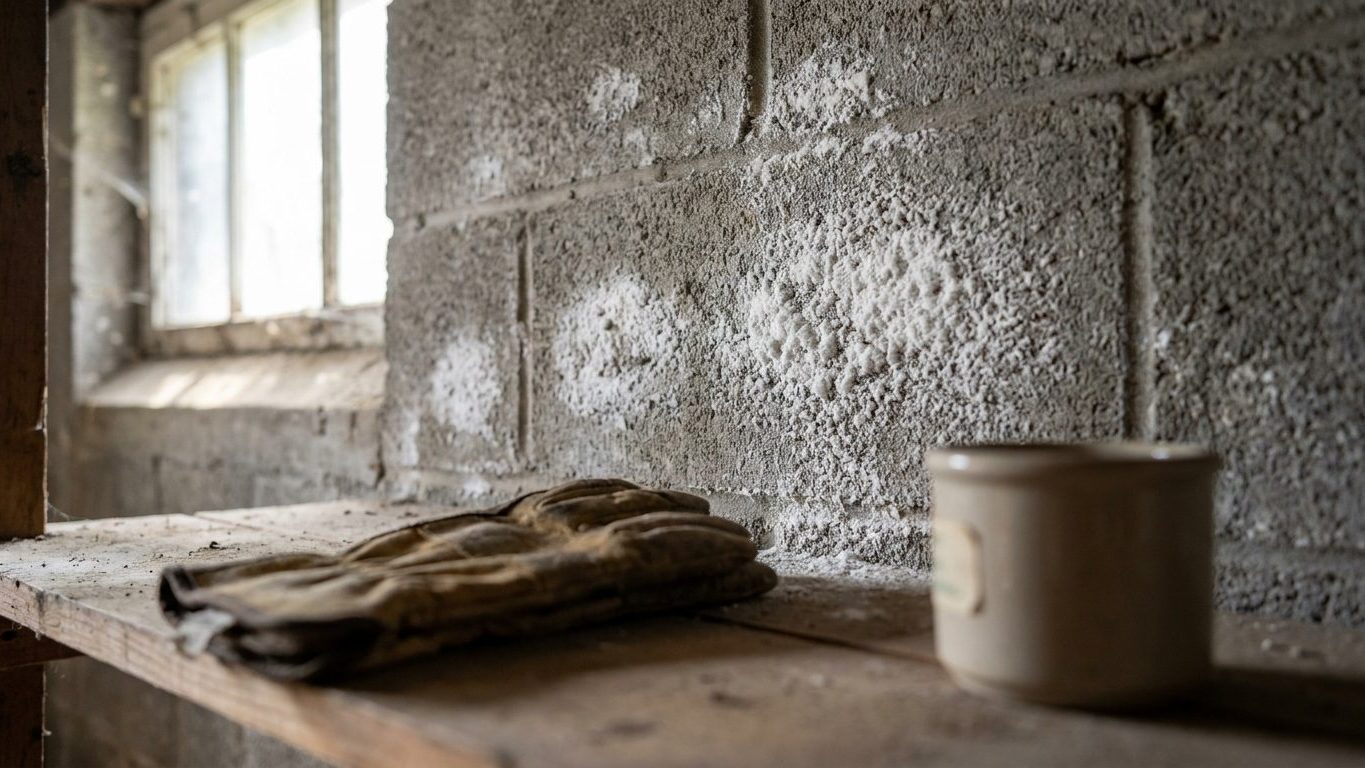

Efflorescence is what that white crust is called, and it means water has passed through the concrete or block and left dissolved minerals behind on the surface as it evaporated. It is not mold, and scrubbing it off changes nothing about the moisture that produced it. Follow the powder back to where it’s thickest, the crack, the mortar joint, or the floor-wall seam, because that’s where the water is actually getting in.
What is actually going on

The thing to understand here is dissolved salts. Water moving through concrete, brick or block picks up naturally occurring minerals, mostly calcium salts, and carries them toward whatever surface is drying fastest. When that water evaporates at the surface, the salts stay behind as a fine white crust. That crust is efflorescence, and it is a symptom, not something you need to remove. Wire-brushing it off does nothing to the moisture behind it. It comes back after the next wet spell, in the same spot, because the water is still finding the same path through the wall.
That’s the useful part of efflorescence: it works like a map. Salts only appear where water actually reached the surface and evaporated, so the pattern tells you roughly where the moisture is coming in and how much of it there is. A faint dusting near a cove joint, where the wall meets the floor, points to a different problem than a heavy bloom running the full length of a crack. Read the wall before you touch it.
People often mistake efflorescence for mold, since both show up as pale patches on a wall that already looks damp. They aren’t related. Efflorescence is mineral, it’s dry to slightly crumbly, it doesn’t have a smell, and it doesn’t spread onto wood framing or stored belongings the way mold does. If there’s a musty odor along with the white powder, that’s a second problem sitting on top of the first, and it’s worth reading what a basement smell actually means before assuming the powder explains everything you’re seeing.
Why sealing the wall does not fix it
Once you know it’s water, the instinct is to paint over the powder or apply a waterproofing coating to the inside face of the wall. That treats the symptom and leaves the cause untouched. Water under pressure from the soil outside will find another route in, another crack, another mortar joint, or it will push in behind the coating and lift it from the back. Interior sealants and paints manage surface humidity and hide staining. They do nothing about water moving through the wall from the outside. Anything applied to the inside face of a foundation wall is a finish, not a fix, until the outside drainage has been dealt with first.
This fits a larger pattern in basement problems generally: almost everything that goes wrong down there traces back to where water is or isn’t allowed to go, and efflorescence is just one of the more visible signs of it. For the wider picture of how foundation moisture moves and where it tends to show up, see this overview of foundations and basements.
What to look at, and in what order
Efflorescence by itself only tells you that water reached the surface. What matters next is how much water, how often, and from where, and you can answer most of that without spending anything on a repair. Work from the cheapest, least invasive check toward the more involved ones, and note what each step confirms as well as what it rules out.
- Look at the pattern first. A light, even dusting spread across a large area usually points to slow moisture movement through the whole wall, sometimes from ordinary humidity rather than a leak. A heavy bloom concentrated at one crack or joint rules that out and points to a specific entry point instead.
- Run a simple moisture check. Tape a small square of plastic sheeting flush against the wall, sealed on all four edges, and leave it a couple of days. Moisture on the wall side of the plastic means water is moving through the wall itself. Moisture on the room side points to humid air condensing, which rules out a wall leak and points instead toward ventilation.
- Trace the crack or joint it follows. Efflorescence that runs down a single crack, rather than sitting in a random patch, usually means that crack is the active path. A crack that runs straight up and down a poured wall behaves differently from a stair-step crack in a block wall, and it’s worth reading about vertical cracks in a poured wall before deciding what the crack itself needs.
- Look outside, right at that spot. Stand at the exterior point that lines up with the interior stain and check the grading, the downspout position, and which way the ground actually slopes. This step alone resolves a large share of basement moisture complaints, because a downspout dumping water a couple of feet from the foundation, or ground sloping toward the house instead of away from it, is often the whole cause.
- Note when it shows up. Efflorescence that appears only after heavy rain or snowmelt points to surface water and grading. Efflorescence that’s constant regardless of weather points more toward a persistently high water table, which rules grading out as the sole answer and raises the odds of a drainage or sump problem instead.
None of these steps require opening the wall or disturbing soil against the foundation, and that kind of work carries its own risks and belongs to a contractor with the right equipment, not a weekend project. What the list gives you is a rough answer to one question before anyone touches the wall: is this water passing through steadily, or only under specific conditions.
Watch it, or get someone in
Most efflorescence, on its own, is something you can watch rather than act on right away. A light dusting that appears seasonally, doesn’t grow year over year, and isn’t paired with a crack that’s widening or a floor that’s heaving, is within the range of things a homeowner can reasonably track with a photo and a pencil mark.
What you can monitor yourself
- Whether the powder is spreading to new areas of the wall or staying confined to the same spot.
- Whether a crack it follows is getting wider, checked with a pencil line or piece of tape across it as a simple gauge.
- Whether it correlates with rain or snowmelt, which helps separate surface water from groundwater.
- Whether a musty smell has joined the white powder, which points toward hidden moisture rather than a purely cosmetic issue.
Get someone in when the pattern changes rather than repeats. A crack that’s visibly wider than it was, a wall that bows inward, a basement door or window frame that has started sticking, or water now standing on the floor instead of just leaving a stain, are all signs this has moved past cosmetic.
Which professional you call matters, because they aren’t interchangeable. A structural engineer assesses the wall and the movement without selling you a repair. That’s the value of hiring one: no product to install and no incentive to find more work than exists, so their read on whether a crack is structural or cosmetic is about as neutral as you’ll get. A drainage contractor handles grading, gutters, downspouts and exterior or interior drain systems, the actual water management side of the problem. A waterproofing company representative is, in practice, often selling that company’s own coating or membrane system, and their inspection tends to arrive at their own product as the answer. That doesn’t make their work useless, but it’s a different conversation than the one you’re having with an engineer.
A reasonable order, if any of the signs above show up: engineer first if there’s a real question of structural movement, drainage contractor next if the source is clearly outside, and only then a waterproofing product for the interior finish, if one is even needed once the outside water is under control.
What has to happen first
The order of operations is where money gets wasted on this problem more than almost anywhere else in a house. Efflorescence shows up on the inside, so the instinct is to fix the inside first, painting the wall or applying a sealant or a vapor barrier. That’s backward. Water management on the outside of the house comes before any interior finish, every time, because an interior treatment applied over an active leak just moves the failure point somewhere you can’t see it until it’s worse.
Start with the parts of the house that control where water goes before it ever reaches the foundation. Gutters that are clogged, or downspouts that dump water right next to the foundation wall, are one of the most common causes of exactly this kind of moisture, and a roofing guide covering gutter maintenance and downspout extensions is the right place to check that box first. If water is still reaching the basement despite decent grading and gutters, the next question is whether it’s being managed once it’s inside the foundation footprint, which is where a sump pump and interior drainage system come in, covered in the plumbing guides on this site.
Only after the water side is addressed does it make sense to think about finishing the wall itself. Basement wall insulation, if that’s part of the plan, has its own rules about vapor movement and which materials tolerate occasional dampness, and installing it before the water problem is solved usually means redoing it later, covered in the insulation guides for basement walls. The same logic applies below the wall: what goes on a basement floor, whether that’s a coating or a finished floor covering, depends on whether moisture is still coming up through the slab, and that’s covered separately in the flooring guides.
Some jurisdictions require a permit before an interior drain tile and sump system goes in, so that’s a call to make to the local building department before the work starts, not after the floor has already been opened up.
Common questions
Is the white powder on my basement wall dangerous to breathe?
No, efflorescence itself is just mineral salt and isn’t toxic to be around. The concern isn’t the powder, it’s whatever is causing the moisture behind it, and whether that moisture is also supporting mold somewhere out of sight.
Will it eventually stop coming back on its own?
Only if the water behind it stops, which it usually doesn’t without some change to grading, gutters, or drainage. A wall that keeps producing new efflorescence season after season is telling you the water source is still active.
Can I just paint over it and be done with it?
You can, but the paint will likely blister or peel where moisture keeps pushing through, and the salts will often re-form on top of the new surface anyway. Painting over efflorescence without addressing the water is a cosmetic fix on a problem that isn’t cosmetic.
Does efflorescence mean my foundation is failing?
Not by itself. Plenty of basements show mild efflorescence for years without any structural issue at all. It becomes a structural question only when it’s paired with a widening crack, a bowing wall, or standing water, which is when it’s time to call a structural engineer rather than keep watching it.