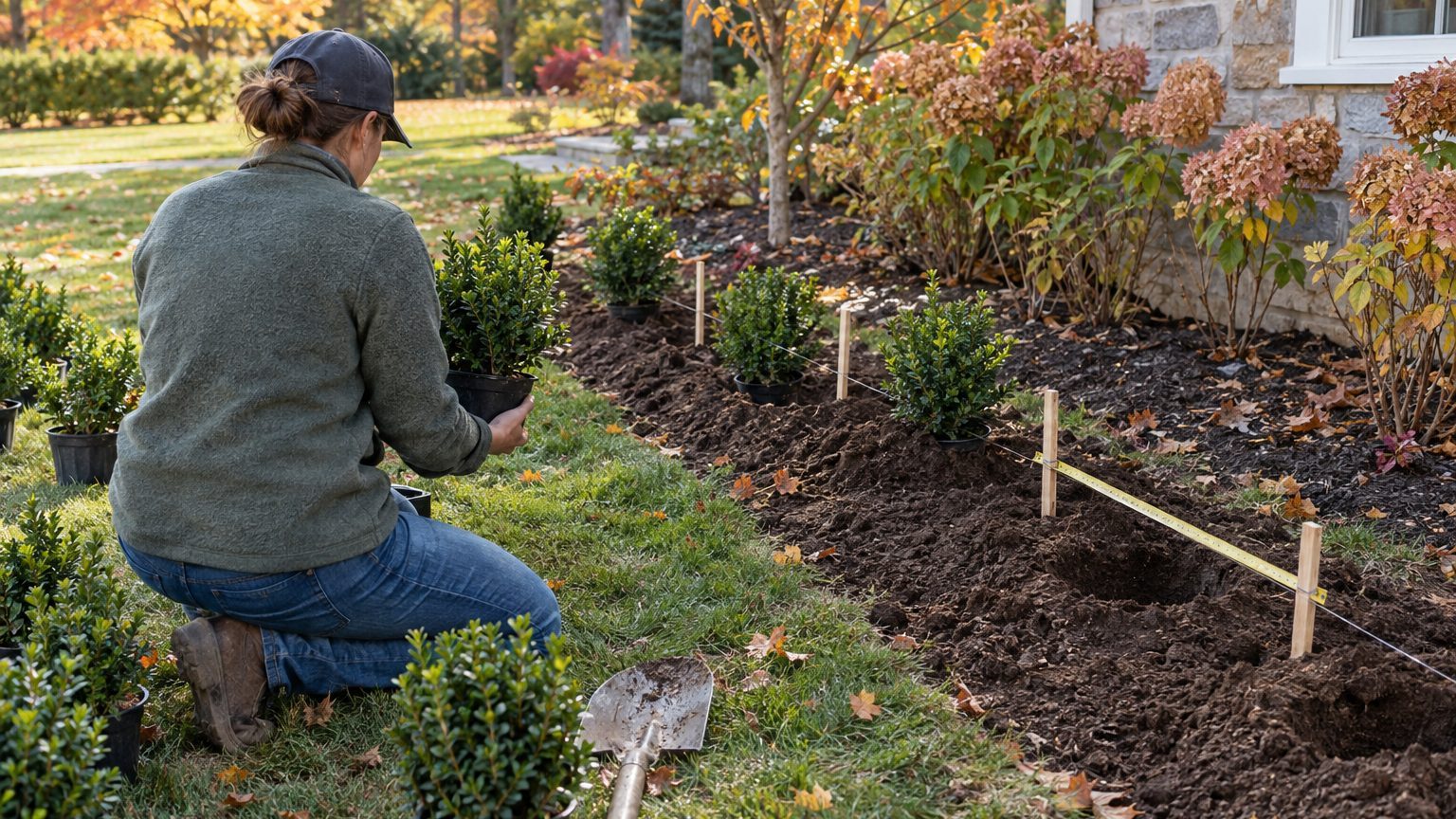

Divide the mature width on the plant label by two, or multiply it by two-thirds. That range is your spacing for a boxwood hedge, measured from the center of one plant to the center of the next. Which end you pick depends on how quickly you want a solid green wall and how many years you want it to stay healthy. The label matters more than the species, as the next section shows.
How far apart to plant boxwood
Start from the label, not the species
Boxwood (Buxus sempervirens) left alone can spread 5 to 15 feet wide. That figure is a ceiling: what an unclipped plant does with decades and no shears. It is not a spacing. Hedges are built from selected cultivars that stay far narrower, and they get clipped every year on top of that. So the number that counts is the mature width printed on the tag of the plant in your hand.
The arithmetic, worked once
Take half of that width for a screen that closes fast. Take two-thirds for plants that stay healthy longest. Say the tag reads 4 feet. Half is 2 feet, two-thirds is 2 feet 8 inches, so the shopping-list answer is 2 feet to 2 feet 8 inches apart, center to center. Swap in your own tag width and the same two multiplications give you your range.
| Mature width on the tag | Half (faster screen) | Two-thirds (longer-lived) |
|---|---|---|
| 3 feet | 18 inches | 2 feet |
| 4 feet | 2 feet | 2 feet 8 inches |
| 5 feet | 2 feet 6 inches | 3 feet 4 inches |
Those widths are practice numbers, not a claim about any particular cultivar. Read your own tag.
Choosing a point in the range
Growth rate drives the choice. Boxwood adds 3 to 6 inches a year, and it is usually kept at 2 to 6 feet as a hedge, so nobody gets a finished wall overnight. Tighter spacing looks like a way to rescue the schedule, but it rescues less than it seems (the next section puts a number on it).
Lean toward two-thirds for a long boundary run you will maintain for decades. Lean toward half for a short formal edge where a gap between young plants would show every day. Boxwood is rated for USDA zones 5 to 8, so gardeners outside that band are working against the plant before spacing even enters the picture.
What planting them closer really buys you
The year you gain
Every extra 6 inches you leave between plants is a gap the plants must grow across. If width keeps pace with the 3 to 6 inches a year of overall growth, that gap takes one to two seasons to fill. So planting at half instead of two-thirds closes the row maybe a year sooner. One year, that’s the whole prize.
What the crowd costs later
The price shows up over the following twenty years. Plants set tight compete at the root, drop their lower leaves for lack of light, and hold still, damp air in the middle of the hedge. Boxwood has a particular weakness here. Volutella blight takes hold in crowded, unthinned plants. Boxwood blight defoliates from the bottom up and survives in fallen leaves, and a dense, thin-based hedge is exactly where those leaves pile up and stay wet. Boxwood leafminer is a separate pest, but a stressed hedge is a poor place to fight it.
The bare base is also the hardest flaw to hide, because a hedge that is thin at the bottom looks tired even when the top is lush. Squeezing plants for one year of speed trades it for a thin, damp, disease-prone base, and no amount of clipping fixes air that cannot move.
Boxwood does have a safety net that most hedge plants lack. It carries dormant buds under the bark, so it regrows from bare brown wood and takes hard renovation. A conifer never comes back from that. Renovate in late spring, after the last frost. Your state’s cooperative extension service can tell you the local frost date, because it shifts by weeks across the country. Still, renovation is a rescue and not a planning tool. Wider spacing means you may never need it.
One row or two
Single row: the default
A single row is what most gardens need. It suits a property line, a foundation edge, a walkway border, or any hedge that will sit in the 2 to 6 foot range. Each plant gets air on both sides, clipping is simple, and if one plant fails you replace one plant. At the label-based spacing above, it fills in cleanly and stays that way.
Staggered double row
A staggered double row zigzags a second line of plants so each one sits opposite a gap in the first. It closes faster and screens better, since there is no straight sightline through the middle. The cost is real. You buy roughly twice the plants, and you give up roughly twice the width, so a hedge that needs 4 feet of finished width in one row needs about 8 feet of ground in two.
Choose the double row when the goal is a screen: hiding a road, a neighbor’s shed, or a utility area, and when you have the width to spare. Choose the single row when the goal is edging, definition, or a narrow strip. If your yard is small, the double row eats space that a single row would leave for a path or a border of flowers.
One caution applies to the double row. More plants in a tighter mass means less airflow, which is the very condition that invites volutella blight. If you go double, space within each row toward the two-thirds end and thin as the hedge matures.
Working out how many plants you need
Run length divided by spacing, plus one
Measure the run in feet, divide by your chosen spacing in feet, and add one for the plant at the end. A 30-foot run at 2-foot spacing is 15 spaces, so 16 plants. If the division leaves a fraction, round up, then nudge the spacing slightly wider to fit the count evenly. A hedge with one odd gap at the end looks worse than one spaced 2 inches wider throughout.
For a staggered double row, run the same math for each row and add them. Expect a little more than twice the single-row count.
Corners and boundary setback
Two things change the answer. The first is a corner. Put one plant right at the corner and share it between the two legs. Count each leg separately, then subtract one. A 20-foot leg and a 10-foot leg at 2-foot spacing give 11 plus 6, minus the shared corner plant, for 16.
The second is the setback from the boundary. Whatever the plan says, the plant will reach its full width. With a 4-foot label, the center of the row belongs at least 2 feet from a fence, a neighbor’s line, or a walkway, and more if you need room to get shears in from that side. Plant at the edge of the property and the hedge will end up on someone else’s side within a few years.
Common questions
Can I plant boxwood closer for an instant hedge?
Half the label width is the tightest sensible spacing. Going below that buys no extra speed worth having, and it raises the odds of thin bases and volutella blight in the crowded center.
When should I clip a new boxwood hedge?
Clip in late spring, after the last frost, and treat that as a season and not a calendar date. Your state’s cooperative extension service publishes local frost dates, and NC State Extension’s Gardener Plant Toolbox lists the species’ zone range of 5 to 8.
What if I already planted too close?
Thin the interior so air moves through, and rake up fallen leaves, since boxwood blight survives in them. Boxwood regrows from old wood, so hard renovation in late spring is possible if the base has gone bare.
Is the spacing the same for other hedge species?
The method is the same, but the widths are not, so use the label of whatever you buy. See the guides for How Far Apart to Plant Cherry laurel for a Hedge and How Far Apart to Plant American hornbeam for a Hedge, or browse all of the Hedges guides.