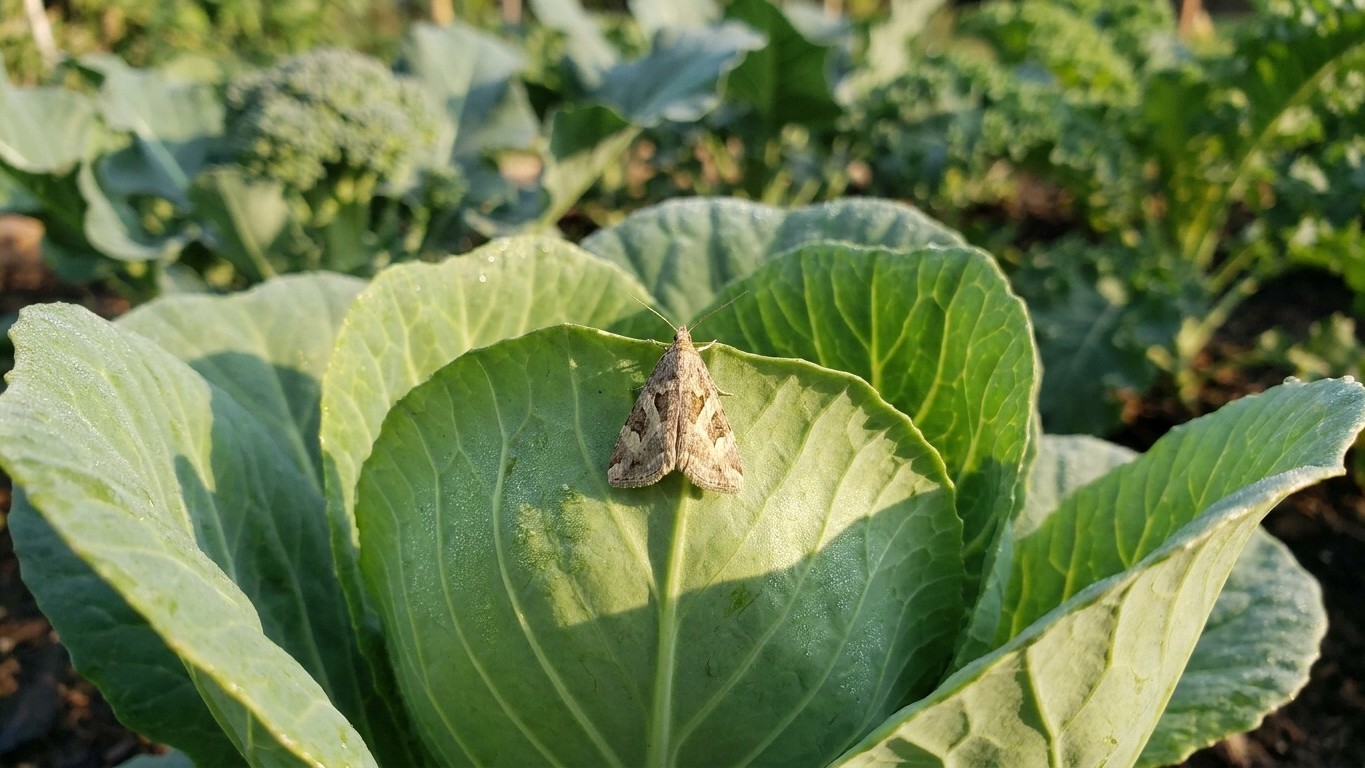

Diamondback moth shows up on South Carolina’s cole crops whenever cabbage, broccoli, or kale are in the ground, spring through fall, because the state’s mild winters let it breed nearly year-round instead of dying back the way it does farther north. Row covers timed to planting, tight crop rotation, and quick debris cleanup are what keep populations from building into the kind of pressure that shreds a harvest.
The weeks to watch
Clemson Cooperative Extension Home and Garden Information Center does not publish a specific flight window for diamondback moth the way it does for tomato fruitworm, stink bugs, or leaffooted bug. So the general pattern for the species has to fill that gap: diamondback moth is a cool-season insect that tracks its host plants, meaning it’s present whenever cole crops (cabbage, broccoli, collards, kale) are actively growing in South Carolina gardens, which in practice covers a spring run and a fall run with a summer lull when brassicas aren’t typically planted.
Spring generations
Moths become active as soon as young cole crop transplants or direct-seeded plants are established, generally as spring temperatures climb. Because the species can complete a generation in a matter of weeks under warm conditions, several overlapping generations can move through a single planting before it’s harvested.
Fall generations
A second wave tracks the fall cole crop planting, which many South Carolina gardeners rely on more heavily than spring cabbage because cooler fall weather suits brassicas better and cuts down on some other pest pressure. Diamondback moth doesn’t disappear for this window; it simply moves to whatever brassica foliage is available.
Reading the calendar from your last frost
The one date most South Carolina gardeners actually plan around is the last spring frost, which NOAA’s 1991-2020 climate normals put at February 28 to March 17 for the reference station used here, with peninsular Charleston running milder and the Upstate running tighter at both ends. Diamondback moth doesn’t answer to that date directly. It answers to how fast the soil warms and how quickly cole crop transplants put on tender new growth, so an unusually warm March pulls activity earlier and a cold, wet spring pushes it back, regardless of what the calendar says.
- Start from your local last frost date (February 28 to March 17 in this dataset, adjusted for your part of the state).
- Expect the first feeding signs on young cole crop leaves within roughly two to three weeks of transplanting, once the moths locate the planting and lay eggs, a general pattern rather than a fixed count.
That arithmetic is what decides when a row cover needs to go on: ideally right at transplanting, before the first moths find the bed, and it needs to come off or be lifted once plants flower if you’re growing anything that needs pollinators, since cole crops grown for heads or leaves rarely need that trade-off during the vulnerable early weeks.
What it attacks, and what the damage looks like
Most gardeners notice diamondback moth damage before they ever see the insect itself. Leaves develop small, pale, translucent patches, often called windowpaning, where young larvae have fed on the tissue between the leaf’s outer layers without chewing all the way through. As larvae grow, those patches turn into ragged, irregular holes, and on young plants the feeding can concentrate on the growing point, the bud at the center of a cabbage or broccoli plant that determines whether it forms a solid head at all.
The larval stage does essentially all of the damage. Adult moths themselves don’t feed on the crop; they mate and lay eggs, and it’s the small, pale green caterpillars that hatch from those eggs and chew through foliage for one to two weeks before pupating. That timing matters because once larvae have tunneled into a dense, wrapped cabbage head, damage becomes harder to see and harder to reach with any control measure.
Crops at risk in South Carolina gardens include:
- Cabbage
- Broccoli
- Cauliflower
- Kale
- Collards
- Mustard greens and other brassica relatives
How South Carolina sits in this pest’s range
This site currently documents diamondback moth in one territory, South Carolina, so there’s no basis here for saying the state sees more or less pressure than any neighboring state. That single-territory count reflects what’s been written up on this site so far, not a claim about the moth’s actual biological range, which is effectively worldwide; diamondback moth is recognized as one of the most widely distributed crop pests globally, present anywhere cole crops are grown in significant volume.
What that means practically for a South Carolina gardener is that the state isn’t some unusual hot spot or a marginal edge of the species’ range. It’s simply one point in a pattern that repeats wherever cabbage-family crops are planted, with local timing set by South Carolina’s own frost dates and growing season rather than by anything unique about the insect’s presence here. As more territories get added to this site, the comparison that will actually matter is timing (how early the spring generation starts, how long the fall run lasts) rather than whether the pest shows up at all.
What actually works against it
- Time cole crop plantings to avoid peak pressure. Getting transplants in early enough that they’re past the seedling stage before moth populations build gives young plants a head start, since the smallest larvae do proportionally more damage to tender new growth than to established leaves.
- Rotate cole crops out of the same bed each season. Diamondback moth pupae and any overwintering stages tied to old brassica debris don’t have a host waiting nearby if the next planting of cabbage-family crops goes into different ground.
- Use row covers from transplanting through early growth. A lightweight cover placed over the bed at planting physically blocks adult moths from reaching the leaves to lay eggs. It stops working the moment eggs are already on the plant before the cover goes on, or once the cover is removed for weeding, watering, or because the crop needs pollinator access.
- Hand-pick visible larvae and eggs. Checking the undersides of leaves for the small green caterpillars and squashing them is realistic for a home garden bed, but it stops being effective once larvae have moved into a tightly wrapped cabbage head where they’re no longer visible from outside.
- Clear and destroy crop debris after harvest. Removing old cole crop stalks and leaves takes away a place for late-season larvae or pupae to finish developing between plantings.
- Encourage natural predators and parasitic wasps. Leaving some flowering plants nearby supports the small parasitic wasps that attack diamondback moth larvae and eggs, a control that works over a season rather than overnight and doesn’t replace the steps above.
Common questions
Does diamondback moth survive South Carolina winters?
The state’s generally mild winters allow at least some overlap between generations rather than a hard reset each spring, unlike colder regions where the insect largely dies out and has to reinvade. Clemson’s Home and Garden Information Center doesn’t publish a specific overwintering study for this species in South Carolina, so treat this as general biological pattern rather than a local count.
Can diamondback moth damage a cabbage crop even if I only see a few holes?
Yes, because the most serious damage often happens where you can’t see it, at the growing point of a young plant or inside a forming head, before the leaf holes become obvious. A light amount of visible feeding on outer leaves doesn’t rule out heavier damage developing underneath.
Do row covers alone solve a diamondback moth problem?
Row covers are one of the more reliable low-effort measures, but they only work if they go on before adult moths reach the planting and stay sealed at the edges. Once larvae are established under the cover or inside a head, the cover itself does nothing to remove them.