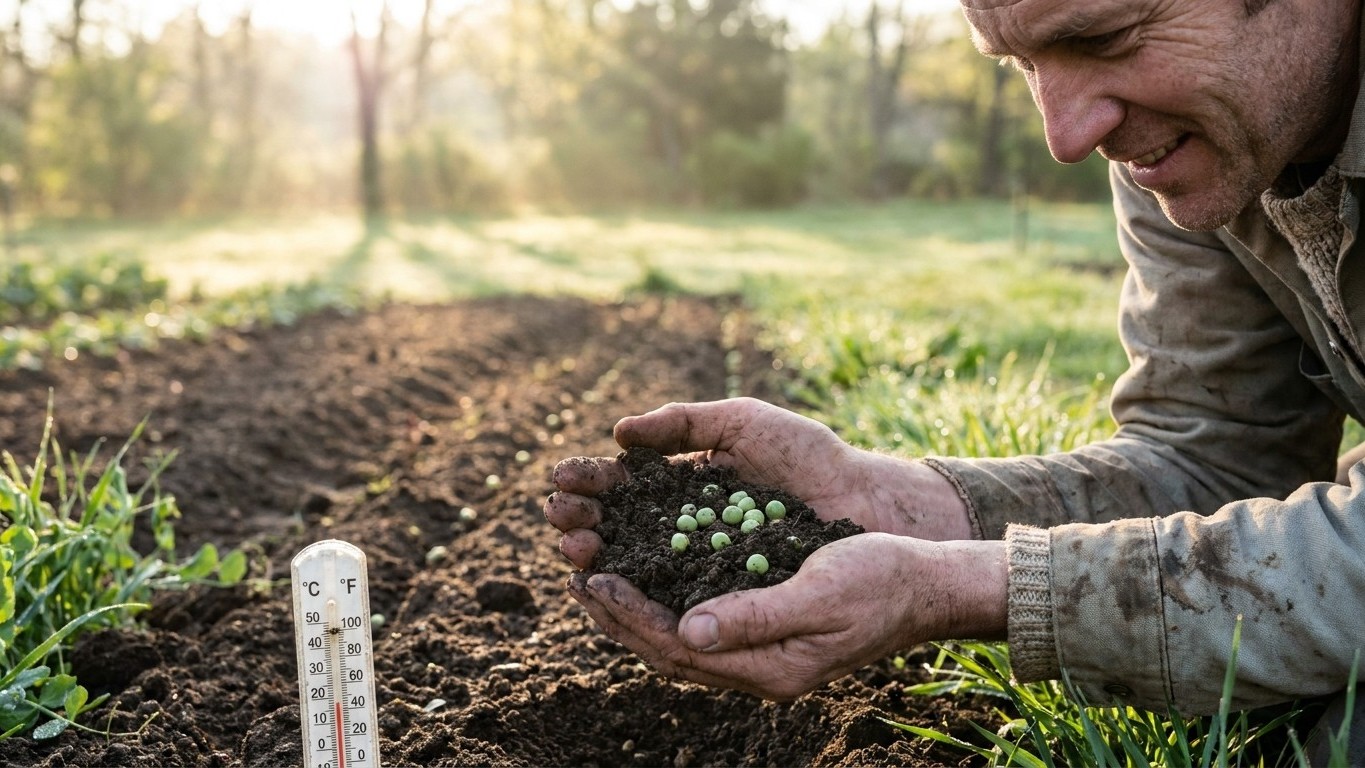

Sow peas the moment the soil can be worked in spring, not on a date circled on the calendar. Utah State University Extension puts it plainly: peas are cool-season, frost-tolerant vegetables, so the trigger is dry, tillable ground, not a countdown of weeks Before the Last Frost. Get that timing right and four separate problems, from a fungal wilt to a pod-boring weevil, simply run out of runway.
The short answer
Utah State University Extension answers this with a condition, not a season: start planting peas as soon as you can till the soil in the spring. That single line does more work than it looks like at first glance, because peas don’t follow the frost-avoidance math that governs warm-season crops. There’s no “wait until danger of frost has passed” clause here. Peas shrug off cold snaps that would flatten tomatoes, and the crop’s real enemy is heat, not cold.
The numbers back this up. Seeds germinate and emerge better once soil Temperatures climb above 40 F, and they come up fastest, in 7 to 10 days, when soil sits between 55 and 65 F. That’s a narrow, cool window, and it closes from the top: once soil and air temperatures push past 80 F, germination and plant growth both suffer. So the planting rule isn’t “wait for warmth.” It’s “get in while it’s still cool enough.”
Maturity time adds pressure to move early. Peas need 60 to 70 days from seed to harvest, and pea flowers are very sensitive to temperatures above 80 F. If dry conditions hit at the same time, the plants abort their flowers outright. Sow late, and the crop is still flowering or setting pods right as the thermometer crosses the line that kills yield. Sow as soon as the ground is workable, and the plant finishes its cycle while the weather is still working in its favor instead of against it.
This is also why the source treats early sowing as a season-long habit, not a one-time event. Successive plantings every 14 to 21 days keep garden peas coming, though snap peas produce pods over a long enough stretch that one planting usually covers the season. Either way, the anchor point is the same: workable soil, cool ground, and a race against 80 F that starts as early as the calendar allows.
What actually decides it

Here’s the part that makes early sowing worth more than a scheduling tip. According to Utah State University Extension, four distinct problems, three diseases and one insect, share a single point of failure: soil that’s too warm when the crop is still vulnerable. Fix the timing once, and all four risks drop at the same time.
Soil temperature and disease
Fusarium wilt shows up as downward-curling leaves and brittle stems, with yellow-orange discoloration inside the vascular tissue. It becomes a problem specifically when soil temperatures exceed 70 F. The Extension’s remedy is direct: plant early, so the crop develops before the soil reaches that optimum temperature for wilt development. Powdery mildew follows a similar logic without needing a hard number. Spring crops simply have fewer mildew problems than autumn plantings, because the fungus favors the later, more humid conditions that fall sowings run into.
Aphids and the virus they carry
Pea enation mosaic is a virus, and viruses need a vector. Aphids are that vector here. The Extension’s advice for susceptible varieties is to plant early specifically to avoid aphids, since populations build as the season warms. Miss that window and the mottled, crinkled, stunted leaves, plus badly distorted pods, follow.
Weevils and pod timing
Pea weevils lay eggs on young pods, and larvae burrow inside. Early planting and harvest minimizes exposure, closing the gap between when pods are vulnerable and when weevil populations are active.
Nitrogen: one habit, two costs
Peas fix their own nitrogen through soil bacteria attached to their roots, so extra fertilizer isn’t needed if compost or fertilizer went in at planting. Adding more nitrogen over-stimulates leaf growth, delays flowering, and reduces pod set. It also increases pea aphid populations, the same insect that spreads pea enation mosaic. One habit, two separate costs, and both point back to leaving the nitrogen alone.
How to do it
- Check the soil, not the calendar. Avoid compacted or wet ground, since peas planted in soggy soil are prone to root rot and damping off. Wait until the soil is below 65 F and can actually be tilled.
- Skip the extra nitrogen. If compost or fertilizer went into the bed already, that’s enough. More nitrogen delays flowering and feeds aphid populations.
- For the very earliest sowing only, germinate seed indoors first. These Transplants establish more rapidly than direct-sown seed in cold ground. As soils warm, switch to planting directly in the garden, which is the normal method for the rest of the season.
- Sow at the right depth and spacing. Place seeds 1/2 to 1 inch deep, spaced 1 to 2 inches apart, in rows 12 to 24 inches apart. Figure 2 to 3 ounces of seed per 100 feet of row. No thinning is necessary even if the stand comes up thick.
- Stagger plantings if you want garden peas over time. Sow again every 14 to 21 days while cool weather remains. Snap peas produce over a long enough window that a single planting is usually enough.
- Set up support for taller varieties. Most pea varieties are self-supporting, but taller types are more productive and easier to harvest when caged, trellised, or fenced. Snap and snow peas climb naturally.
- Control weeds early. Use shallow cultivation to avoid root damage, and focus effort during the first 6 weeks of growth, when competition matters most.
- Water consistently, especially after flowering. Let soil dry until half the available water is used before rewatering to field capacity. Don’t overwater, since wet soil promotes root rot. Mulch later plantings to buffer heat and dryness as temperatures climb.
- Harvest by pod type, not by date. Pick snap peas 5 to 8 days after flowering, when pods are full size with small seeds and firm, crisp flesh. Pick garden peas 18 to 21 days after flowering, once seeds are plump, and shell before use.
What goes wrong

- Fusarium wilt, pea enation mosaic, powdery mildew, and pea weevil damage. All four trace back to the same missed window: soil that warmed past 70 F while the crop was still developing, or aphid and weevil populations that had time to build before harvest. The remedy is the one already covered above: sow as early as the soil can be worked, so the crop matures ahead of the heat and ahead of the pests.
- Pea aphids colonizing new growth. They form colonies under leaves near the tips, and they transmit pea enation virus. Wash them off with a stream of water, destroy infested plants after harvest, and skip the extra nitrogen, since over-fertilizing increases aphid populations.
- Root rot and damping off. These show up in compacted or wet soil. Seed in spring when soil is below 65 F, and avoid using too much nitrogen, which compounds the problem.
- Dropped flowers and tough, stringy pods. Both are evidence of heat or water stress. Pea flowers are very sensitive above 80 F, and dry conditions make plants shed flowers outright. Keep soil moist, and mulch later plantings to reduce the stress. Water needs are most critical after flowering, since drought stress at that stage causes pod abortion, smaller seeds, and stringier pods.
- Slow or poor germination. Peas generally germinate better above 40 F soil and fastest between 55 and 65 F. Above 80 F, germination and growth both suffer. If seedlings are patchy or slow, the soil temperature is the first thing to check.
Some gardeners also time this by the Moon: when to plant peas by the moon, as almanac tradition rather than fact.
Common questions
Can peas be planted in fall instead of spring?
Utah State University Extension notes it’s possible, but yields of fall-grown peas are much lower than spring-sown plantings, since the crop runs into the same heat sensitivity on the way into the season instead of avoiding it.
How much row should I plant per person?
The Extension recommends 15 to 20 feet of row per person for fresh use, plus an additional 40 to 60 feet of row if you’re canning or freezing.
Do peas need fertilizer to produce well?
No. Peas fix nitrogen from the air through bacteria attached to their roots, and they don’t need additional fertilizer if compost or fertilizer was applied at planting. Extra nitrogen over-stimulates leaves, delays flowering, and reduces pod set.
Why do snap peas and garden peas have different harvest windows?
They’re grown for different textures. Snap peas are ready 5 to 8 days after flowering, while the pod is still full, crisp, and edible. Garden peas need 18 to 21 days after flowering so the seeds inside can plump up for shelling. Using the wrong window on the wrong type gives either tiny, underdeveloped seeds or a tough, stringy pod.