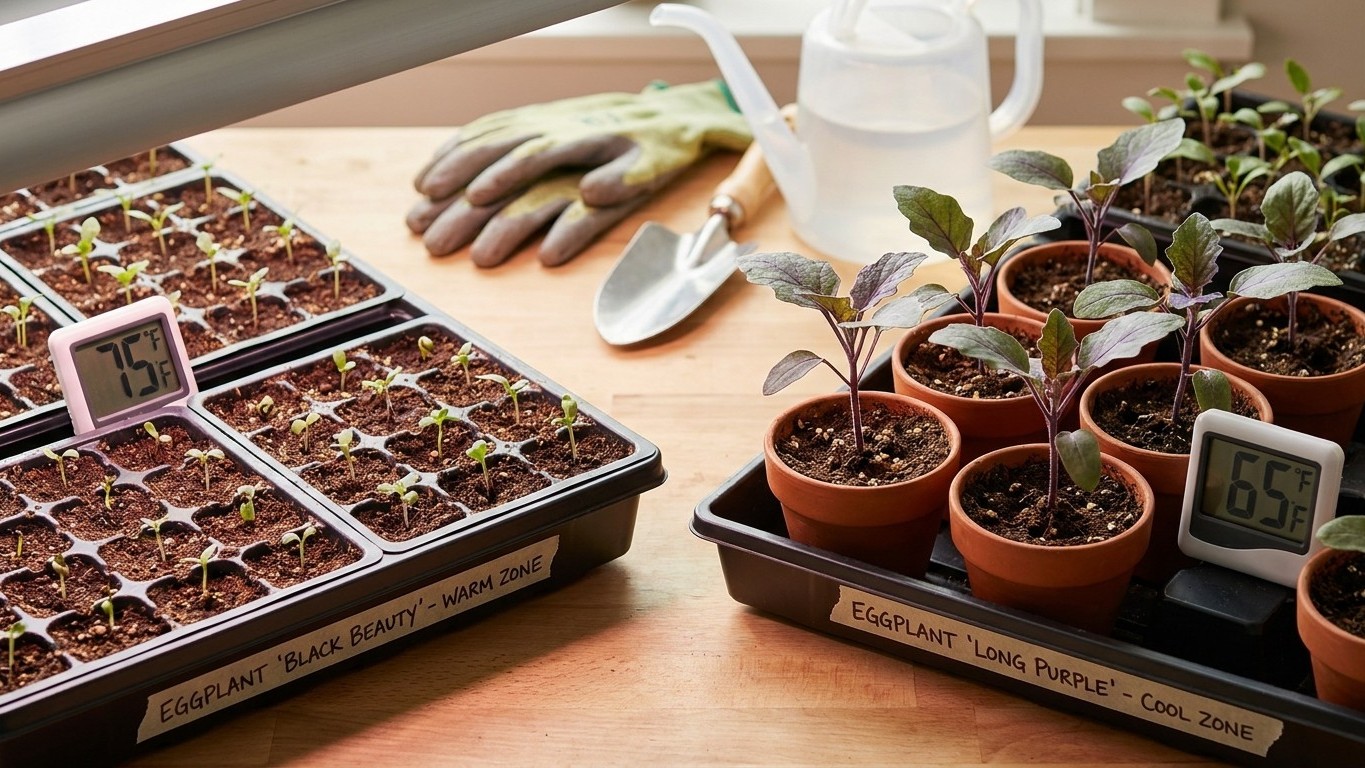

Eggplant seedlings need eight to ten weeks indoors before they’re ready to leave the tray, according to Utah State University Extension. But the week count alone won’t get you a healthy transplant. This crop asks for two separate temperatures along the way, one to wake the seed up, another to grow it out, and mixing up the order is where most of the trouble starts.
The short answer
Utah State University Extension states it plainly: “When growing Transplants, allow 8-10 weeks to grow the plant.” That’s the window between sowing a seed and having a plant sturdy enough to go into the garden. Eight weeks on the short end, ten on the long end, no month attached, because the right start date depends entirely on your own last frost date, not a calendar page.
Eggplant is a warm-season crop through and through. Unlike cabbage or lettuce, which tolerate a chilly transplant date, eggplant doesn’t move outside until all frost danger has passed and the soil itself has warmed to 60 F. That soil Temperature detail matters more than people expect. Air can feel warm on a spring afternoon while the ground underneath is still cold from winter, and eggplant roots sitting in cold soil simply stall. So the eight-to-ten-week count isn’t just about how long it takes the plant to reach transplant size indoors. It’s also about working backward from a moving target outdoors, one tied to soil warmth rather than a fixed date.
Why such a wide range, eight weeks versus ten? Growing conditions indoors vary from one setup to the next. A seedling under strong, consistent light and steady temperatures reaches transplant size closer to the eight-week mark. A seedling fighting weak light, uneven temperatures, or inconsistent feeding takes longer to reach the same size, and that’s where the extra couple of weeks in the range comes from. Utah State University Extension doesn’t offer a single number because there isn’t one. The range exists because eggplant seedlings grow at different rates depending on light, temperature, and feeding, and each of those has its own target.
The practical takeaway is this: pick a start date that gives your seedlings the full eight to ten weeks before your realistic transplant date, and build in the two-temperature approach from day one rather than treating it as an afterthought. Getting the count right doesn’t matter much if the temperature sequence is wrong, because a poorly started seedling won’t reach transplant size in eight weeks or ten.
What actually decides it
The eight-to-ten-week figure is really the sum of three separate mechanisms working together, or working against each other. Get any one wrong and the whole timeline stretches, sometimes past the point where the plant is still useful.
The two-temperature sequence
Utah State University Extension is specific about this: “Germinate the seeds at 80 F until the seed root emerges, then plant the seeds in sterile seeding mix and grow out at 65-75 F.” Notice the order. Heat comes first, for germination only, and it’s a narrow job with a clear endpoint, the emergence of the seed root. Once that root shows, the job changes. The seedling now needs to build leaf tissue and stem strength, and that happens better in the cooler 65-75 F range, not in the same heat that got the seed moving. Run the whole cycle at 80 F straight through and the seedling grows fast but soft, stretching toward whatever light it can find. Run it too cool from the start and germination drags out or fails, eating into the eight-to-ten-week window before the plant has even sprouted.
Light drives structure, not just growth
Temperature gets a plant germinated and growing, but light is what keeps it from falling apart structurally. Utah State University Extension calls this out directly: “Adequate light is essential to produce a quality plant. Cool white fluorescent tubes placed 2 to 3 inches above the plants and lit for 14-16 hours per day will ensure plants grow large and healthy.” The mechanism here is a chain reaction. A seedling that doesn’t get enough light stretches upward searching for it, producing a tall, thin stem instead of a compact, sturdy one. That stretched stem is weaker at the base, which means it’s more vulnerable to breaking or wilting the moment it faces real garden conditions. Skimping on light doesn’t just slow growth, it changes the physical structure of the plant in a way that follows it right through transplanting.
Feeding compensates for a sterile medium
Sterile seeding mix has no nutrient reserve of its own, which is exactly why it’s used, it keeps disease pressure low. But that same sterility means the seedling depends entirely on what you add. Utah State University Extension calls for regular water and weekly feeding “with 1/2 strength soluble complete fertilizer.” Skip that weekly feeding and the seedling runs out of stored nutrients from the seed itself within a couple of weeks, then growth slows even if temperature and light are both correct. The three mechanisms aren’t independent. A seedling grown at the right temperatures under strong light still stalls if it isn’t fed, and the eight-week timeline quietly becomes a ten-week timeline, or worse.
How to do it
- Germinate at 80 F. Sow seed and hold it at 80 F until the seed root emerges. This step has one job and one endpoint, the visible emergence of that root, not a fixed number of days.
- Move to sterile seeding mix at 65-75 F. Once the root has emerged, transplant the seedling into sterile seeding mix and shift the growing temperature down to the 65-75 F range for the remainder of its indoor life.
- Set up lighting immediately. Position cool white fluorescent tubes 2 to 3 inches above the seedlings and run them 14 to 16 hours per day. This isn’t a later addition, it starts as soon as the seedling is up and growing.
- Water regularly and feed weekly. Apply a half-strength soluble complete fertilizer on a weekly schedule, since the sterile mix supplies no nutrients of its own.
- Count backward from your last frost date. Take your own local last frost date and count backward eight to ten weeks to find your seed-starting date. If your last frost typically falls on a given date, the seed goes into the germination heat eight to ten weeks before that date, not before.
- Wait for two conditions before transplanting outdoors. Eggplant only moves outside once all frost danger has passed and the soil itself has reached 60 F. Both conditions need to be true at the same time, not just the frost date passing on the calendar.
What goes wrong
- Germinating and growing at the same temperature. Holding seedlings at 80 F straight through, or starting them too cool from the beginning, either delays germination or produces soft, stretched growth. The fix is following the sequence as given: 80 F only until the seed root emerges, then a shift down to 65-75 F for the growing phase.
- Not enough light, or light placed too far away. Seedlings stretch toward whatever light source they can find, producing weak, leggy stems. The remedy is cool white fluorescent tubes held 2 to 3 inches above the plants, running 14 to 16 hours a day, no further away and no shorter a duration.
- Skipping the weekly feeding schedule. Sterile seeding mix has nothing to offer nutritionally on its own, so a seedling left unfed stalls once its seed reserves run out. Feeding weekly with a half-strength soluble complete fertilizer keeps growth moving through the full eight-to-ten-week window.
- Transplanting before the soil has actually warmed. A calendar date passing isn’t the same as the soil being ready. Eggplant needs both frost danger gone and soil at 60 F before it goes outside; setting it out earlier stunts or damages the plant even if the air feels warm enough.
- Verticillium wilt. Utah State University Extension gives no varietal resistance for this disease, none of the varieties it names carries resistance to it. The only measures offered are crop rotation and soil solarization. There is no remedy once the disease is established in a plant, prevention through rotation and solarization is the extent of what’s available.
Common questions
Can I start eggplant seeds without a heat source for germination?
Utah State University Extension specifies 80 F for germination until the seed root emerges. Without a way to hold that temperature, germination slows and becomes less reliable, which eats into the eight-to-ten-week timeline before growth has even begun.
Does eggplant transplant at the same time as cabbage or lettuce?
No. Eggplant is a warm-season crop and goes outside only after all frost danger has passed and the soil has reached 60 F, a later and more specific window than cool-season crops that tolerate transplanting Before the Last Frost.
What happens if I use full-strength fertilizer instead of half-strength?
Utah State University Extension specifies half-strength soluble complete fertilizer applied weekly for seedlings. That’s the guidance given for this stage of growth; the source doesn’t provide an alternative strength for eggplant transplants.
Is there a variety that resists verticillium wilt?
Not according to Utah State University Extension. The source names thirteen varieties without attaching resistance ratings to any of them, and states that verticillium wilt has no varietal resistance. Rotation and soil solarization are the measures it offers instead.