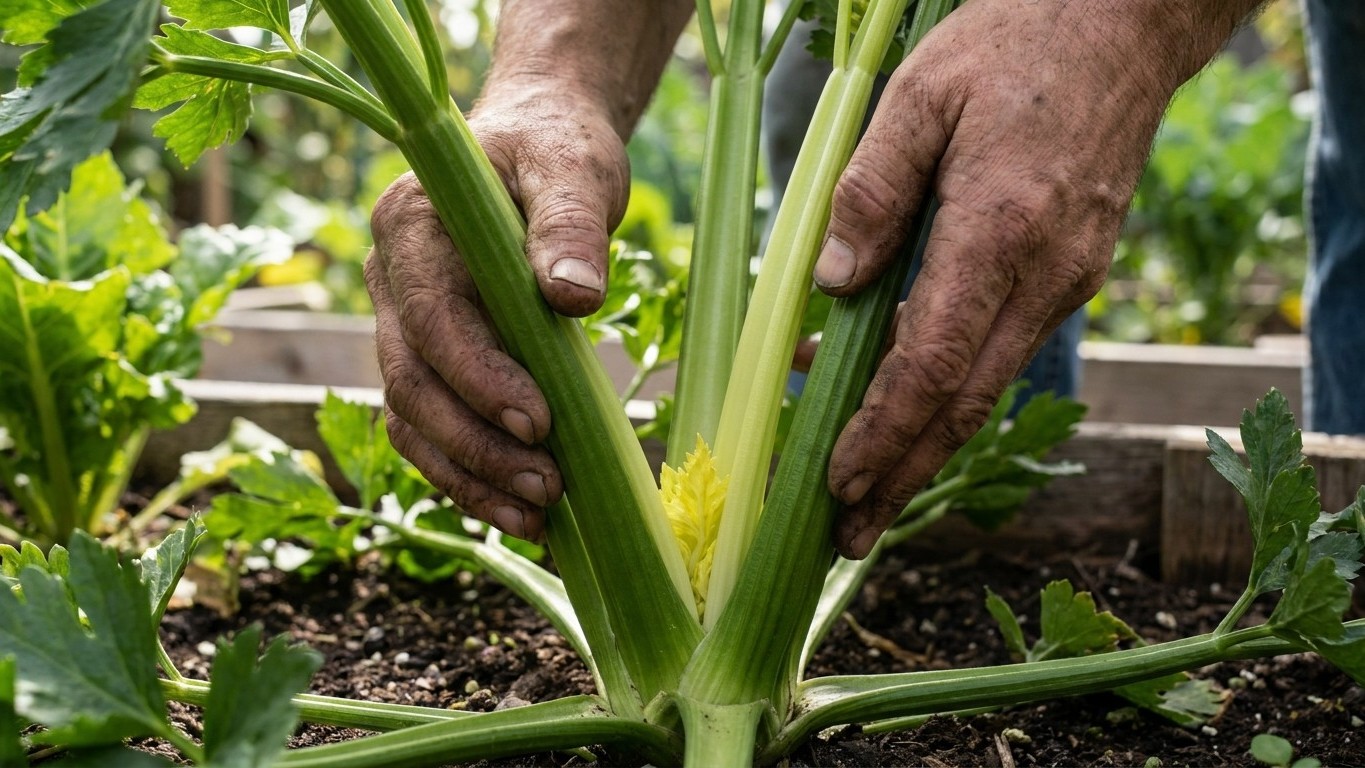

The short version: you don’t harvest celery all at once. You pull the outer petioles as soon as they hit a foot or more in length, leaving the center to keep producing, and you treat the whole plant as ready for a full cut only once the base reaches 3 inches or more across. That’s the standard set by Utah State University Extension, and it changes how you plan a celery bed from day one.
The short answer
Utah State University Extension’s guide to growing celery in the home garden spells out two separate thresholds, and mixing them up is where most gardeners go wrong. The first is for individual stalks: pull the outer petioles once they’ve grown to a foot or more in length. That’s a per-stalk decision, made stem by stem, not a whole-plant event. The second threshold covers the plant itself: a celery plant is considered ready to use as a whole once its base measures 3 inches or more in diameter.
Those two numbers work together, not against each other. A celery plant sits in the ground for weeks, building a rosette of stalks from the center outward. The oldest, outermost petioles mature first and reach harvest length well before the plant as a whole has bulked up. So the extension service’s advice is to snap those outer stalks off individually as they hit that foot-long mark, rather than waiting for the entire plant to size up. This keeps stalks from getting stringy and overgrown while the center continues filling in.
Meanwhile, the inner stalks, the ones still tucked close to the heart of the plant, are doing something different. Utah State University Extension notes that the inner stalks are the most tender and taste the best uncooked. That’s not a minor aside. It means the harvest strategy isn’t just about size, it’s about matching each part of the plant to its best use. Outer petioles, once they clear that foot-long bar, are fine for cooking, soups, stocks, braising. Inner petioles, smaller and paler, are the ones worth saving raw, for salads or snacking, because they haven’t toughened up yet.
What this means practically is that a single celery plant gives you a rolling harvest rather than a one-time cut. You can be pulling outer stalks off a plant for weeks while the center keeps growing, and you only bring the whole plant in, roots and all, once it’s put on enough girth to justify it. If you’re managing a row of a dozen plants, that translates into checking stalk length regularly rather than marking a single harvest day on the calendar.
What actually decides it
Celery’s harvest timing isn’t governed by a calendar date. It’s governed by two things happening inside the plant, and understanding the mechanism explains every rule that follows.
The plant grows from the center out
Celery produces new petioles from a central growing point, with each new stalk emerging inside the ring of stalks that came before it. That means the outermost stalks on any given plant are always the oldest ones. Age is what makes them ready first. Once an outer petiole has been growing long enough to reach that foot-long length Utah State University Extension specifies, it has already done its job of producing food for the plant, and removing it doesn’t set the plant back the way removing an inner, younger stalk would. This single fact, that celery ages from the outside in, is why the harvest is described as a sequence of individual removals rather than a single cutting date.
Tenderness fades as stalks mature
The same aging process that makes an outer stalk long enough to harvest also makes it firmer and more fibrous than a younger, inner stalk. That’s the mechanism behind Utah State University Extension’s point that inner stalks are the most tender and the best eaten raw. It isn’t a matter of variety or growing conditions, it’s simply that the stalk hasn’t had as much time to develop the toughened strands that make older celery better suited to cooking. So the decision about when to pull a stalk and what to do with it once you’ve pulled it are answered by the same underlying clock: how long that particular petiole has been growing.
Diameter reflects the whole plant’s development
While individual stalks mature on their own schedule, the plant’s overall diameter is a rougher, slower measure of total development, since it depends on how many stalks have accumulated around the crown. A 3-inch base means the plant has built up enough structure that harvesting it as a whole, rather than continuing to pick individual outer stalks, makes sense. That threshold is the plant-level equivalent of the stalk-level foot-long rule, and the two operate on different timelines because they’re measuring different things: one stalk’s age versus the whole crown’s accumulated growth.
How to do it
- Count backward from your last frost date to start seeds. Celery needs a long stretch indoors before it can go outside, so work out your own last frost date and count back 9 to 13 weeks from it to know when to start seed indoors. This wide window gives you room to adjust for how warm your particular growing area gets in spring.
- Transplant seedlings outdoors after your last frost has passed. Wait until the danger of frost is behind you before moving seedlings into the garden bed, since celery Transplants are tender and won’t tolerate a late cold snap.
- Space plants 12 inches apart, in rows 2 feet apart. This tighter spacing isn’t arbitrary. A tight planting helps force tall growth and long petioles, which is exactly what you want if your goal is stalks worth harvesting rather than a short, sprawling plant.
- Keep the bed consistently watered as plants establish. Celery is a heavy water user, and steady moisture keeps petioles growing rather than stalling out, which matters if you’re aiming for that foot-long harvest length.
- Check outer stalks regularly once plants are well established. Rather than waiting for a single harvest date, start looking at the outermost petioles on each plant as they lengthen, and pull them individually once they reach a foot or more.
- Remove outer petioles by hand or with a clean cut at the base. Take only the outer stalks at first, leaving the center of the plant intact so it keeps producing new growth from within.
- Reserve the innermost stalks for eating raw. Since the inner stalks are the most tender and taste best uncooked, plan on using outer, more mature stalks for cooked dishes and saving the youngest inner ones for salads or fresh eating.
- Harvest the whole plant once the base reaches 3 inches or more in diameter. At that point the plant has built up enough structure that a full harvest, rather than continued individual stalk picking, is the better move.
- Refrigerate what you pick promptly. Harvested celery keeps in the refrigerator for up to 2 weeks, so there’s no need to harvest more than you can use in that window.
What goes wrong
- Waiting for the whole plant before harvesting anything. Gardeners who hold off until the entire plant looks “done” end up with outer stalks that have overgrown and toughened well past their best point. Once a stalk has passed the useful window, that toughness can’t be reversed, so the fix is to start pulling outer petioles individually as soon as they reach a foot or more, rather than waiting on the whole plant.
- Wide spacing that produces short, sprawling plants. Planting much farther apart than 12 inches lets celery spread out instead of growing tall, and the resulting short petioles never really deliver the long stalks the tighter spacing is meant to produce. Since stalk length is set by how the plant grew from the start, a season of wide spacing can’t be corrected mid-summer; the remedy is planting at 12 inches, in rows 2 feet apart, from the beginning of the next planting.
- Cooking stalks that should have been eaten raw. Using the toughest outer petioles for a salad, or the tender inner ones for a long-simmered stock, wastes the difference in texture between the two. The fix is simple sorting at harvest: outer, more mature stalks for cooking, inner stalks for raw eating, decided at the moment you pick rather than after the fact.
- Letting harvested celery sit out instead of refrigerating it. Petioles left on the counter lose crispness fast, and once that moisture loss has happened, the stalk won’t firm back up. Refrigerate what you cut right away, and use it within the 2-week window Utah State University Extension gives for storage.
- Starting seed too close to the transplant date. Because the seed-to-transplant stretch runs 9 to 13 weeks, starting seed just a few weeks before your last frost date leaves seedlings too small to transplant successfully, and there’s no way to speed up that early growth once it’s behind schedule. Count back from your own last frost date at the outset instead of estimating later in the season.
Common questions
Do I need to harvest the whole celery plant at once?
No. Utah State University Extension recommends removing outer petioles individually once they reach a foot or more in length, while the center of the plant keeps growing. A full-plant harvest only makes sense once the base has reached 3 inches or more in diameter.
Which celery stalks are best eaten raw?
The inner stalks. Utah State University Extension notes they’re the most tender and taste the best uncooked, which is why they’re worth reserving for salads or snacking rather than cooking.
How long does harvested celery keep in the refrigerator?
Up to 2 weeks, according to Utah State University Extension, so there’s little benefit to harvesting more than you can use within that period.
How far apart should celery plants be spaced?
12 inches apart, in rows 2 feet apart. This tighter spacing is intentional: it helps force tall growth and long petioles, which is what makes the outer stalks worth harvesting once they reach that foot-long length.