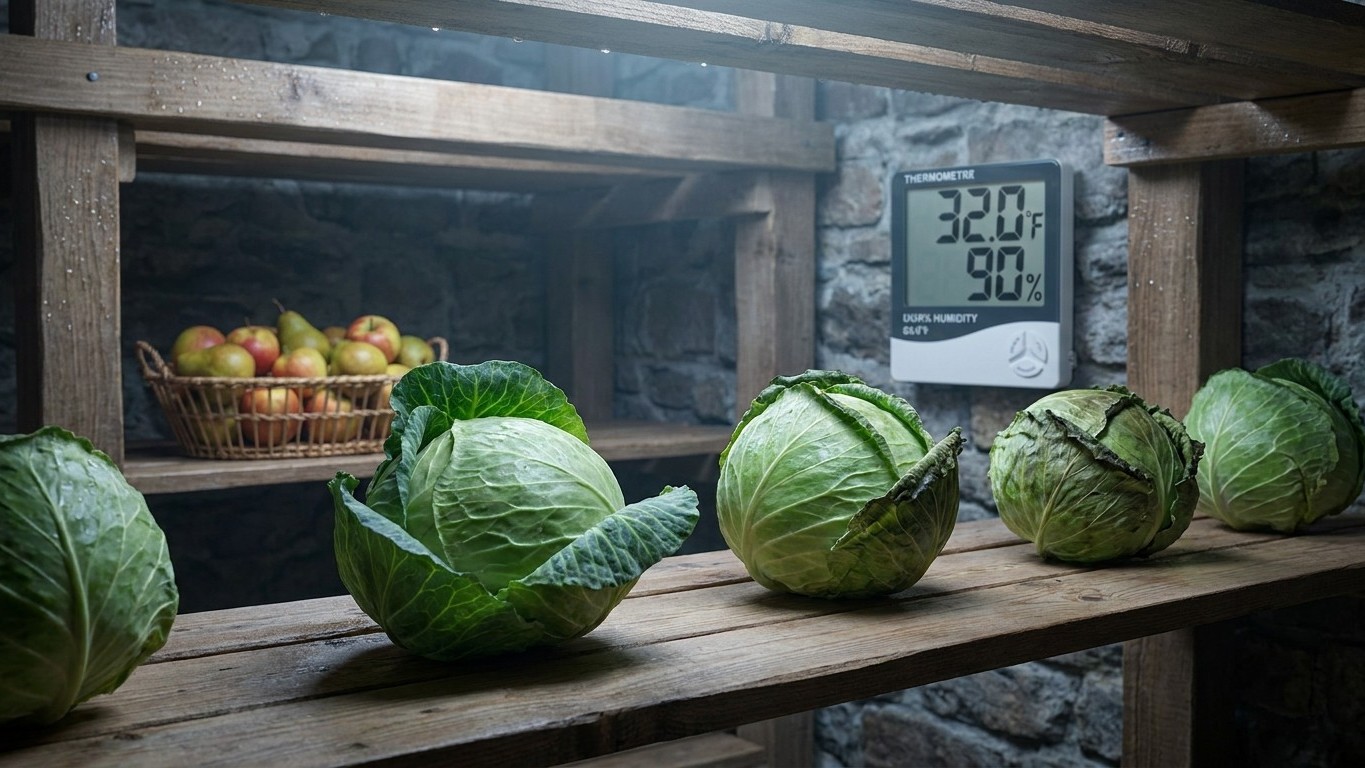

A cabbage head stored at 32 F and 95% relative humidity keeps for 2 to 6 months, according to Utah State University Extension’s guide to growing cabbage. That’s the direct answer. What separates the two-month head from the six-month head has less to do with luck and more to do with what’s sitting on the shelf next to it, starting with any apple, pear, or other fruit giving off ethylene gas.
The short answer
Two to six months. That’s the window Utah State University Extension puts on cabbage held at 32 F and 95% relative humidity, and it’s worth writing on a piece of tape and sticking to the cellar door before the first heads come in from the garden. The range is wide on purpose. A head that lands at the low end usually got there through some combination of rough handling, uneven cold, or exposure to fruit gases. A head that makes it to six months usually got almost nothing wrong done to it.
Utah State University Extension is specific about the one step that separates those two outcomes at harvest: cut the stem below the head, leaving 2 to 3 wrapper leaves for protection. Those outer leaves aren’t cosmetic. They’re the first line of defense against the drying and bruising that shortens storage life before the head ever reaches 32 F.
Scale matters too, and the same source gives numbers for planning ahead rather than guessing at harvest time. A 10-foot row produces 10 to 15 pounds of cabbage. For a household planning to eat cabbage fresh and put some away, the recommendation is 3 to 4 plants per person for fresh use, plus another 5 to 10 plants per person set aside specifically for storage. That second number matters because storage cabbage is a different commitment than a summer coleslaw crop. It’s heads you’re deliberately growing to still have in the kitchen months after the garden is done, and planting for that up front avoids the scramble of trying to stretch three heads across a whole winter.
None of that changes the ceiling, though. Even a perfectly handled, perfectly wrapped head tops out at 6 months under ideal cold and humidity. Anything beyond that isn’t a storage failure so much as the natural limit of the vegetable itself.
What actually decides it

The ethylene problem
Utah State University Extension is blunt about this one: avoid storing cabbage with apples, pears, or other ethylene-producing fruits, because bitter flavors will develop. This is a rule most households break without realizing it, mostly because the root cellar, the garage fridge, and the fruit bowl often end up sharing the same corner of the house. Ethylene is a gas. It doesn’t stay put with the fruit that produced it, it moves through the air in whatever enclosed space it’s given, and cabbage tissue absorbs it readily. That’s a transport problem, not a shortage problem. Adding more cold storage space, buying a bigger fridge, or spreading the heads out further doesn’t stop the gas from reaching them if an apple is anywhere in that same airspace. The only fix is separation, not more room.
Temperature and humidity as a system
The 32 F and 95% relative humidity target isn’t two separate numbers, it’s one system. The cold slows respiration and enzyme activity inside the head, which is what keeps it from going soft and starchy. The humidity keeps moisture from leaving the outer leaves, which is what keeps the head from shriveling. Get the temperature right without the humidity, and a head that would have lasted six months turns leathery and dried out in two. Get the humidity right without the cold, and rot sets in even faster than it would in a dry, warm pantry. Both numbers have to hold at the same time for the full range to be reachable.
Wrapper leaves as physical armor
Those 2 to 3 wrapper leaves left on at harvest do mechanical work every day the head sits in storage. They take the scuffs and bruises that would otherwise land directly on the tissue you’re planning to eat, and they slow moisture loss from the outermost layers of the head itself. A head stripped down to bare, tight leaves at harvest is already starting its storage clock from a disadvantage, no matter how good the cellar conditions are afterward.
How to do it
- Plant with storage in mind before the last frost. Cabbage goes into the ground before your last frost date, not after it, the same way broccoli does and unlike tomatoes. Count Back From your local last frost date and get transplants in the ground a few weeks ahead of it, since cabbage tolerates cold conditions that would set back warm-season crops.
- Let the head mature fully before cutting. Cabbage can handle temperatures down to 25 F in the field, which gives storage-intended heads room to size up fully before harvest without rushing to beat an early cold snap.
- Cut the stem below the head, leaving 2 to 3 wrapper leaves attached. The gesture is simple: a clean cut below the head, outer leaves left intact rather than trimmed away. The mechanism behind it is protection, those leaves buffer the head against bruising in transport and slow the moisture loss that would otherwise dry the tissue out early in storage.
- Set the storage space to 32 F and 95% relative humidity before loading it. Verify both numbers with a thermometer and a hygrometer rather than guessing at a root cellar’s conditions from feel.
- Keep the storage area physically separate from apples, pears, or any ethylene-producing fruit. This means a different room or a sealed-off section, not just a different shelf in the same open space, since the gas moves through shared air regardless of distance on a shelf.
- Check heads periodically and pull any showing soft spots. One deteriorating head can spread rot to neighbors sitting against it, so a quick visual pass every few weeks protects the rest of the batch.
What goes wrong

- Cabbage stored next to apples or pears develops a bitter flavor. This is the failure Utah State University Extension calls out directly. The remedy is physical separation, a different room or a sealed-off area, since the ethylene gas the fruit gives off travels through shared air and no amount of extra cold storage space fixes it while the fruit stays in the same room.
- Storage temperature drifts above 32 F. Even a few degrees of warmth accelerates respiration and shortens the storage window well below the 2 to 6 month range. Check with an actual thermometer placed near the heads, not just the appliance’s dial setting, and adjust until it holds steady.
- Humidity drops below the 95% target. Low humidity dries and wilts outer leaves quickly, even at the right temperature. Damp sand, moist burlap, or a dedicated humidity-controlled space around the heads keeps moisture loss in check.
- Too many wrapper leaves get trimmed off at harvest. A head cut down to bare, tight leaves loses its protective buffer against bruising and drying. Leave the 2 to 3 wrapper leaves USU Extension recommends, and trim only what’s visibly damaged.
- More cabbage gets planted than there’s storage space to hold. Ten to 15 pounds per 10-foot row adds up fast, and a harvest that outpaces cold storage capacity ends up wasted on the counter. Plan planting around the 3 to 4 plants per person for fresh eating, plus the 5 to 10 additional plants per person for storage, matched against actual cellar or fridge space before the seedlings go in.
Common questions
Can cabbage be stored in a refrigerator instead of a root cellar?
Yes, as long as the target of 32 F and 95% relative humidity can be maintained. Standard refrigerators run colder and drier than that humidity target, so heads may need to sit in a perforated bag or the crisper drawer specifically to hold moisture in.
How can you tell when stored cabbage has gone bad?
Soft spots, a strong off odor, or leaves that have gone slimy signal it’s past use. Since one deteriorating head can spread rot to others nearby, pulling it out during a periodic check protects the rest of the stored batch.
Does the variety of cabbage affect storage?
Utah State University Extension lists varieties by days to maturity: Golden Acre at 65 days, Ruby Ball at 55, Savoy Ace at 80, and Danish Ball Head at 100. Longer-season varieties like Danish Ball Head are the traditional choice for storage crops, planted to mature late in the season, while quicker varieties like Golden Acre and Ruby Ball are typically grown for fresh eating.
Can cabbage be stored alongside other vegetables?
The specific warning from Utah State University Extension covers apples, pears, and other ethylene-producing fruit, not vegetables generally. The core rule to follow is keeping any ethylene source out of the same airspace, regardless of what else shares the shelf.