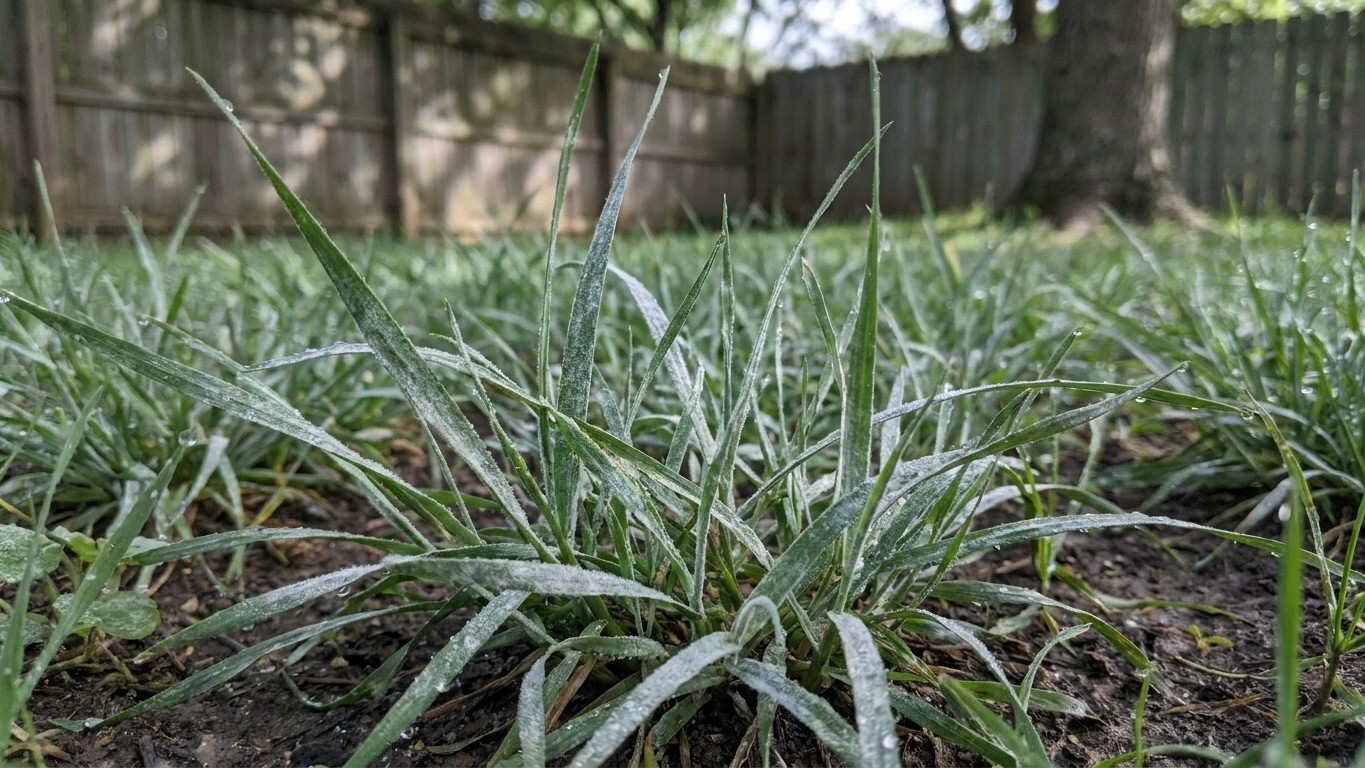

Powdery mildew is the fungal disease behind that white, flour-like coating you see on grass blades growing under trees or along a shaded fence line. It thrives where sunlight is scarce and air barely moves, and while it looks alarming, it rarely kills the turf outright. The dust is the fungus itself, spreading across the leaf surface rather than inside it.
What you are looking at
From a few feet away, powdery mildew shows up as a grayish-white haze scattered across patches of lawn, usually in irregular blotches rather than a uniform sheet. The affected areas almost always sit under a tree canopy, next to a wall, or in a low-light corner of the yard where morning dew lingers into the afternoon. Walk the border of the patch and you’ll often find it fades gradually into healthy green grass rather than stopping in a sharp line, which is one clue that separates it from other turf problems.
Bend down and look at a single blade and the diagnosis gets easier. The coating sits on top of the leaf, not embedded in it, and you can often smudge it off with a fingertip, leaving a faint gray or white residue on your skin. Early on, the spots are small, roughly the size of a pinhead, scattered like dust that landed unevenly. As the infection matures, those spots merge into a continuous felt-like layer that can cover most of the blade’s upper surface. The color stays in the white-to-pale-gray range; it doesn’t turn orange, black, or reddish-brown the way some other fungal issues do.
Underneath the powder, the leaf tissue itself may look slightly yellowed or weakened, but it’s rarely mushy or water-soaked. In heavy infections that go untreated for weeks, older leaves can eventually turn a dull yellow and die back, but this is a slow decline, not the sudden collapse you’d see from a root problem or heat stress. Grass crowns and roots are typically untouched, which is part of why lawns affected by powdery mildew tend to bounce back once conditions shift.
What it is not
The detail that separates powdery mildew from almost everything else on this list is texture and location on the plant. If the white or light-colored material is on the soil surface rather than the blades, or if it disappears entirely after a rain, you’re probably looking at something other than a living fungus. Fine dust kicked up by dry soil, residue from a granular fertilizer application, or lime dust from a recent soil amendment can all sit on grass tips and look deceptively similar from a distance, especially in photos taken in bright sun.
Rust disease is the fungal look-alike people confuse it with most often. Rust produces an orange to reddish-brown powder that rubs off on your shoes or pant legs as you walk across the lawn, rather than the grayish-white film of powdery mildew. Dollar spot, another common turf disease, leaves small, silver-dollar-sized straw-colored patches with a cobweb-like fungal growth visible only in early morning dew, and it lacks the dusty coating entirely.
Sometimes the honest answer is that nothing is wrong with the grass at all. Certain ornamental grasses and even some turf varieties release a light bloom of natural wax or pollen dust during seed head formation in late spring, and this can be mistaken for disease by someone scanning the yard for the first time. If the white coating is confined to seed stalks rather than the leaf blades, that’s a seasonal, harmless event, not an infection.
The conditions that bring it on
Powdery mildew has a specific taste in weather, and it’s a little different from most lawn fungi. Where many turf diseases need standing water or a soaked leaf surface to get going, powdery mildew actually prefers dry leaf surfaces paired with high humidity in the surrounding air. That combination shows up most reliably in shaded areas with poor air circulation, where humidity builds up close to the ground but the tree canopy above blocks the dew from burning off in direct sun. Cooler weather in the 60s to low 70s Fahrenheit, common in spring and again in early fall, tends to favor the fungus more than the heat of midsummer.
Not every lawn is equally vulnerable, and the grass type matters as much as the weather. Among cool-season grasses, Kentucky bluegrass is the most frequently affected, particularly cultivars planted in dense shade where they’re already struggling to photosynthesize efficiently. Fine fescues can show symptoms as well, though usually to a lesser degree. Warm-season lawns aren’t immune either; St. Augustinegrass growing in shaded, humid conditions is a known host, especially in the transition weeks of spring and fall when temperatures sit in that same moderate range.
| Grass type | Season most affected | Typical trigger |
|---|---|---|
| Kentucky bluegrass (cool-season) | Spring, early fall | Dense shade, moderate temps, still air |
| Fine fescue (cool-season) | Spring, fall | Shade combined with high humidity |
| St. Augustinegrass (warm-season) | Spring, fall transition weeks | Shade under trees, moderate temperatures |
Grass already stressed by low light struggles to build the thick, waxy leaf cuticle that helps resist fungal colonization, which is part of why the exact same lawn can stay clean in full sun and develop mildew twenty feet away under a maple tree.
What to do now
For most home lawns, the honest answer is to do very little and let the season handle it. Powdery mildew tends to fade on its own once the weather shifts, either warming up past the fungus’s comfort zone in summer or drying out the humid microclimate that let it establish in the first place. The grass underneath is usually still alive, and once conditions change, new growth pushes through clean.
Where the disease is genuinely heavy, thinning out the tree canopy above the affected patch or pruning back low branches to let in more light and airflow does more good than anything sold at a garden center. Raising the mowing height slightly can also help by leaving more leaf surface for photosynthesis, giving the grass a better chance to outgrow the infection rather than being weakened further by a close cut.
Fungicide is rarely the right first move for an ordinary residential lawn. It’s a recurring cost against a disease that’s largely a symptom of the site, not the seed, and spraying a shaded patch that will stay shaded next month just delays the same problem. Products containing sulfur or myclobutanil are labeled for homeowner use against powdery mildew on turf, but they work best as a short-term measure on high-visibility areas, like a front lawn strip, rather than as an ongoing solution. If the shade problem never gets addressed, expect the mildew to return the following spring regardless of how many applications went down this year.
Preventing it next season
Most of the fix here is a habit change, not a purchase. Watering early in the morning, rather than in the evening, gives any moisture on the grass blades time to evaporate during the day instead of sitting overnight in a shaded, humid pocket where the fungus thrives. Evening watering is one of the single most common mistakes behind repeat mildew problems in shaded lawns.
Nitrogen timing matters too. Heavy spring fertilization pushes soft, fast growth that’s more vulnerable to fungal infection, particularly in shaded turf that’s already photosynthesizing at a disadvantage. Spacing out nitrogen applications and avoiding a big spring flush on shaded areas gives the grass steadier, tougher growth instead.
Mowing height plays a supporting role: taller grass in shaded zones (toward the higher end of the recommended range for your specific grass type) keeps more leaf area available for energy production without over-stressing the plant. Combine that with actual airflow improvements, thinning overhanging branches, removing lower limbs, or even reconsidering whether turf is the right plant choice for a deeply shaded corner, and the environment stops favoring the fungus in the first place. A shade-tolerant ground cover or mulch bed under a dense canopy is sometimes a more realistic long-term answer than fighting the same disease every spring.
Common questions
Does powdery mildew spread to other plants in the yard?
The specific fungus that infects turf grass is generally host-specific to grasses and won’t jump to your roses or vegetable garden, though those plants can have their own separate powdery mildew species that look similar but behave independently.
Will the white coating wash off with a hose?
Rinsing knocks some spores loose temporarily, but it doesn’t cure the infection, and the humid, still air that caused the problem in the first place will let it return within days if nothing else changes.
Can I overseed a mildew-affected patch with the same grass?
Yes, once conditions improve, but if the underlying issue is deep, permanent shade, overseeding with the same shade-sensitive variety just resets the clock. Choosing a more shade-tolerant cultivar suited to your grass type gives better long-term odds.
Is powdery mildew more common in wet years or dry years?
It’s less about total rainfall and more about humidity trapped near the ground combined with dry leaf surfaces, so it can show up in a lawn that isn’t being watered heavily as long as the shaded, still-air conditions are in place.