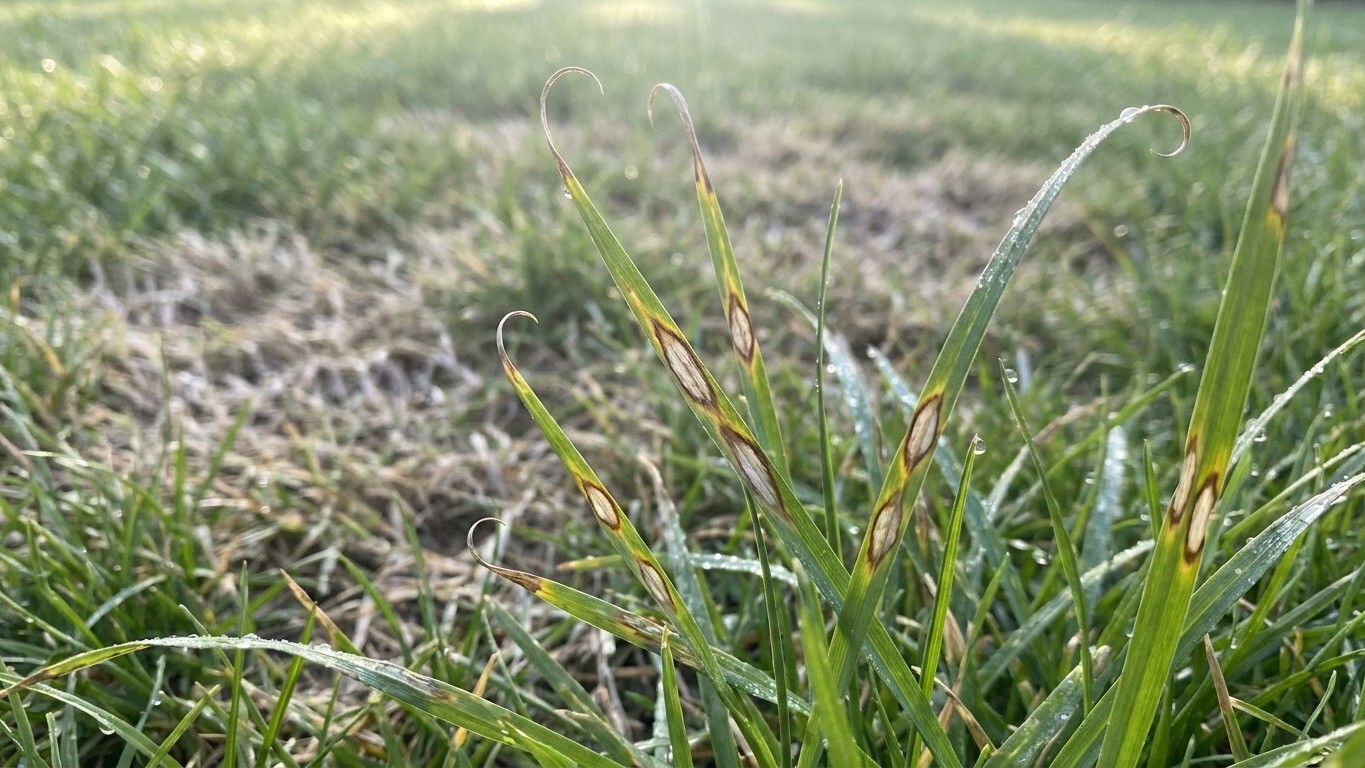

Ryegrass that thins into ragged tan-gray patches in August, especially in humid weather with warm nights, is very likely showing Gray Leaf Spot. The disease targets leaf blades directly, weakening the grass until it collapses under mowing and foot traffic. Confirming it takes a closer look at the individual blade, not just the pattern in the yard.
What you are looking at
Step back from the lawn first. Gray Leaf Spot shows up as irregular, tan to gray patches ranging from a few inches to several feet across. From a distance, the affected areas can look scorched, almost like a drought patch or a spot where gas spilled. The grass looks thin and matted rather than uniformly brown, and the edges of the patches are ragged instead of a clean circle.
The confirmation is on the blade itself. Pull a few affected leaves and look closely, ideally with a hand lens. Gray Leaf Spot lesions start as small, water-soaked spots, roughly 1/8 to 1/4 inch, that dry into an oval or diamond shape. The center of the lesion turns a bleached tan-gray, while the border stays a darker brown, sometimes with a faint yellow halo around the whole spot. On ryegrass in particular, heavily infected blades often develop a distinctive curl at the tip, sometimes described as a “fish hook” bend, as the tissue dies and contracts.
Under humid, still conditions (especially early morning while dew is still on the grass) you may also see a faint gray, fuzzy growth on the lesion surface. That’s the fungus producing spores, and it’s the clearest visual sign that separates this disease from simple leaf scorch. As lesions multiply and merge, entire blades die back from the tip down, and the stand thins because so many leaves are compromised at once rather than because the crowns themselves have died.
One more detail worth checking: newly seeded or recently overseeded ryegrass, and areas that were mowed short right before a humid stretch, tend to show symptoms first and worst. Thin, tender growth gives the fungus an easier foothold than mature, hardened blades.
What it is not
Before assuming disease, rule out the more common culprits. Plain heat and drought stress on cool-season ryegrass during August looks similar from ten feet away, but the blades themselves tell a different story. Drought-stressed grass turns a uniform straw color without the oval lesions or dark borders, and the discoloration follows the pattern of your sprinkler coverage (or lack of it) rather than random patches scattered through healthy turf.
Dull mower blades are another frequent stand-in. If the lawn has a whitish or grayish cast after mowing but the individual leaf tips look shredded or frayed rather than spotted, that’s mechanical damage, not fungus. Sharpening the mower blade usually clears it up within a week or two of new growth.
Grub damage is worth a quick check too, especially if the thin patches lift up like loose carpet when you tug on them. Gray Leaf Spot doesn’t loosen the root system; the grass stays anchored even as the leaf blades die. If a patch peels back easily, the problem is underground, not on the leaf surface.
Dog urine spots are usually smaller, more concentrated, and ringed by a strip of darker green growth (nitrogen runoff feeding the surrounding grass), which Gray Leaf Spot patches don’t produce. And summer dormancy, where cool-season grass simply shuts down growth in extended heat, tends to affect the whole lawn evenly rather than in isolated patches with lesioned blades. Brown, dormant grass is not dead grass; it typically greens back up once Temperatures drop and rain returns, no diagnosis required.
The conditions that bring it on
Gray Leaf Spot is a warm-weather, high-humidity disease, and that’s exactly why it shows up on ryegrass in August rather than in spring or fall. The fungus needs extended periods of leaf wetness, meaning dew, overnight irrigation, or stretches of muggy weather that don’t dry off until late morning, to infect the blade tissue. Warm nights matter as much as hot days; when overnight temperatures stay elevated and humidity doesn’t break, the leaf surface simply stays wet longer, giving the fungus more hours to establish each infection cycle.
Which grasses are susceptible
This is a cool-season story with a specific target. Perennial ryegrass is the most susceptible grass to Gray Leaf Spot, and newly seeded or overseeded stands are especially vulnerable because young tissue is tender and hasn’t hardened off. Tall fescue can also develop the disease under similar conditions, though generally to a lesser degree than ryegrass. Kentucky bluegrass, by contrast, is rarely affected in the same way.
There’s a separate wrinkle worth knowing about if you also manage warm-season turf: St. Augustinegrass in the Gulf Coast and Southeast has its own strain of gray leaf spot, active during its warm growing season rather than in a cool-season lawn’s late summer. The two situations look similar on the leaf but involve different grass species and different calendars, so identifying the grass type first matters more than the calendar date alone.
Fertility plays a role too. A flush of tender new growth from a heavy nitrogen application right before a humid stretch gives the fungus soft tissue to colonize, which is one reason lawns fed hard in early summer sometimes show the worst August damage.
What to do now
For most home lawns, the honest answer is that Gray Leaf Spot runs its course and the turf recovers once the weather pattern breaks. When nights cool down and humidity drops, even significantly, the fungus loses the wet-leaf window it needs, and the ryegrass typically resumes normal growth within a few weeks. Mature, established lawns usually shrug it off with thinning rather than permanent loss, especially if overseeding follows in fall.
Fungicide is worth considering in narrower situations: newly seeded ryegrass under active infection pressure, high-value turf like a sports field or a lawn heading into a big event, or a property with a documented history of severe outbreaks year after year. In those cases, timing matters more than the product itself. Fungicides labeled for Gray Leaf Spot, including products with chlorothalonil or azoxystrobin as active ingredients, work preventively by protecting healthy tissue before infection; they don’t reverse lesions that have already formed. Applying fungicide after the patches appear mostly protects new growth going forward, not the damage already done.
Before buying anything, check your state’s pesticide regulations. Some active ingredients used against turf diseases carry use restrictions or require specific application timing in certain states, and labels vary by region, so read the product label fully rather than assuming a garden-center purchase is automatically approved for your yard’s use case.
For everyone else, the practical move is patience paired with good mowing hygiene: keep the mower blade sharp, avoid cutting wet grass, and let the weather do the rest.
Preventing it next season
Prevention here is almost entirely a matter of habit rather than a product on a shelf. The single biggest lever is watering schedule: irrigate early in the morning, ideally before sunrise, so the leaf surface dries with the day’s sun rather than sitting wet overnight. Evening watering is the single most common human contributor to prolonged leaf wetness, and cutting it out solves more disease pressure than any spray.
Nitrogen timing matters almost as much. Avoid heavy nitrogen applications in early-to-mid summer that push soft, tender growth right as humidity peaks; shift the bulk of feeding to spring and early fall when ryegrass can put that growth to use without the disease window overlapping.
Mowing height and frequency round out the routine. Keep ryegrass on the taller end of its recommended range through summer rather than scalping it, since shorter grass has less leaf tissue to spare and stresses more easily. Mow often enough that you’re never removing more than about a third of the blade at once, and clean or sharpen the mower blade regularly so cuts heal cleanly instead of leaving ragged tissue that’s easier for fungus to enter.
Finally, airflow and density help more than most homeowners expect. Thin out overhanging branches, avoid dense thatch buildup, and space out sprinkler heads so water doesn’t pool in low spots. When overseeding ryegrass in the fall, look for cultivars marketed with improved gray leaf spot tolerance, since breeding has made real progress on that front and it costs nothing extra to choose a better-suited seed blend.
Common questions
Does Gray Leaf Spot kill ryegrass permanently?
Rarely on established lawns. The fungus damages leaf blades, not the crown or root system, so most mature ryegrass recovers once cooler, drier weather arrives. Newly seeded stands are more vulnerable and can suffer real stand loss if infection is severe.
Can I treat Gray Leaf Spot after I’ve already seen lesions?
Fungicide applied after lesions appear mostly protects future growth rather than reversing existing damage. If the lawn is otherwise healthy, waiting out the weather is often more practical than spraying.
Why does this show up in August specifically?
Gray Leaf Spot needs warm nights and extended leaf wetness, conditions that peak in late summer when humidity stays high overnight. Spring and fall rarely provide the same stretch of warm, wet nights the fungus needs.
Is Kentucky bluegrass at the same risk as ryegrass?
No. Perennial ryegrass is the most susceptible cool-season grass to this disease, with tall fescue also affected to a lesser extent. Kentucky bluegrass is rarely a concern for Gray Leaf Spot.