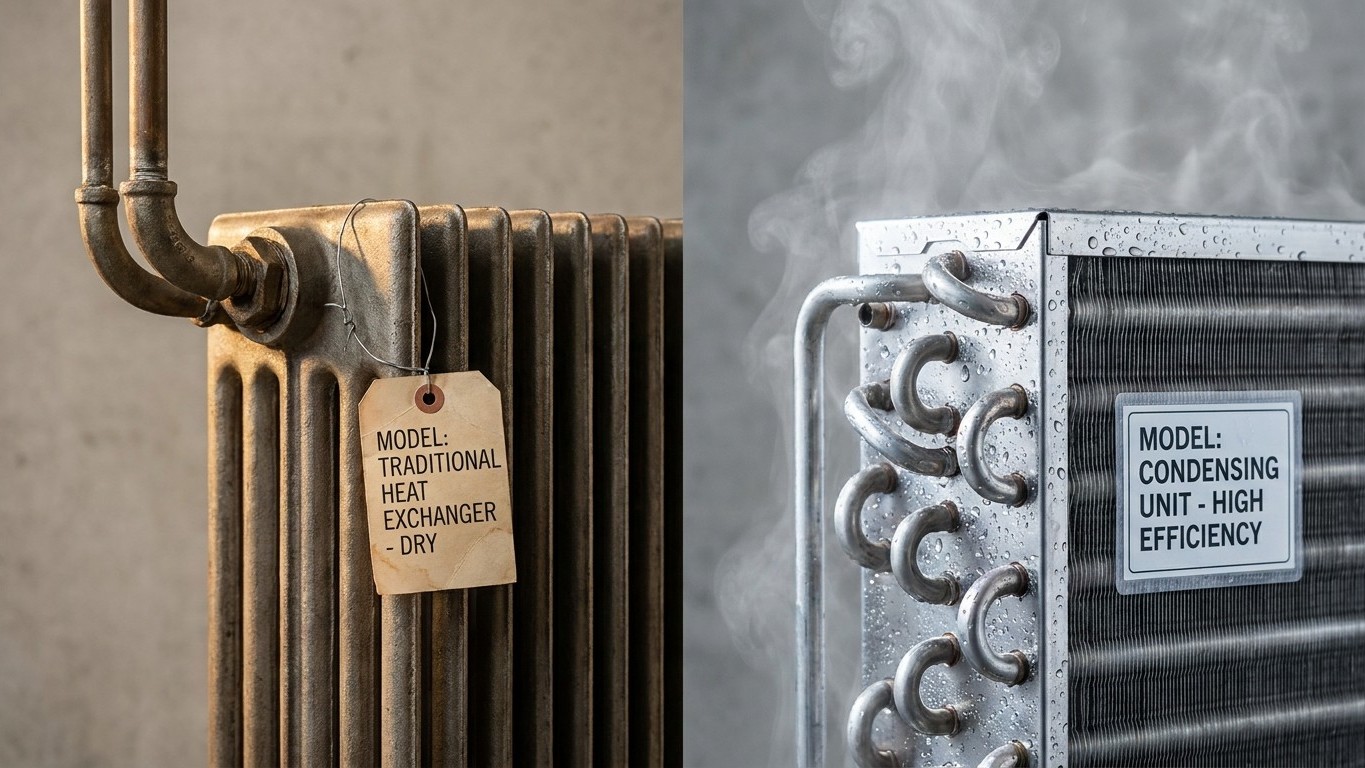

A condensing boiler only delivers its high efficiency rating when the water returning to it is cool enough to pull the extra heat out of the exhaust gas. Run it with hot return water, on emitters or settings sized for an old-style boiler, and it burns fuel like a standard model while you pay condensing-boiler prices. The temperature of the return water, not the badge on the front, decides what you actually get.
Efficiency comes from the exhaust, not the flame
Every boiler, condensing or not, turns fuel into heat and sends some of that heat straight up the flue as hot exhaust gas. A standard boiler just accepts that loss. A condensing boiler is built to squeeze more out of the same fuel by cooling the exhaust gas until the water vapor inside it condenses back into liquid, releasing the latent heat that would otherwise escape into the atmosphere. That single design decision, a second heat exchanger sized to bring flue gas down far enough to trigger condensation, is the entire difference between the two categories of appliance.
This is where the efficiency numbers on the label actually come from. AFUE, the figure used to rate these appliances, is the ratio of a boiler’s annual heat output to the total annual fossil fuel energy it consumes. An AFUE of 90% means 90% of the fuel’s energy becomes heat in the home and 10% leaves up the flue and elsewhere. That remaining 10% isn’t a rounding error or a manufacturing flaw; it’s the physical cost of running combustion equipment at all.
What the federal benchmark shows
The U.S. Department of Energy’s Federal Energy Management Program uses AFUE to set a floor for federal purchasing: an ENERGY STAR-qualified residential gas boiler meets 0.90 AFUE. FEMP’s own worked example, built for agencies buying equipment under federal procurement rules rather than for a household weighing a replacement, compares models rated at 0.84, 0.90, and 0.97 AFUE side by side. The gap between those numbers is the gap between a boiler that condenses reliably and one that barely gets there, or doesn’t.
That gap only shows up in practice under the right conditions. A 0.97 AFUE rating is a laboratory measurement taken with the boiler condensing as designed. Move that same appliance into a house where it rarely condenses, and the real-world number drifts toward the low end of that range, no matter what the sticker says.
It only condenses if the water comes back cool
Here’s the condition almost nobody explains at the point of sale: condensation inside the heat exchanger only happens when the water returning from the radiators or baseboards is cool enough to bring the flue gas below its dew point. Above that threshold, the water vapor in the exhaust stays a gas, the latent heat stays locked inside it, and it leaves the building unused, exactly as it would in a standard boiler. The appliance hasn’t failed. It simply isn’t being asked to do the thing it was designed to do.
The exact temperature at which this switch flips depends on the fuel being burned and the specific appliance, and it’s set out in that unit’s own manual, not in a general rule that applies to every boiler on the market. What matters for a homeowner is the principle: there’s a return-temperature line, and every degree the return water sits above it is a degree of the boiler’s premium design that goes unused for that hour of operation.
Why systems drift above that line without anyone noticing
Older systems were commonly designed around one assumption: hotter water means faster, more reliable heat into the room, especially on the coldest days of the year. Radiators, baseboards, and control settings were often sized and configured with that goal in mind, keeping the boiler firing at a high, steady temperature regardless of how cold it actually is outside. A condensing boiler dropped into that same setup, with the same emitters and the same controls, simply inherits those high return temperatures.
The U.S. Department of Energy’s study on optimizing hydronic heating for comfort and performance, which looked at central hydronic systems in multifamily buildings, put the underlying problem in plain terms: “Unfortunately, control settings are often best guesses and are not typically optimized.” That study’s own savings figures, an average of 11% gas savings and a maximum of 33% in the buildings it examined, belong specifically to multifamily central systems and shouldn’t be read across to a single-family house. But the pattern it describes, controls set once and never revisited, is exactly the kind of setup that keeps a residential boiler’s return water hotter than it needs to be, year after year.
What that means for a retrofit
Swap an old boiler for a new condensing one, leave the radiators, baseboards, and thermostat settings exactly as they were, and the disappointment some homeowners report starts to make sense. The new appliance is capable of much higher efficiency, but if the emitters were sized for hot water and the controls keep pushing hot water back to the boiler, it spends most of the heating season working like the boiler it replaced. The fuel bill drops a little, not the leap the AFUE label implied.
Getting the return temperature down usually means rethinking how the system is controlled, not just which box sits in the basement. A weather-responsive reset curve, which adjusts the water temperature the boiler supplies based on the outdoor temperature rather than firing at one fixed setting all winter, is the main tool installers use to keep return water in the range where condensing actually happens. How that curve gets set, and why the factory default rarely fits a specific house, is covered in detail on our boiler reset curve page.
This is also the conversation to have before signing anything, not after. Anyone replacing a boiler should ask directly whether the existing emitters and piping can support low return temperatures, and whether the installer plans to commission a reset curve as part of the job, not just swap the appliance and leave the old settings in place. A condensing boiler installed without that step isn’t defective. It’s just running below its potential, quietly, for the life of the equipment.
Two maintenance points apply regardless of how the system is set up. First, the U.S. Fire Administration advises to “maintain heating equipment and chimneys by having them cleaned and inspected each year by a professional,” and a condensing boiler’s second heat exchanger and condensate drain make that annual check more relevant, not less. Second, a boiler is a fuel-burning appliance (unless it’s electric, which burns nothing), so the same carbon monoxide precautions that apply to any combustion heating equipment apply here in full: CO is colorless and odorless, and a working CO alarm is required. For pressure settings, temperature setpoints, or anything governed by local code, the appliance’s own label and manual are the reference, and the local code office is the authority on what’s required in a given jurisdiction.
Common questions
Does a condensing boiler always run more efficiently than a standard boiler?
Only when it’s actually condensing. Its heat exchanger is built to capture extra heat from flue gas, but that only happens below a certain return-water temperature. Installed on emitters or controls that keep return water hot, it can perform much closer to a standard boiler than its rating suggests.
How do I know if my condensing boiler is condensing?
The clearest sign is a steady trickle of condensate from the drain during cold weather, since that liquid is the visible byproduct of the process. A unit that almost never produces condensate, especially during the coldest stretches of winter, is a signal worth raising with an installer, since return temperature or control settings are the usual cause.
Can I lower my return water temperature without replacing my radiators?
In many houses, yes, largely through control changes rather than new equipment. A reset curve that ties supply temperature to outdoor conditions, rather than firing at one high fixed setting all season, is the main adjustment installers use. Existing radiators or baseboards can often work at lower temperatures too, though they may need slightly longer to bring a room up to temperature.
Is a condensing boiler worth it if my system was designed for high water temperatures?
It depends on whether the settings and controls get adjusted along with the equipment. Installed with no other changes, it may only produce a modest improvement. Installed alongside a properly configured reset curve, and on emitters that can tolerate lower supply temperatures, it has a much better chance of running near its rated efficiency for a meaningful share of the heating season.