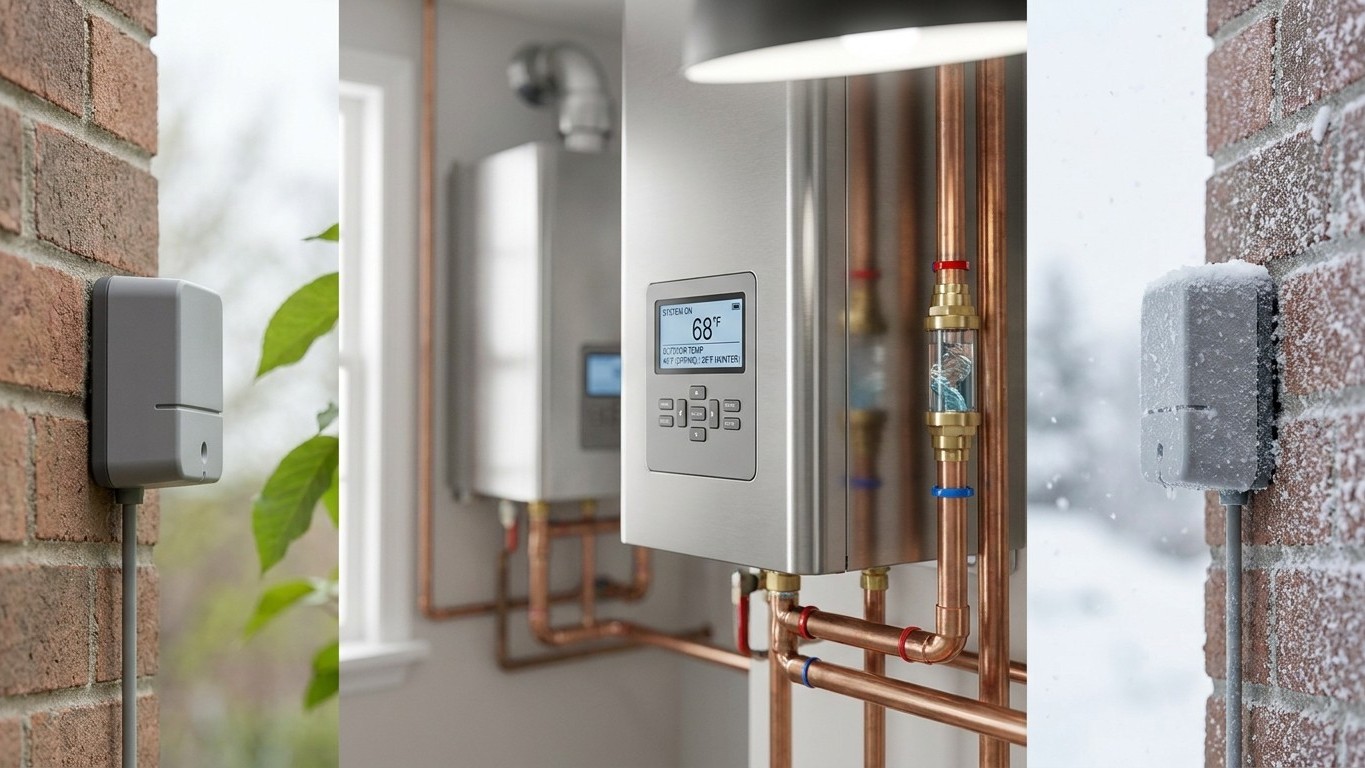

An outdoor reset is a control setting that links a boiler’s water temperature to the temperature outside, so the system sends out only as much heat as the weather actually demands. Most boilers built in the last fifteen years have this function built into the control board. Few homeowners know it exists, and many installers never activate it. Turning it on, and dialing in the right curve for a particular house, costs nothing extra on equipment already installed. It just requires someone to go into the settings and do the work.
Match the water to the weather
Here’s what happens without a reset: the boiler heats water to one fixed supply temperature, say a number the installer typed in on day one, regardless of whether it’s 45 degrees outside or 10 degrees. On a mild afternoon, that water is hotter than the house needs. The boiler fires, satisfies the thermostat fast, then shuts off. Minutes later it fires again. That short-cycling wears on components and rarely lets the system settle into a steady, efficient rhythm.
An outdoor reset changes the math. A small sensor mounted outside feeds the control board a real-time reading. The board then adjusts the supply water temperature along a programmed curve: warmer outside, cooler water; colder outside, hotter water. The house still gets enough heat, but the boiler runs longer at a lower, steadier temperature instead of blasting hot water in short bursts. Longer, gentler run times tend to match how hydronic systems, baseboard and radiant floors especially, actually distribute heat evenly through a room.
Why lower water temperature matters for efficiency
This connects directly to how a boiler is rated. AFUE, the annual fuel utilization efficiency, measures the ratio of a boiler’s annual heat output to the total annual fossil fuel energy it consumes. An AFUE of 90% means 90% of the fuel’s energy becomes heat in the home, and 10% leaves up the flue and elsewhere. On a condensing boiler, that ratio improves when the water returning to the unit is cooler, because the appliance can extract more heat from the flue gases before they exit. Running the boiler hotter than necessary all winter, which is exactly what happens without a reset, works against the very design that makes a high-AFUE unit worth installing in the first place.
The capability itself is common. The configuration is not. A reset curve has to be set for the specific house, the specific radiators or floor loops, and the specific climate zone. Skipping that step doesn’t make the boiler stop working. It just means the equipment spends the season doing more than the weather is asking it to do.
What the research actually says
Federal purchasing guidance offers a useful reference point for what “efficient” means on paper. The U.S. Department of Energy’s Federal Energy Management Program notes that an ENERGY STAR-qualified residential gas boiler meets 0.90 AFUE, and its own worked example compares models rated at 0.84, 0.90, and 0.97 AFUE to illustrate how efficiency tiers stack up.
| AFUE rating | What it means |
|---|---|
| 0.84 | 84% of fuel energy becomes usable heat |
| 0.90 | ENERGY STAR qualifying threshold for residential gas boilers |
| 0.97 | Near-condensing performance, minimal flue loss |
That guidance is written for federal purchasers evaluating procurement decisions across large portfolios of buildings. Its cost-effectiveness comparisons assume federal buying power and federal timelines, not a household weighing a single replacement boiler. It’s a useful way to understand what the AFUE numbers on a spec sheet mean. It is not a shopping guide for a homeowner, and its dollar thresholds shouldn’t be read that way.
The more direct evidence on control settings comes from a separate DOE study, “Optimizing Hydronic Heating for Comfort and Performance.” The researchers put it bluntly: “Unfortunately, control settings are often best guesses and are not typically optimized.” That single sentence describes the exact problem an outdoor reset is meant to fix, a setting configured once, roughly, and never revisited.
The scope matters here, and it’s worth being precise about it. That study examined multifamily buildings and central hydronic systems, the kind of large boiler plant that serves an apartment complex or a shared building system, not a single-family furnace room. Its results, an average gas savings of 11% and a maximum of 33% when settings were optimized, describe what happened in those multifamily systems. Those figures shouldn’t be transposed onto a single house with its own boiler. The underlying finding, that reset settings are frequently left unoptimized, is the transferable part. The specific savings percentages are not.
What to ask a technician
Three questions cover most of what matters when a technician is on site for a service call or a new installation. Does the boiler support outdoor reset. Is an outdoor sensor actually installed, since the control logic is useless without the hardware feeding it real data. And what curve is currently programmed, since a curve set for a different climate zone or a different type of emitter (baseboard versus radiant floor, for instance) won’t perform the way it should for the house it’s serving.
- Does this boiler have outdoor reset capability, and is it currently enabled?
- Is there an outdoor temperature sensor installed and wired to the control board?
- What reset curve is programmed, and was it set for this specific home’s heating system?
- Can the curve be adjusted if rooms run too warm or too cool at certain outdoor temperatures?
There’s a practical reason this setting gets skipped so often. Commissioning a reset curve properly takes time: watching how the house responds over a range of outdoor temperatures, then adjusting the curve accordingly. On a new installation with a tight schedule, that step is easy to defer. And because nothing visibly fails when the reset is left off, factory default, or set to a generic curve, there’s no obvious signal telling the homeowner or the installer that anything needs attention. The boiler still heats the house. It just does so less efficiently than it could.
Don’t lose sight of basic safety while you’re at it
A boiler is a fuel-burning appliance, and that brings the same carbon monoxide precautions that apply to any combustion equipment in the home. CO is colorless and odorless, and a working CO alarm is not optional. An electric boiler, by contrast, burns nothing and doesn’t carry that particular risk. Whatever type of boiler is in the house, the U.S. Fire Administration’s guidance stands regardless of reset settings or efficiency tuning: “Maintain heating equipment and chimneys by having them cleaned and inspected each year by a professional.” A technician visit is also the natural time to bring up outdoor reset, since the same appointment already involves checking the system’s settings and safety components together.
Common questions
Does outdoor reset work with any boiler?
It depends on the control board. Many modern boilers include the logic for outdoor reset as a built-in feature, but older units or stripped-down models may not support it at all. Check the manufacturer’s manual or ask a technician to confirm before assuming the capability exists.
Will outdoor reset lower my heating bill?
It can reduce cycling and help a condensing boiler run closer to its rated efficiency, but no specific savings percentage applies to a single-family home based on current research. The multifamily study cited above measured savings in shared central systems, not individual houses, so those figures aren’t a reliable predictor for a home furnace room.
Can I set the reset curve myself?
Some control boards allow homeowner access to basic settings, but getting the curve right requires understanding the home’s specific heat loss and emitter type. A technician who commissions the system properly, rather than leaving factory defaults in place, is generally worth the visit.
Does a higher AFUE boiler need outdoor reset to perform well?
Higher-AFUE, condensing boilers benefit the most from outdoor reset because their efficiency depends on keeping the return water temperature low enough for the flue gases to condense. Running one hot all season, without a reset, works against the very design that makes it efficient in the first place.