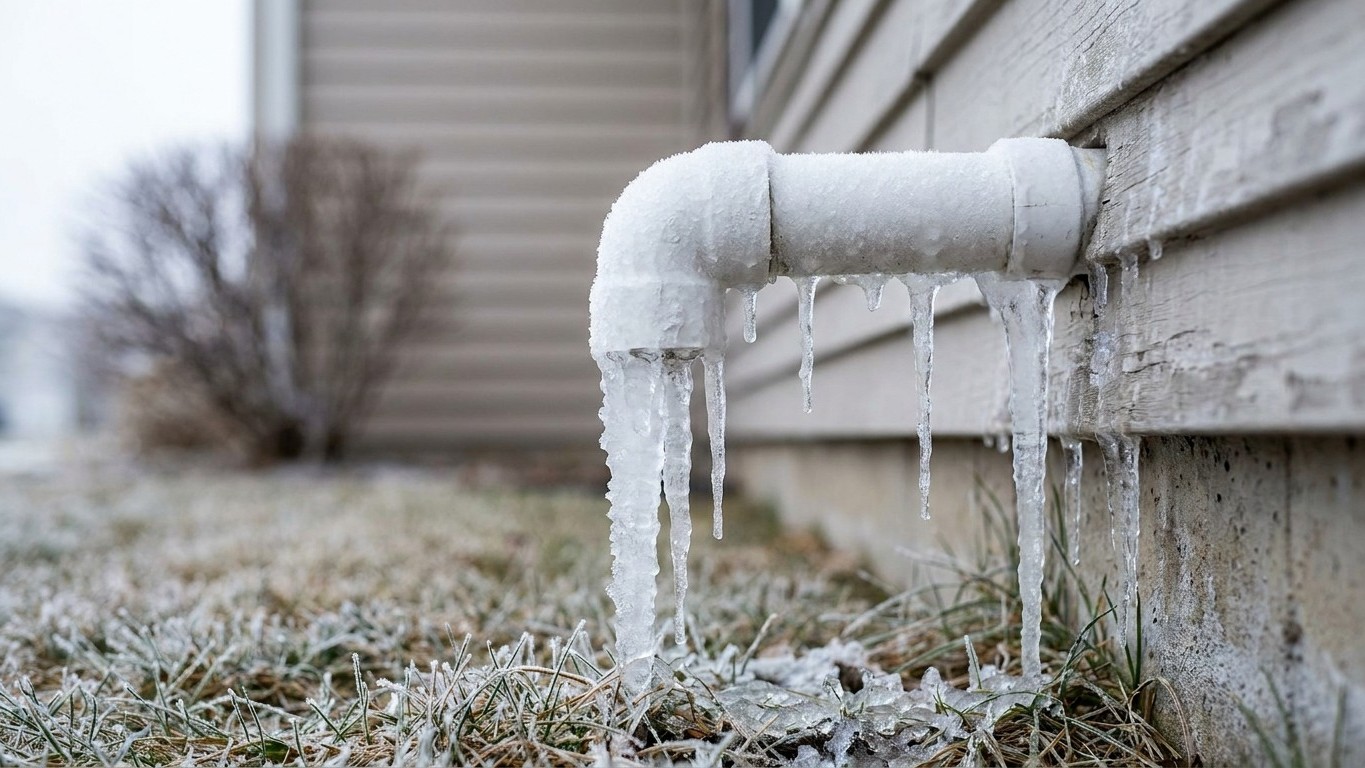

A frozen condensate pipe stops a modern gas boiler cold, usually overnight, usually during the first hard freeze of the season. The fix for the immediate problem is warm water poured along the outside of the blocked section, followed by whatever reset sequence the boiler’s own manual specifies. The fix for next winter is insulation, a wider pipe, or moving the run indoors, work best left to a licensed installer.
A modern boiler drains, and the drain can freeze

Why efficiency creates a drain
High-efficiency gas boilers squeeze more heat out of every therm of fuel than older models did, and that extra heat comes from condensing water vapor out of the flue gases. AFUE, the annual fuel utilization efficiency rating, measures exactly this: the ratio of a boiler’s annual heat output to the total annual fossil fuel energy it consumes. An AFUE of 90% means 90% of the fuel’s energy becomes heat in the home and 10% leaves up the flue and elsewhere. The U.S. Department of Energy’s Federal Energy Management Program notes that an ENERGY STAR-qualified residential gas boiler meets 0.90 AFUE, and its own worked example compares models rated at 0.84, 0.90, and 0.97 AFUE to show how efficiency scales. That guidance is written for federal purchasers weighing procurement costs, not for a homeowner pricing a replacement, but the underlying mechanism applies to any condensing boiler on a residential street.
Condensing the flue gas produces liquid water, mildly acidic, that has to go somewhere. It exits through a small plastic pipe, usually PVC, that runs from the boiler to a drain, a soil stack, or straight outside to a soakaway. That last routing, common in additions and retrofits where an indoor drain wasn’t handy, is the one that freezes.
Why it strikes whole streets at once
This is the failure that clusters. When overnight temperatures drop into the teens or lower across a region, every boiler installed the same way, with the same short run of exposed pipe, the same builder-grade insulation (or none), fails on the same morning. Installers who service a given subdivision often see a dozen calls in a single day after the season’s first deep freeze, all with the identical symptom, because the homes share a construction era and a plumbing pattern. It isn’t a coincidence and it isn’t a sign of a defective unit. It’s geometry and weather intersecting on thousands of nearly identical pipe runs at once.
How to recognize it
What to check first
The boiler will have locked itself out, meaning it stopped firing and is displaying an error rather than attempting to run. Most units show this on a small screen or with a blinking light pattern, and the exact code varies by manufacturer and even by model year, so the manual is the only reliable reference for what that particular sequence means. Resist the urge to assume a code you’ve seen before on a different boiler applies here. The pattern worth noticing, though, is timing: the lockout appears overnight or first thing in the morning, right after a hard freeze, and not during a mild stretch. That timing alone is a strong clue, even before checking the code.
Go outside and find where the condensate pipe exits the house. It’s typically a white or gray plastic pipe, an inch or so in diameter, running a short distance to a drain, gully, or soakaway. Look for ice visible at the termination point, a sagging low spot in the pipe where water pools, or frost built up on the outside of the pipe itself.
The specific signs of a blockage
A gurgling or bubbling sound from inside the pipe, especially right as the boiler tries to fire, is a strong indicator that condensate is backing up against ice rather than draining freely. Some installations include a condensate trap near the boiler that can also freeze if it sits in an unheated space like a garage or basement wall, so the blockage isn’t always outdoors. Because a boiler is a fuel-burning appliance, any lockout tied to a blocked drain also touches on combustion safety, which is why a working carbon monoxide alarm matters in any home with gas equipment. Carbon monoxide has no color and no odor, so an alarm is the only practical way a household detects it, and that holds whether the immediate problem is a frozen pipe or something else entirely. An electric boiler, by contrast, burns nothing and carries no such risk.
Thawing, and preventing
Thawing safely
The standard approach is warm water, not boiling, poured slowly and directly onto the outside of the pipe at the point where ice has formed, working from the boiler end toward the outlet. A hot water bottle, a cloth soaked in warm water, or a kettle of warm (not scalding) water applied gradually all work toward the same goal: melting the blockage without cracking the plastic pipe with a sudden Temperature shock. Boiling water risks exactly that kind of thermal stress on PVC, particularly in already-freezing air, so it’s avoided in favor of warm.
Once the pipe runs clear again, the boiler needs to be reset, and this is where the manual, not general advice, is the authority. No fault code and no reset sequence is universal across manufacturers; some units clear automatically once the fault condition resolves, others need a button held for a specific interval, and getting it wrong on the wrong model can trigger a different lockout entirely. If the pipe won’t clear, or the boiler won’t reset after it does, that’s the point to call a heating engineer rather than keep working at it.
Preventing next winter
A U.S. Department of Energy study on hydronic heating in multifamily buildings, examining central systems rather than single-family boilers, found that “control settings are often best guesses and are not typically optimized.” That finding belongs specifically to multifamily central plants and their savings figures don’t transfer to a house with one boiler, but the broader point, that hydronic systems often run on settings nobody has revisited since installation, is a reasonable prompt to have an installer review a home’s setup rather than assume the original configuration is still the right one.
Preventing a repeat freeze usually comes down to one of a few fixes an installer can make:
- Wrapping the exposed section of pipe in purpose-made pipe insulation or foam lagging
- Replacing a narrow condensate line with a larger-diameter pipe, which holds more water and resists freezing longer
- Re-routing the pipe to drain internally, through a sink trap or an indoor waste line, removing the outdoor exposure entirely
Any of these is a job for a licensed installer, since it involves altering how a fuel-burning appliance disposes of condensate. The U.S. Fire Administration’s broader guidance on heating equipment applies here too: “Maintain heating equipment and chimneys by having them cleaned and inspected each year by a professional.” An annual visit is also the moment to flag a condensate pipe that’s frozen before, so it gets insulated or rerouted before the next cold snap rather than after.
Common questions
Does every boiler lockout in cold weather mean a frozen condensate pipe?
Not necessarily. Ignition faults, low pressure, and thermostat issues can all produce a lockout too, and each shows a different code. A frozen pipe is the likely cause when the lockout coincides with a hard freeze and the boiler was working fine the day before, but the display code, checked against the manual, is the way to confirm it.
Can I use a hairdryer or space heater to thaw the pipe faster?
A hairdryer on a low setting, held a short distance from the pipe, is sometimes used alongside warm water, but open flames, blowtorches, or anything that heats the plastic pipe unevenly and quickly should be avoided, since PVC can warp or crack under sudden, uneven heat.
Is a frozen condensate pipe a carbon monoxide risk on its own?
The lockout itself is the safety system doing its job, since the boiler stops firing rather than continuing to burn fuel with a blocked drain. The broader point still stands for any gas appliance in the home: carbon monoxide is colorless and odorless, and a working alarm is the practical way a household would ever know if a combustion problem were producing it.
How do I stop this from happening every winter?
Have an installer look at the pipe’s route and diameter before the cold sets in, not after the first freeze. Insulating the exposed section, upsizing the pipe, or moving the run indoors are the standard fixes, and raising it during the annual inspection the U.S. Fire Administration recommends is the natural time to get it done.