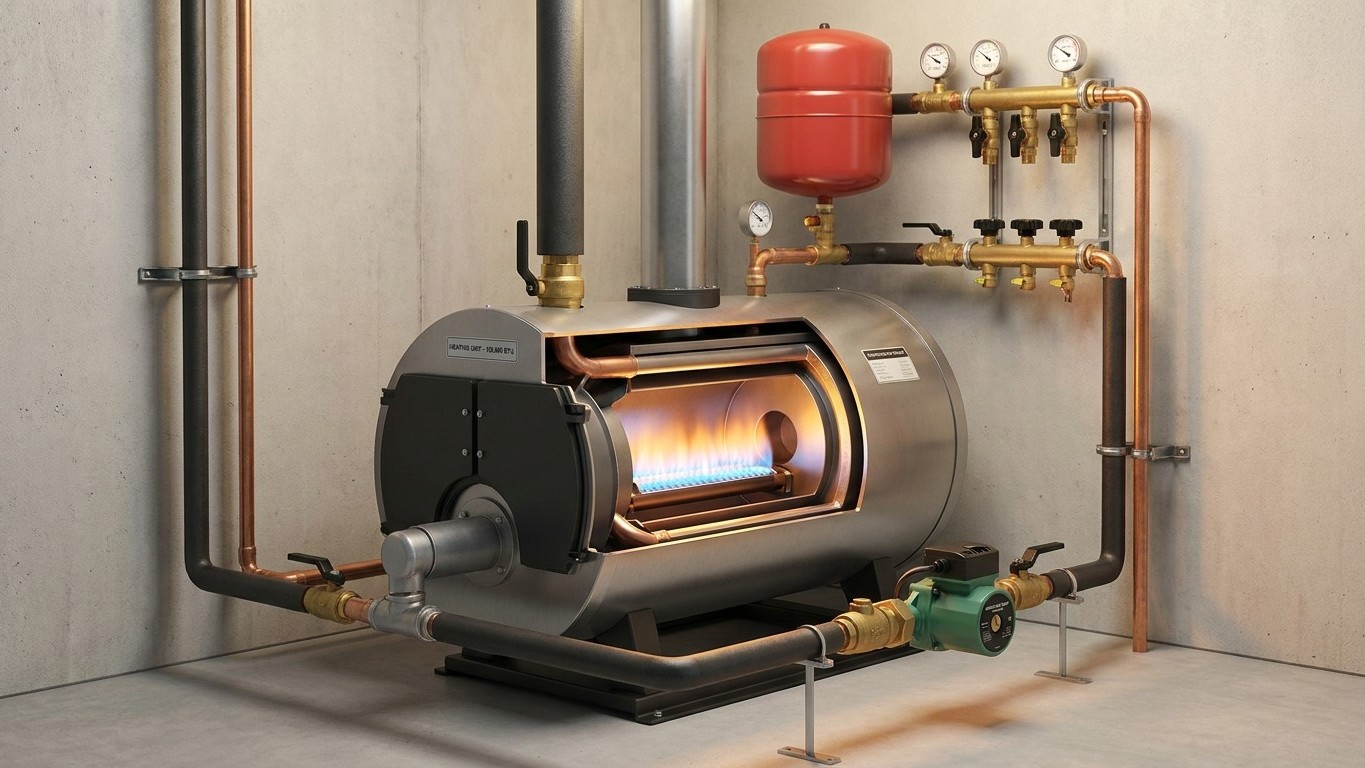

A boiler doesn’t blow hot air through your house. It heats water, keeps that water moving through a sealed loop of pipes, and lets radiators, baseboard, or floor tubing pull the heat out room by room. The burner (or electric element) has one job: hold that circulating water at whatever Temperature the thermostat is asking for. Everything else in the system, the pump, the valves, the tank that absorbs pressure, exists to move that same water around and send it back for reheating.
The same water, going round

Here’s the detail that trips up a lot of homeowners moving from a furnace to a boiler, or buying a house that already has one: the water inside a hydronic system is not consumed. It’s not like the Water Heater in the basement, filling and refilling as you shower and do dishes. A boiler’s water fills the loop once, gets sealed in, and stays there, cycling through the same pipes for years. It gets hot, gives up heat at the radiators or baseboard, comes back cooler, and gets hot again. The only thing the system actually uses up is fuel, whether that’s natural gas, propane, oil, or electricity.
Five parts do the work. The boiler itself is the heat source, a sealed vessel with a burner or electric element that raises the water temperature. The circulator is a small pump, usually mounted on a pipe near the boiler, that pushes the water through the loop; without it, the water would just sit there getting hot with nowhere to go. The expansion tank handles a basic physics problem: water expands when it’s heated, and in a sealed loop that expansion has to go somewhere or pressure builds dangerously. The tank gives the water room to expand without stressing the pipes. Zone valves act like traffic gates, opening to send hot water to one part of the house (say, the upstairs bedrooms) while keeping it out of another zone that isn’t calling for heat. And the emitters, whatever form they take, are where the water finally gives up its heat to the room.
None of that resembles a furnace. A furnace burns fuel to heat air directly, then a blower forces that air through a network of ducts and out through registers in the floor or wall. A boiler never heats air at all. It heats water, and it’s the water, not moving air, that carries the heat to each room. That’s why a house with a furnace has ductwork running through the attic or basement, while a house with a boiler has pipes, and why the two systems feel different to live with: one delivers a blast of warm air on a cycle, the other keeps surfaces steadily warm.
Where the heat leaves the water
Once the water is hot and moving, it has to hand that heat off somewhere, and that’s the distribution side of the system rather than the generation side this page is focused on. Three approaches dominate in American homes, and each has its own installation logic, response time, and maintenance quirks worth understanding on their own.
Cast-iron and panel radiators are the classic answer: a metal body filled with hot water, radiating heat into the room by both direct radiation and natural convection off its surface. Hydronic baseboard runs along the base of exterior walls, using a copper pipe with metal fins to shed heat as air moves past it, which is why furniture placement in front of a baseboard unit matters more than people expect. Radiant floor systems bury the tubing in or under the floor itself, turning the whole surface into a low, even heat source rather than relying on a single fixture in the room.
Each of these has enough going on, in sizing, placement, and troubleshooting, to deserve its own explanation rather than a few lines here. The mechanism that matters for this page is simpler: whichever emitter a house uses, it’s drawing heat from the same hot water the boiler just produced, and sending that water back cooler to be reheated. The choice of radiator, baseboard, or radiant floor changes comfort and response time, but it doesn’t change what the boiler itself is doing upstream. If you’re deciding between them or troubleshooting one already installed, the radiator and baseboard pages on this site go into that distribution side in the depth it deserves.
What decides when it fires
The boiler doesn’t run constantly, and it doesn’t run on a fixed schedule either. It runs because something asked it to. A thermostat in a given zone senses the room has cooled below its setting and closes an electrical circuit. That signal opens the zone valve for that area of the house, starts the circulator moving water through it, and tells the boiler’s control board to fire the burner. The burner keeps running, and the circulator keeps pumping, until the water reaches a target temperature, or until the thermostat is satisfied and calls for the cycle to stop.
That target water temperature is a setting, not a fixed law of the system, and it’s the single number that most affects both how comfortable the house feels and how much fuel gets burned to keep it that way. A boiler holding water hotter than a house actually needs on a mild day is spending fuel it didn’t have to spend. This is exactly the ground covered on this site’s reset-curve page, which explains how modern controls adjust that target temperature automatically based on outdoor conditions rather than holding one number all winter.
It’s tempting to assume these settings are dialed in precisely by an installer and left that way for good reason. The U.S. Department of Energy’s study “Optimizing Hydronic Heating for Comfort and Performance,” which looked at multifamily buildings and central hydronic systems, found otherwise: “Unfortunately, control settings are often best guesses and are not typically optimized.” That’s a federally documented gap between what a system is capable of and how it’s actually set up and left running, and while that particular study’s building type and savings figures don’t transfer directly to a single-family home, the underlying point does: the water temperature setting is worth understanding, not just accepting as factory default.
Fuel efficiency itself is measured by a number called AFUE, the ratio of a boiler’s annual heat output to the total annual fossil fuel energy it consumes. An AFUE of 90% means 90% of the fuel’s energy becomes heat in the home, and the other 10% leaves up the flue and elsewhere. The U.S. Department of Energy’s Federal Energy Management Program, which writes purchasing guidance for federal buyers rather than homeowners, sets an ENERGY STAR-qualified residential gas boiler at 0.90 AFUE, and its own worked example compares models at 0.84, 0.90, and 0.97 AFUE. That comparison and its cost-effectiveness thresholds were built for federal procurement decisions, not for a household weighing a replacement boiler, so treat the AFUE number itself as useful and the dollar math around it as somebody else’s budget.
Because a boiler is a fuel-burning appliance (unless it’s an electric model, which burns nothing at all), it carries the same carbon monoxide risk as any furnace or gas water heater. CO is colorless and odorless, which is precisely why a working CO alarm in the home is not optional. Annual attention matters too. The U.S. Fire Administration’s advice is direct: “Maintain heating equipment and chimneys by having them cleaned and inspected each year by a professional.” For exact pressure, temperature setpoint, or clearance numbers specific to your unit, the appliance’s own label and installation manual are the authority, and your local code office is the final word on what’s required in your jurisdiction.
Common questions
Does a boiler heat the air in my house directly?
No. A boiler heats water, and that hot water is what carries heat to radiators, baseboard, or radiant floor tubing. Air in the room warms up because it’s near a hot emitter, not because the boiler blew it through a duct.
Why doesn’t my boiler run all the time in winter?
It’s cycling in response to thermostat calls, not running on a fixed clock. Once the water in a given zone reaches its target temperature and the thermostat is satisfied, the burner and circulator for that zone shut off until heat is called for again.
Is the water in a boiler the same water I use in the shower?
No, in a standard heating boiler the loop water is entirely separate from your household hot water supply. It’s sealed in and reused for heating only. Combination boilers that also produce domestic hot water use a separate heat exchanger to keep the two apart.
Do I need a carbon monoxide alarm with a boiler?
If it burns gas, propane, or oil, yes. It’s a fuel-burning appliance producing the same colorless, odorless CO risk as any furnace, and a working alarm is essential. An electric boiler, which burns no fuel, doesn’t carry that same combustion byproduct risk.