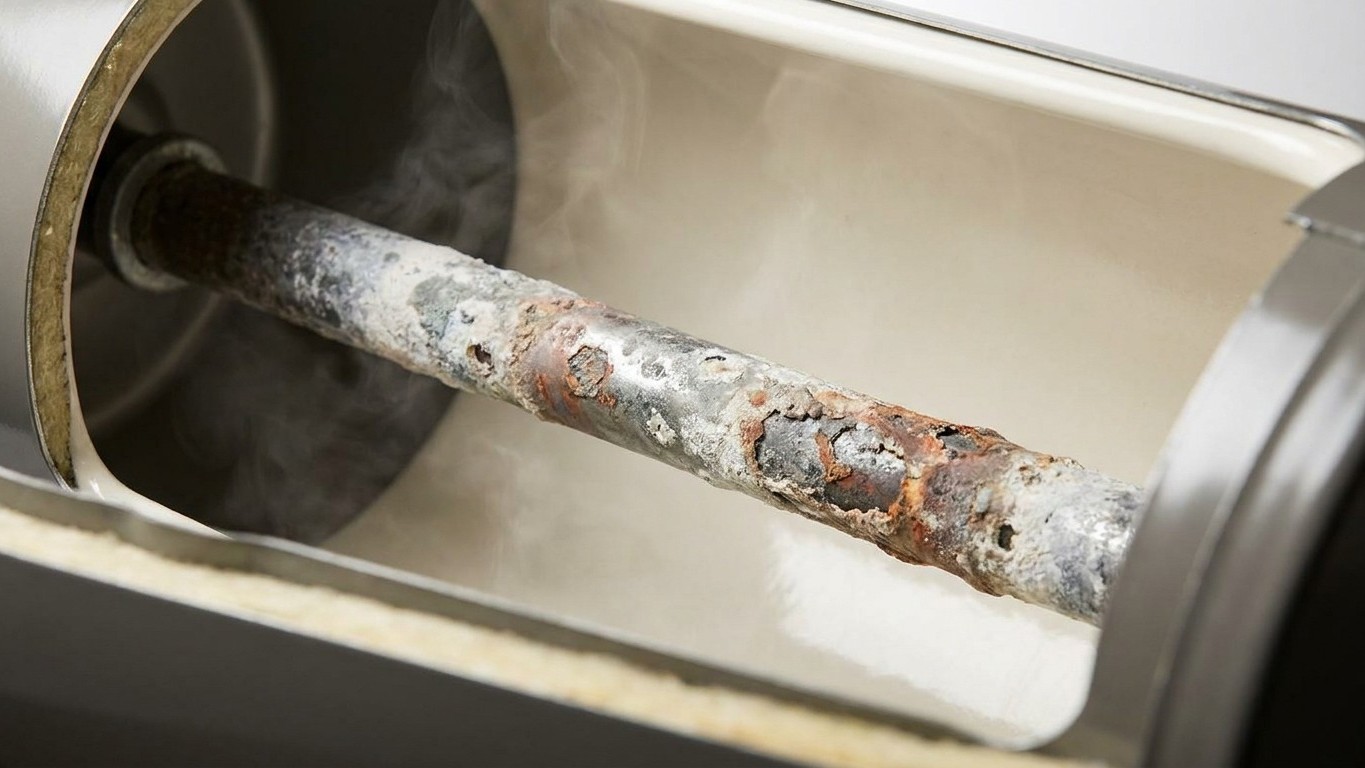

The anode rod is a rod of reactive metal, usually magnesium or aluminum, suspended inside a water heater tank. Its whole purpose is to corrode first. As long as it keeps sacrificing itself, the steel tank around it stays intact. Once the rod is used up, the tank has no more protection, and rust starts eating the steel itself. Replacing a spent rod is one of the few repairs that can add years to a water heater for the cost of a single part.
It corrodes so the tank does not

Every residential water heater tank is steel with a thin glass, or porcelain-like, lining baked onto the inside. That lining is what keeps hot water from sitting directly against bare metal. But no lining is perfect. Manufacturing leaves microscopic gaps, hairline cracks form as the tank heats and cools thousands of times, and welds are especially prone to pinholes. Wherever the lining fails, water touches steel, and steel in contact with water and dissolved minerals corrodes.
This is where the anode rod earns its keep. Because it’s made of a metal more electrochemically reactive than steel, it becomes the preferred target for that corrosion process, in what’s essentially a controlled galvanic reaction. Electrons flow from the rod to the tank, the rod slowly dissolves, and the steel is left alone. It’s a sacrifice built into the design on purpose, and it’s the reason a tank that should corrode from day one instead lasts for years.
Temperature plays a role in how fast that sacrifice happens. Hotter water speeds up the chemical reactions at the rod’s surface, which means a tank running hot consumes its anode faster than one kept moderate. The Department of Energy recommends setting a water heater thermostat to 120°F, a level it describes as comfortable for most household uses. That number is presented as a compromise: lower settings save energy and reduce the risk of scald injuries, while higher settings do the opposite on both counts. There’s a real trade-off buried in that recommendation, too. Water stored too cool is a recognized concern for bacterial growth, including Legionella, so households with infants, elderly residents, or anyone with a compromised immune system should raise the question with their doctor or their local water utility rather than guess.
Water heating isn’t a minor line item either. The DOE puts it at roughly 14% to 25% of the energy consumed in a typical home, depending on the household and the equipment. Given how much of a home’s energy bill runs through that tank, a part costing far less than a service call, and doing the one job that determines whether the tank survives, is about as cost-effective as home maintenance gets. It’s also one of the least performed. Most homeowners never open the access point, and most contractors only get called once the tank is already leaking, past the point where an anode rod would have mattered.
Checking and replacing it
On most residential tanks, the anode rod sits at the top, either under its own dedicated hex-head plug or, on some models, combined with the hot water outlet fitting. A tape measure held against the tank’s total height gives a rough idea of how much clearance is needed above the unit to draw the rod straight out; in tight utility closets or low basements, that clearance sometimes isn’t there, which is why segmented, flexible anode rods exist for cramped installations.
Tools and access
Pulling the rod itself calls for a socket wrench with a long breaker bar, or an impact wrench where one’s available, since factory-installed rods are often torqued down tight and can seize further over years of mineral buildup and corrosion at the threads. A rod that has never been removed since the tank was installed is a common source of frustration: the hex head can round off, or the rod can shear inside the fitting. Penetrating oil, patience, and a socket that fits snugly, rather than one that’s slightly worn, all help avoid that outcome. Before touching anything, shutting off power to an electric unit, or the gas or propane supply to a fuel-burning one, and draining several gallons from the tank to relieve pressure, are standard precautions.
Gas and propane water heaters are fuel-burning appliances, which means the same carbon monoxide precautions that apply to any combustion equipment apply here: CO is colorless and odorless, and a working CO alarm in the home is not optional. Electric and heat pump water heaters don’t burn fuel and don’t carry that particular risk, though heat pump units still use a conventional storage tank with its own anode rod inside, following amended federal efficiency standards that brought common electric storage water heaters up toward the efficiency level of an entry-level heat pump water heater. The tank and the sacrificial rod inside it work the same way regardless of what heats the water.
What a spent rod looks like
Once out, the difference between a healthy rod and a spent one is visible. A rod with life left in it still has a reasonably straight, thick core with an even layer of metal around it. A spent rod is a different picture entirely:
- A thin steel core wire exposed along most of its length, with the surrounding magnesium or aluminum eaten away
- Heavy calcium or mineral crust clinging to what’s left
- Sections that have broken off entirely, leaving bare wire dangling in the tank
- A rod less than about half its original diameter
There’s no fixed number of years to schedule this by, because consumption rate depends heavily on local water chemistry (soft water tends to be harder on rods than hard water) and on how much hot water the household actually uses. A tank feeding a family of five runs through anode material faster than one in a house occupied a few days a month. Pulling the rod for a look, rather than guessing on a calendar, is the only reliable way to know where it stands.
The rotten-egg smell
A sulfur odor that shows up only in hot water, and never in cold water from the same faucet, almost always traces back to a reaction happening at the anode rod. Certain water supplies contain sulfate-reducing bacteria that, under specific conditions, convert sulfate into hydrogen sulfide gas, the compound responsible for that classic rotten-egg smell. The magnesium commonly used in anode rods can accelerate that reaction chemically, which is why the smell often appears after a tank has been sitting a while, and why it’s frequently traced to well water rather than municipal supply, though it can occur with either.
This is a water chemistry issue, not evidence that anything is broken or unsafe in the plumbing itself. The tank is doing exactly what it’s designed to do; the anode is reacting with the water exactly as anodes do. The smell is simply a byproduct of a specific mix of minerals, bacteria, and metal that happens to be present in that particular water supply, which is why identical water heaters in different houses, or even different parts of the same town, can behave completely differently.
What actually changes it
Because the reaction is tied to the type of metal in the rod, swapping the anode is usually the first thing tried. Replacing a magnesium rod with an aluminum or zinc-aluminum alloy rod often reduces or eliminates the smell, since it changes the chemistry driving the bacterial reaction. Where that’s not enough, a powered anode rod, which uses a small electric current rather than a sacrificial metal to protect the tank, sidesteps the reaction altogether because there’s no reactive metal dissolving into the water in the first place. On well water systems, some households also address the bacteria at the source through periodic chlorination of the well, which tackles the root cause rather than the symptom at the tank.
Raising the thermostat is sometimes suggested as a workaround, since higher temperatures can suppress the bacteria responsible, but that runs directly against the DOE’s 120°F recommendation and increases both energy use and scald risk, so it’s worth weighing against a rod swap before adjusting the setting. Whichever route is chosen, the smell itself isn’t a sign of contamination reaching household water in a way that public health guidance treats as dangerous; it’s a nuisance rooted in local water chemistry, and one with a handful of practical fixes rather than one universal answer.
Common questions
Can a water heater run without an anode rod at all?
It can run, but the tank has lost its sacrificial protection, so corrosion moves directly to the steel. It’s the fastest route to a leaking tank and an early replacement.
Does every water heater have an anode rod?
Nearly all storage tank models do, whether gas, electric, propane, or heat pump, because all of them use a steel tank with a glass lining that needs the same protection. Tankless units don’t have one, since they don’t store water in a lined tank.
Is a powered anode rod worth it over a standard sacrificial one?
It depends on the water and the household’s priorities. A powered anode doesn’t dissolve, so it can address sulfur odors and last longer, but it requires a nearby power outlet and typically costs more upfront than a standard rod.
Should the thermostat be lowered to protect the anode rod longer?
Lowering it toward the DOE’s suggested 120°F does slow anode consumption and cuts energy use, but stored water kept too cool is a recognized concern for bacterial growth, so households with vulnerable occupants should check with their doctor or water utility rather than adjust the setting purely to extend rod life.