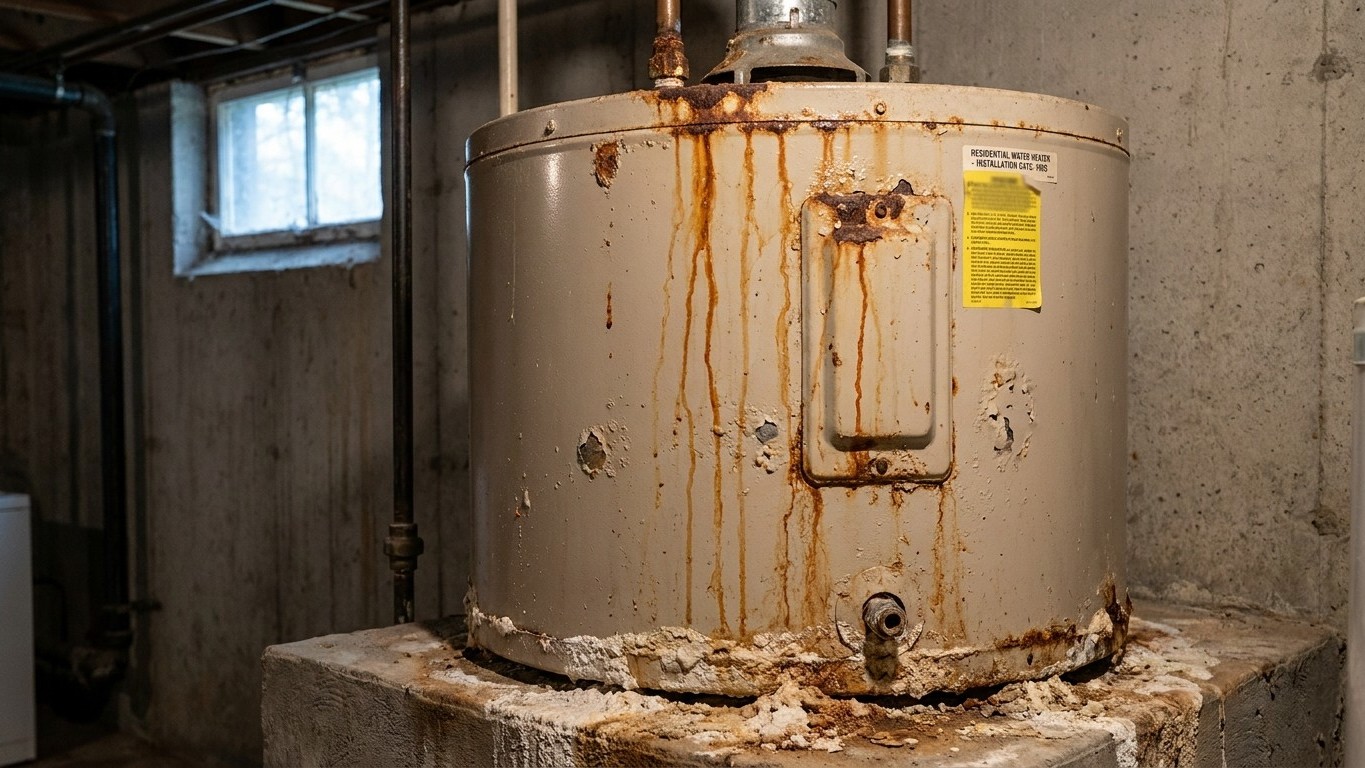

There’s no countdown timer on a water heater. Some tanks fail at seven years, others are still delivering hot showers well past twenty, and the difference has almost nothing to do with age itself. It comes down to what’s happening inside the tank: the water chemistry running through it, the Temperature it’s held at, how much sediment has settled on the bottom, and whether anyone ever swapped out the one part designed to sacrifice itself first. Skip the birthday math. Watch the tank instead.
Tanks die of corrosion, not of age

A standard storage tank is steel with a glass or enamel lining, and that lining is never perfect. Microscopic gaps let water reach bare metal, and that’s where a sacrificial anode rod comes in, usually magnesium or aluminum, wired to corrode before the tank itself does. As long as the anode has material left, it takes the chemical hit. Once it’s consumed, usually after several years of active use, the tank’s steel becomes the next target. A tank that fails prematurely almost always failed because nobody ever pulled the anode rod to check it, let alone replaced it.
Water chemistry decides how fast that clock runs. Soft water, which has had calcium and magnesium stripped out, is more aggressive toward the anode and consumes it faster than hard water does. Homes on well water with high mineral or chloride content can see accelerated corrosion too. None of this is visible from outside the tank, which is part of why so many homeowners are surprised when a heater fails years earlier than a neighbor’s identical unit.
Temperature, sediment, and a real trade-off
Sediment is the other silent factor. Minerals settle to the bottom of the tank over time, and that layer insulates the lowest section from the heating element or burner. The metal underneath runs hotter than it should, corrodes faster in that spot, and the tank starts making popping or rumbling sounds as trapped water works through the debris.
Temperature setting matters here too, and it’s genuinely a two-sided decision. The U.S. Department of Energy recommends setting a water heater’s thermostat to 120°F, describing that as comfortable for most household uses. Lower settings save energy and reduce scald risk for kids and older adults. But stored water held too cool is a recognized concern for bacterial growth, including legionella, so this isn’t a settle-it-once-and-forget-it dial. Households with infants, elderly residents, or anyone immunocompromised should raise the question with their doctor or their local water utility rather than guessing. Water heating isn’t a minor line item either: the DOE estimates it accounts for roughly 14% to 25% of the energy used in a typical home, so the setting you choose shows up on the bill either way.
The signals that it is ending
A failing tank rarely goes quiet about it. The signs tend to show up in a fairly predictable order, and catching them early is the difference between a planned replacement and a flooded utility closet.
- Rusty hot water. If cold water runs clear but hot water comes out tinted brown or orange, the corrosion has likely reached the tank’s interior surface, not just old pipes. Run a few gallons to rule out pipe rust first, but if the color persists specifically on the hot side, the tank is the suspect.
- Damp or staining at the base. A puddle, a rust ring on the floor, or a musty smell near the unit points to a slow leak working its way through a corroded seam. This is one of the clearest warning signs there is, and it deserves immediate attention rather than a wait-and-see approach; a closer look at what counts as active water heater leaking versus normal condensation can help sort out how urgent it is.
- A tank that no longer holds temperature. Showers turning lukewarm faster than they used to, or a dishwasher cycle that suddenly needs a boost, often means a failing heating element, a dying thermostat, or heavy sediment blocking efficient heat transfer.
- Noises that appeared and stayed. An occasional tick as metal expands is normal. Popping, cracking, or rumbling that shows up regularly and doesn’t go away after a flush usually means sediment has built up enough to insulate the tank bottom, and that’s covered in more depth in our guide to water heater noises.
Any one of these on its own is worth a look. Two or more together, especially rust plus dampness, is a strong signal that replacement planning should start now, not after the next symptom shows up.
Replacing before it fails
Here’s the part nobody wants to think about: a tank doesn’t fail quietly. It fails by emptying itself, and gravity generally sends that water toward a floor, a finished basement, or whatever drywall happens to be nearby. The homeowners who end up with the fewest good options are the ones who wait for that moment, because at that point the replacement gets chosen by whichever plumber can show up the same day, not by whoever offers the best fit for the house.
What a calmer replacement looks like
Planning ahead means there’s actually time to compare options instead of grabbing whatever’s in stock. That includes deciding between tank and tankless, gas and electric, or a heat pump water heater, a comparison worth walking through in our guide to water heater types, and it means getting the capacity right the first time by checking household demand against our water heater sizing guidance rather than matching whatever size is already installed.
It’s also worth knowing the market has shifted under this decision. Amended federal efficiency standards now bring common electric storage water heaters up to roughly the efficiency level of an entry-level heat pump water heater, which changes the calculus for anyone whose old electric tank is on its way out. That’s a meaningful shift in what “replacing like for like” even means for these units.
One more distinction matters when comparing options: a gas or propane Water Heater Is a fuel-burning appliance, which means it produces carbon monoxide, a gas with no color and no smell. That’s not a reason to avoid gas units, but it does mean a working CO alarm near the unit is non-negotiable, full stop. An electric or heat pump water heater burns no fuel and carries no such risk. Either way, the appliance’s own label and installation manual govern the specifics, and the local code office remains the authority on what’s required in a given jurisdiction.
Common questions
Does flushing the tank every year actually extend its life?
Removing sediment reduces the insulating layer that causes localized overheating and corrosion at the tank’s bottom, so regular flushing addresses one of the real mechanisms behind early failure. It won’t fix a spent anode rod, but it removes one major stressor on the tank.
Should I lower the thermostat to save energy even if it’s set higher right now?
It’s worth considering, since the DOE recommendation of 120°F balances energy savings and scald safety for most households. But because stored water that’s too cool is a recognized concern for bacterial growth, anyone with vulnerable household members should check with their doctor or water utility before changing the setting.
Can I tell how much anode rod is left without draining the whole tank?
Not from the outside. The rod threads into the top of the tank and has to be removed to inspect wear, which usually means shutting off water and power or gas first. It’s a straightforward maintenance task, but it does require getting physical access to the fitting, not just looking at the unit.
Is a rusty smell in hot water the same warning as rusty color?
Not necessarily. Smell can come from bacterial activity in the tank or from a magnesium anode reacting with certain water chemistries, while visible rust color points more directly toward corrosion of the tank or pipes. Either symptom is worth investigating rather than ignoring, but they don’t automatically mean the same underlying problem.