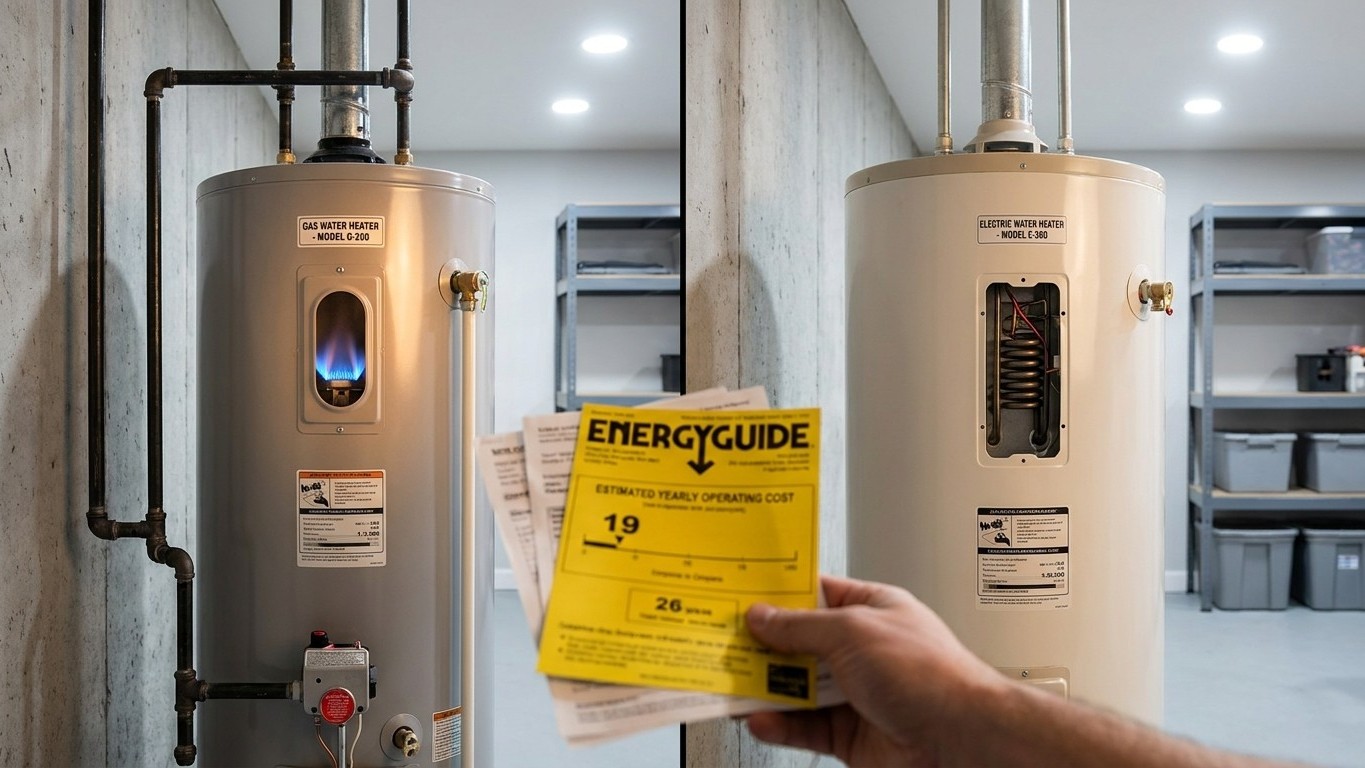

Neither fuel wins outright. Gas typically costs less per unit of heat delivered, while electric units waste less of what they draw simply moving heat into water. Which one actually saves you money depends on what your utility charges for a therm of gas and a kilowatt-hour of electricity in your own zip code, not on a national average. The bigger day-to-day difference isn’t cost at all: it’s how fast the tank recovers, and what a flame in your basement or closet requires that an electric element never does.
Which costs less depends on your two prices
Every water heater comparison starts with a mismatch. A gas storage tank burns fuel that’s priced by the therm, and a fair amount of that heat escapes up the flue before it ever reaches the water. An electric storage tank converts nearly all the energy it draws into hot water, but electricity itself is priced per kilowatt-hour, a unit that costs more per equivalent unit of heat almost everywhere in the country. Put those two facts side by side and you get a wash that only your own bills can settle.
The workable method is simple, and it doesn’t require a spreadsheet from a manufacturer. Pull your last twelve months of gas and electric statements. Find the rate per therm on the gas bill and the rate per kilowatt-hour on the electric bill. Then look at the efficiency rating on the water heater’s yellow EnergyGuide label, the one every unit sold in the U.S. carries. That label estimates annual energy use in the units specific to that fuel, so you’re not comparing therms to kilowatt-hours directly, you’re comparing two separate dollar estimates built from your local rates.
Why the “usually” matters
Gas usually comes out cheaper to operate month to month, which is why so many households default to it without a second look. But usually isn’t always. Utilities in some regions price electricity aggressively for off-peak use, and some households qualify for time-of-use plans that make electric storage tanks, especially newer high-efficiency ones, competitive or better. The Department of Energy notes that water heating accounts for roughly 14% to 25% of the energy consumed in a typical home, which means this single appliance is one of the few places where a rate-plan quirk can move your total utility spending in a noticeable way.
There’s also a federal wrinkle worth knowing before you shop. Amended federal efficiency standards have pushed common electric storage water heaters, the kind installed in most single-family homes for decades, up to the efficiency level of an entry-level heat pump water heater. That’s a meaningful jump in how much of the electricity drawn actually becomes hot water, and it narrows the gap with gas more than older comparisons suggest. If the last time you priced water heaters was years ago, the electric side of the math has changed since then.
Recovery rate is where gas wins
Cost per gallon of hot water is one question. How fast that gallon shows back up is another, and it’s the one that actually affects your morning. Recovery rate measures how quickly a tank reheats incoming cold water to your set Temperature, and a gas burner simply pushes more heat into the tank per hour than a standard electric element does. That’s why a household running back-to-back showers, a load of laundry, and a dishwasher in the same ninety minutes tends to notice gas tanks keep up better.
The mechanism is straightforward. Gas heats the water through a burner and heat exchanger that can be sized to deliver a large heat input quickly, then vents its combustion byproducts out through a flue. An electric element sits directly in the tank and is limited by how much current it can safely draw, which caps how fast it can push heat into the water regardless of how well-insulated the tank is. Neither design is broken; they just recover on different timelines, and a home with heavy simultaneous hot water demand will feel that gap in a way a gas-versus-electric cost comparison never captures.
Electric can close the gap, differently
This is where tank size becomes the real lever instead of fuel type. A larger electric storage tank holds more hot water in reserve, so instead of recovering fast, it simply has more volume to draw down before anyone notices a shortfall. A household that outgrew a smaller electric tank often solves the exact same recovery complaint by moving up a size rather than switching fuels. That’s a sizing decision, not a fuel decision, and it belongs on its own page rather than folded into this cost-versus-recovery conversation, but it’s worth knowing the fix exists before assuming gas is the only route to keeping up with demand.
One more factor sits underneath all of this: the thermostat setting. The Department of Energy recommends 120°F as comfortable for most household uses, and that number is a compromise, not a fixed rule. Set it lower and you save energy and reduce scald risk; set it higher and both go up together. Recovery rate calculations and cost estimates on any manufacturer’s label assume a set temperature, so changing that dial changes both numbers, on gas and electric alike.
Combustion, venting and CO
Choosing gas means choosing a fuel-burning appliance, and that comes with obligations an electric tank simply doesn’t have. A gas or propane water heater needs a flue to exhaust combustion byproducts outside the home and a reliable supply of combustion air to keep burning cleanly. Both of those requirements are why gas water heaters get installed in specific locations, vented specific ways, and inspected against specific clearances that a local code office enforces, not a national one-size rule.
The byproduct that matters most is carbon monoxide, and it’s exactly as serious here as it is with a furnace or a gas range. CO is colorless and odorless, which means a malfunctioning flue, a blocked vent, or a cracked heat exchanger can let it into the living space with no smell to warn anyone. That’s why a working carbon monoxide alarm near a gas water heater’s installation area isn’t optional caution, it’s a baseline safety measure the same way it is for any combustion appliance in the home. For the full rundown on how these alarms work, where to place them, and what symptoms of exposure look like, see this site’s dedicated carbon monoxide page.
An electric or heat pump water heater sidesteps this entirely. There’s no flame, no flue, no combustion air requirement, and no CO risk from the unit itself. That doesn’t make electric automatically the safer overall choice for every home, gas appliances operate safely in millions of houses when installed and vented correctly, but it does mean the ongoing maintenance checklist is shorter with electric: no annual venting inspection, no need to confirm makeup air is reaching the appliance, one less carbon monoxide source to account for in a home that may already have a furnace or stove doing the same job.
Common questions
Is a heat pump water heater the same as electric?
It runs on electricity but works differently than a standard electric storage tank. Instead of using resistance elements to generate heat directly, it moves heat from the surrounding air into the water, which is why amended federal standards now measure common electric storage tanks against an entry-level heat pump unit’s efficiency as the benchmark.
Does lowering the thermostat to 120°F risk bacterial growth?
It’s a real trade-off, not a myth. Lower temperatures save energy and reduce scald risk, but stored water held too cool is a recognized concern for bacterial growth, including Legionella. No single threshold applies to every household, so anyone with an infant, an elderly resident, or someone with a compromised immune system should ask their doctor or their local water utility for guidance specific to their situation rather than guessing at a number.
Can I switch from gas to electric without major renovation?
It depends on what’s already in the space. You’ll need adequate electrical capacity, typically a dedicated circuit sized for the new unit, and if you’re removing a gas line, that needs to be capped and inspected by a qualified professional. A local licensed installer or your code office can tell you quickly whether your electrical panel and wiring can support the switch without a larger rewiring project.
Does a tankless water heater change this comparison?
Tankless units, whether gas or electric, follow the same fuel logic described here: gas tankless models still need venting and carry the same CO considerations, and electric tankless models still draw more current relative to their output than a heat pump tank does. The tank-versus-recovery dynamics shift because there’s no stored volume to draw down, but the underlying fuel cost and combustion safety questions stay the same.