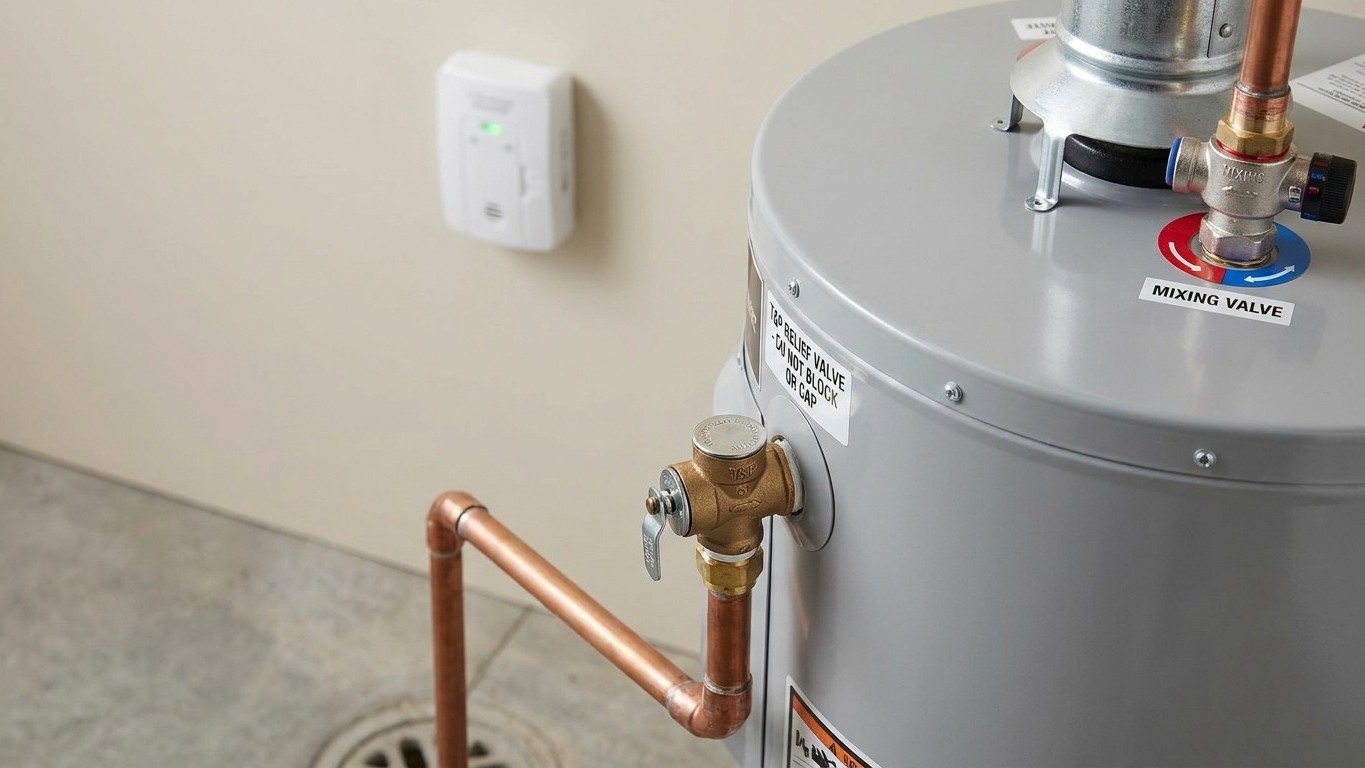

Every water heater ships with safety devices that do their job silently, until the moment they’re asked to prevent something worse. A Temperature and pressure relief valve keeps a tank from turning into a pressure vessel. A mixing valve, where one is installed, keeps scalding water away from a showerhead. And on any gas or propane unit, a working carbon monoxide alarm catches the one hazard the appliance can’t announce on its own. None of these devices is optional gear. Each protects against a specific failure, and each depends on being left alone to do its work.
The T&P valve, and why it must stay free
The temperature and pressure relief valve, usually called the T&P valve, sits near the top of the tank and does one job: it opens automatically if internal pressure or temperature climbs past a safe threshold. A water heater tank holds water under pressure and heats it in a closed space. If that pressure has nowhere to go, the tank itself becomes the outlet, and that failure mode is violent rather than gradual. The T&P valve exists to release pressure before the tank has to.
Attached to the valve is a discharge pipe, and this pipe is not a minor detail. It has to run downward, without upward loops or long horizontal runs that could trap water or steam, and it needs to end somewhere that discharging hot water can’t scald anyone or damage anything, typically a floor drain, a safe pan, or an exterior point low enough to drain by gravity. The pipe’s diameter matters too. A discharge line that’s undersized, kinked, or routed uphill defeats the purpose of the valve even when the valve itself is functioning correctly.
What never to do to this valve
Homeowners occasionally cap a dripping T&P valve, plug the discharge pipe, or swap in a smaller fitting because the original pipe looks oversized. Every one of these is a serious mistake. A capped or plugged T&P valve can’t relieve pressure at all, which removes the tank’s last line of defense. A reduced-diameter pipe can restrict flow at the exact moment full flow is needed. If the valve is dripping or discharging on its own, that’s a signal something upstream, often the thermostat or the pressure in the supply line, needs attention. The fix is diagnosing the cause, never blocking the symptom.
The valve’s own label and the water heater’s manual specify how it should be tested and how often, and that schedule is worth following rather than guessing at. If a valve won’t reseat after testing, or discharges continuously, that’s a call for a plumber, not a project for improvised parts from a hardware store bin. This is also the device local code officials pay closest attention to during inspections, because so many tank failures trace back to a T&P valve that had been blocked, removed, or piped incorrectly at some point in the heater’s life.
Scalding is the everyday hazard
Tank ruptures are rare. Scald injuries are not, and they concentrate in the households least able to react quickly: toddlers in a bathtub, and older adults whose skin burns faster and whose reflexes are slower. Water heated well above what a tap actually needs can injure someone in seconds, and the injury happens long before anyone notices the temperature was too high.
This is where the water heater’s thermostat setting and the plumbing’s mixing valves work together. A mixing valve, sometimes called an anti-scald or tempering valve, blends hot water from the tank with cold water right at the point of use or right where it leaves the tank, so the water reaching a shower or a sink tap is cooler than what’s actually stored inside the heater. That arrangement lets a household store water hot enough to limit bacterial growth while still delivering safer water at the fixture. It’s a compromise device, and a useful one, especially in homes with small children or elderly residents.
The 120°F recommendation, and its trade-off
The U.S. Department of Energy recommends setting a water heater’s thermostat to 120°F, describing that setting as comfortable for most household uses. It’s worth being precise about what this number is and isn’t: it’s a recommendation, not a safety standard and not a code requirement, and it exists because 120°F represents a middle ground. Set the thermostat lower and a household saves energy and reduces scald risk further. Set it higher and both of those move in the wrong direction. Water heating is not a small line item either. The DOE attributes roughly 14% to 25% of a home’s total energy use to heating water, so the thermostat setting on this one appliance has a real effect on utility bills, not just on the temperature at the tap.
There’s a second side to that trade-off, and it deserves an honest mention rather than a dismissal. Stored water held too cool is a recognized concern for bacterial growth, including Legionella, and lowering a tank’s temperature purely to save energy or reduce scald risk isn’t free of that consideration. No single safe threshold is settled enough to print here, and households with infants, elderly residents, or anyone with a compromised immune system should raise the question with their doctor or their local water utility rather than pick a number based on guesswork. This is precisely the kind of decision where a mixing valve earns its keep: it lets the tank stay at a temperature that limits bacterial risk while still protecting people at the fixture. For more on how to weigh that thermostat setting, see how water heater temperature settings balance comfort, energy cost, and safety.
One more shift worth knowing about, even though it’s an efficiency story more than a safety one: amended federal efficiency standards have pushed common electric storage water heaters toward the efficiency level of an entry-level heat pump water heater. That change affects newer-vintage electric storage units and is part of why more households are seeing heat pump water heaters as a standard option rather than a specialty upgrade, alongside the traditional electric and gas tanks already common in most homes.
And on a fuel-burning unit
A gas or propane water heater isn’t just an appliance that makes hot water. It’s a combustion appliance living in a closet, a garage, or a basement, burning fuel to heat that tank, and combustion appliances produce carbon monoxide as a byproduct when they’re not venting or burning correctly. That puts a gas or propane water heater in the same category, for safety purposes, as a furnace or a gas range: it needs the same alarm discipline as every other fuel-burning device on the property.
Carbon monoxide has no color and no smell, which is exactly why an alarm matters more than instinct. A person can’t sense a leak building up in a mechanical room until symptoms appear, and by then exposure has already happened. A working carbon monoxide alarm, placed and maintained according to its own instructions, is the only reliable early warning a household has against a water heater that’s venting improperly, whether from a blocked flue, a cracked heat exchanger, or simple wear on an aging unit.
What changes with electric and heat pump units
An electric water heater and a heat pump water heater burn nothing at all. There’s no flame, no flue, no combustion byproduct, and no carbon monoxide risk tied to the appliance itself. That’s a genuine safety distinction between fuel types, not a marketing point, and it’s one reason some households weigh it when replacing an aging gas unit. It doesn’t make an electric or heat pump water heater risk-free (electrical safety and the T&P valve still apply exactly the same way), but it does remove one entire category of hazard from the list. For a closer look at where that hazard comes from and how alarms should be placed, see carbon monoxide risks from gas water heaters.
Common questions
Can I test the T&P valve myself?
The valve’s manual describes the manufacturer’s recommended test procedure and schedule. Following that guidance is the safest approach; if the valve doesn’t reseat properly after testing, or if it drips afterward, call a plumber rather than continuing to test it or attempting a repair.
Is 120°F a code requirement?
No. It’s a Department of Energy recommendation aimed at balancing comfort, energy cost, and scald risk. Local plumbing codes and the appliance’s own manual are the actual authorities on required settings and installation details, and they can vary by state and by municipality.
Do electric water heaters need a carbon monoxide alarm because of the unit itself?
No. An electric or heat pump water heater doesn’t burn fuel, so it doesn’t produce carbon monoxide on its own. A home may still need CO alarms for other fuel-burning appliances, but the water heater itself isn’t the source in that case.
What should I do if the T&P discharge pipe looks blocked or capped?
Treat it as an active safety problem, not a cosmetic one. Have a licensed plumber inspect and correct the discharge line immediately; a blocked or capped T&P valve removes the tank’s main defense against dangerous pressure buildup.