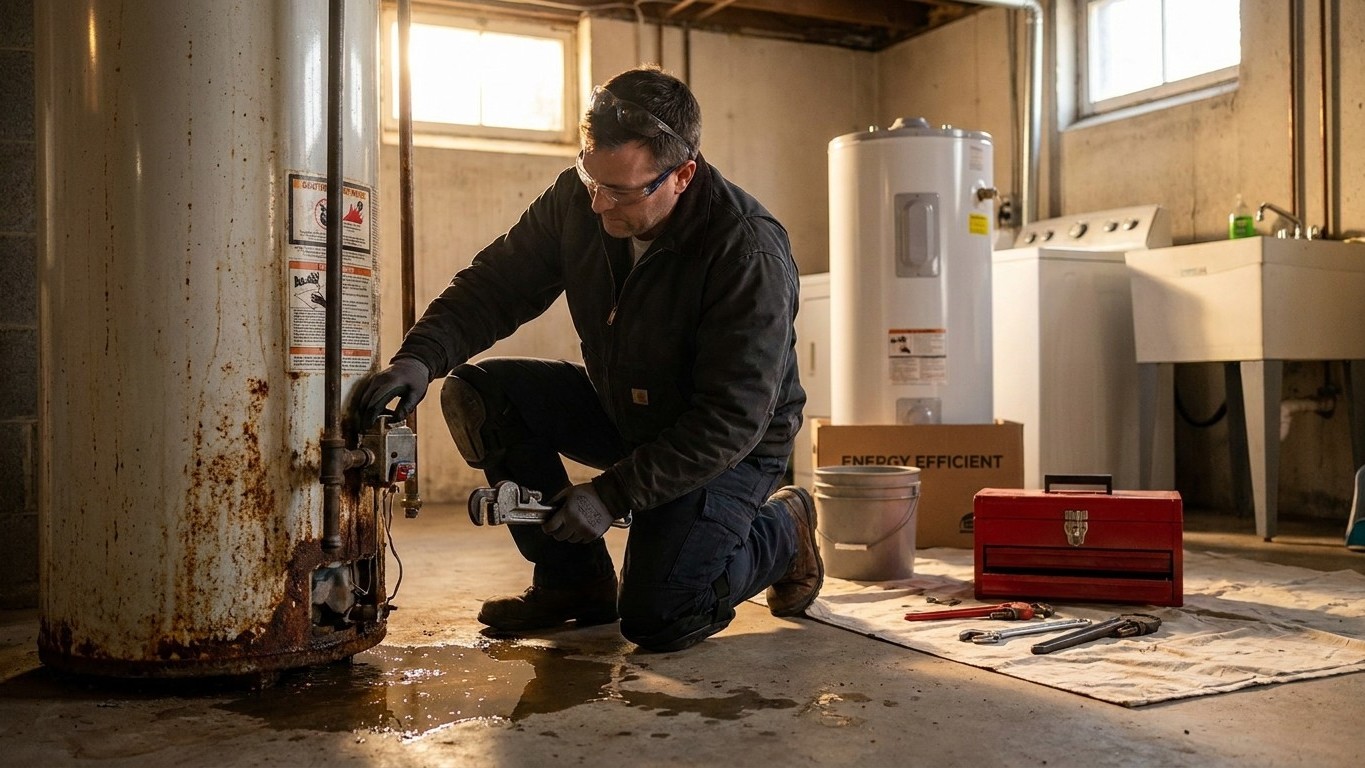

A water heater replacement means swapping the failed or aging unit for a new one: disconnecting the old tank, sizing and choosing the replacement, running new connections, venting a gas unit properly, adding safety components a code officer requires, and pulling a permit so the work gets inspected. The scope changes with fuel type, tank size, and where the unit sits in the house.
Like-for-like is the easy answer, not always the right one
A tank fails on a Tuesday morning, water is spreading across the laundry room floor, and the decision gets made in about ninety seconds: same size, same fuel, same spot, please just fix this. That instinct is understandable. It is also how households end up locked into another fifteen years of the same energy bill, the same recovery time, the same water heater tucked in a spot that never quite made sense.
The Department of Energy estimates that water heating accounts for roughly 14% to 25% of the energy consumed in a typical home, a wide enough range that the equipment choice itself is doing real work on either end of that spread. A storage tank running on an inefficient setup sits at the high end of that range for years. A better-matched system, chosen instead of defaulted into, can meaningfully change that number.
The moment of replacement is the only time most homeowners will ever seriously compare options, because nobody swaps a working water heater on a whim. That makes it worth pausing before the installer shows up with a matching box. A tank that has always felt too small for a growing household, or one that runs out of hot water during back-to-back showers, is a sizing problem, not a fuel problem, and the fix is different from just buying the same model again. A full look at water heater types and sizing lays out how tank capacity, recovery rate, and household demand should line up, something worth checking before assuming the old capacity was ever right in the first place.
Location matters too. A water heater crammed into a closet with no floor drain, installed decades ago before anyone worried about a leak reaching finished flooring below, might make more sense relocated to a garage or utility room this time around, even if that adds cost. Fuel source is the bigger fork in the road: sticking with gas because the house already has a gas line is a reasonable default, but it is a default, not a rule. The section below on heat pump units digs into when that assumption is worth questioning.
None of this means every replacement should turn into a research project. A straightforward tank-for-tank swap is often the right call, especially on a tight timeline or a tight budget. The point is that “right” should be a conclusion, not a default reached under time pressure with water still on the floor.
What is in the quote
Two quotes for what looks like the same job can differ by a wide margin, and the reason is almost always scope, not markup. The appliance itself is one line item. Everything around it is several more, and they explain most of the gap between a bargain estimate and a thorough one.
Connections come first: the water supply lines, the shutoff valves, and often new flexible connectors rather than reusing old ones that have already seen a full service life. On a gas unit, the gas line connection and its shutoff get inspected and sometimes replaced. Venting is where gas installations get more involved than electric ones. A gas water heater exhausts combustion byproducts through a vent, and that vent has to be sized and routed correctly for the new unit, which is not always identical to how the old one was set up, especially if the new appliance has a different efficiency rating or a different physical footprint.
An expansion tank shows up on some jobs and not others, depending on the home’s plumbing setup and whether the water supply is on a closed system. When it is required, it is a real added component with its own mounting and connection, not a minor add-on. A drain pan under the tank, plumbed to a drain line or to the exterior, is another item that some older installations never had and that a quote may now include, particularly for units installed in a location where a leak could damage the space below.
Disposal of the old unit is its own line, since a water heater is heavy, awkward, and often full of sediment, and hauling it away is real labor. Then there is the permit. Pulling a permit and scheduling the resulting inspection takes time and sometimes a fee, and it is the step that gets skipped by installers cutting corners. It should not be skipped: the local code office is the authority on what a given installation requires, from venting clearances to the expansion tank question to how the unit sits relative to other fixtures in the room, and that office’s sign-off is what protects a homeowner if something goes wrong later, insurance-wise or otherwise.
Gas and propane water heaters are fuel-burning appliances, which means the same carbon monoxide precautions that apply to any combustion appliance in the house apply here: CO is colorless and odorless, and a functioning CO alarm near the unit and in nearby living spaces is not optional. An electric or heat pump water heater burns no fuel and carries no CO risk at all, which is one more variable worth weighing when comparing quotes across fuel types.
The case for looking at a heat pump unit
A heat pump water heater costs more upfront than a standard electric tank, sometimes by a wide margin, and that sticker shock is usually where the conversation ends for a lot of households. It should not be, because the operating cost side of that equation tends to look very different once the unit is actually running.
The math behind that is now baked into federal policy. Amended federal efficiency standards bring common electric storage water heaters, the standard tank models that have filled utility closets for decades, up to the efficiency level of an entry-level heat pump water heater. That is a significant shift: it means the baseline electric tank on the market is being pushed toward performance that heat pump models have offered for years, narrowing the efficiency gap between the cheap default and the pricier alternative, at least for newer-vintage units built to the amended standard.
The tradeoff that does not show up on a spec sheet is space. A heat pump water heater pulls heat from the surrounding air, which means it needs a location with enough air volume to work efficiently, and that air needs to stay reasonably warm rather than sitting near freezing for months at a time. A cramped, unheated closet that works fine for a gas or standard electric tank is often a poor fit for a heat pump unit, and that is a real installation constraint, not a minor preference. A garage in a mild climate might work fine; an unconditioned crawlspace in a cold-winter state might not.
Thermostat setting is part of this conversation too, regardless of which fuel type ends up installed. The Department of Energy recommends setting a water heater thermostat to 120°F, describing that setting as comfortable for most household uses, and it is offered as a recommendation rather than a fixed rule. The reasoning is a genuine tradeoff: a lower setting saves energy and reduces the risk of scalding, particularly for households with young children or older adults, while a higher setting raises both energy use and that same scald risk. It is not a free lunch in either direction.
There is a second side to that same tradeoff worth naming honestly. Water stored at too cool a Temperature is a recognized concern for bacterial growth, legionella being the organism most often raised in that context, though no single threshold temperature is settled enough to print here as a hard number. Households with infants, elderly residents, or anyone with a compromised immune system should raise the question directly with a doctor or with the local water utility rather than guessing at a setting. A full comparison of upfront cost, running cost, and the space requirements involved is covered on the heat pump water heater page, worth reading before ruling the option out on price alone.
Common questions
How long does a water heater replacement take?
A straightforward swap, same fuel type and same location, is typically a same-day job. Anything that adds new venting, relocates the unit, or requires an inspection scheduled separately can stretch the timeline by days.
Do I need a permit to replace a water heater?
In most jurisdictions, yes, and the local code office is the authority on what that permit covers and what inspection follows. Skipping it is a common corner cut by unlicensed installers, and it leaves the homeowner without a documented sign-off if problems surface later.
Can I replace a gas water heater with an electric one?
Physically, yes, but it changes the scope significantly: new electrical circuit work replaces the gas line and venting work, and the swap is a good moment to weigh a heat pump unit rather than a standard electric tank, given where federal efficiency standards are heading.
What temperature should the new water heater be set to?
The Department of Energy recommends 120°F as comfortable for most households, balancing energy savings and scald risk against bacterial growth concerns in stored water. Households with vulnerable occupants should confirm the right setting with a doctor or the local water utility rather than relying on a single number.