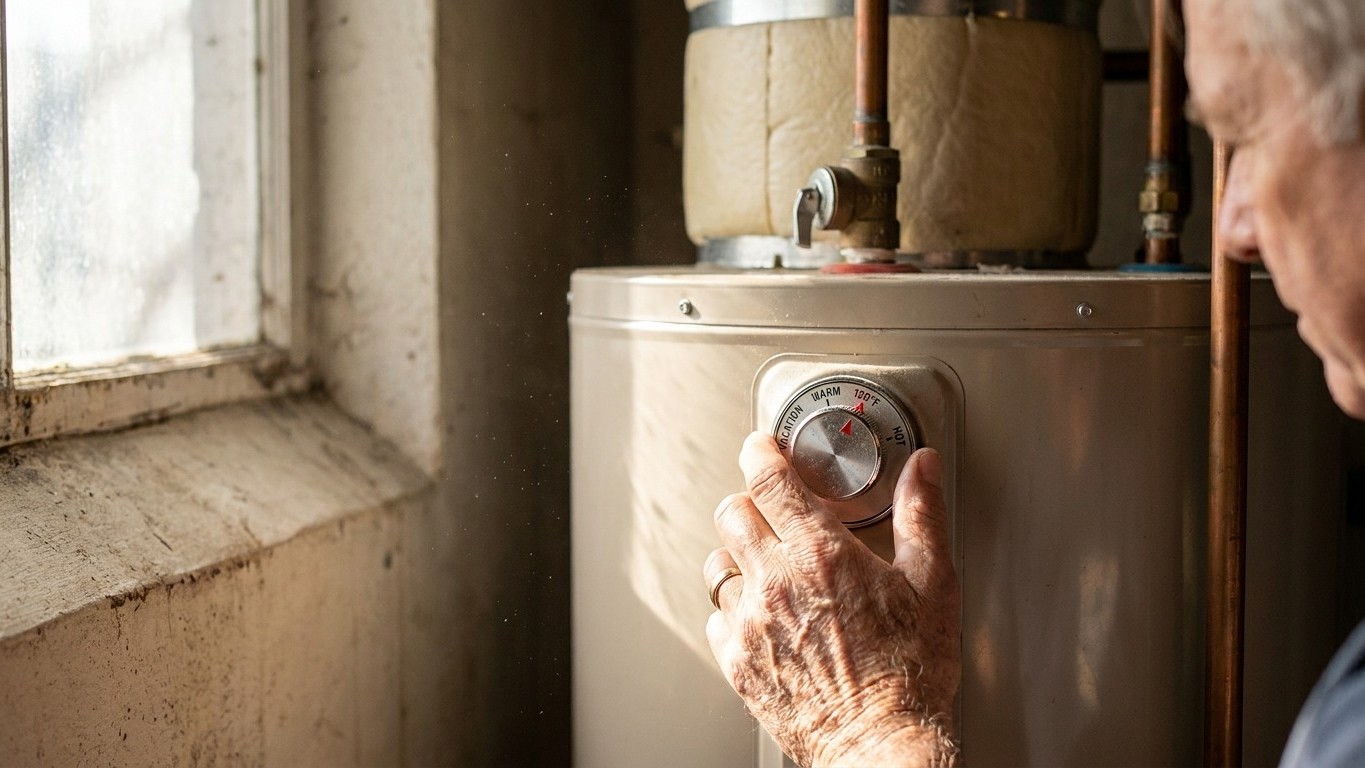

Most water heaters leave the factory with the thermostat set closer to 140°F. The U.S. Department of Energy recommends dialing that back to 120°F for most households, describing it as comfortable for typical daily use while trimming energy costs and cutting the risk of scalding. That figure isn’t a plumbing code or a mandated safety threshold, it’s a recommendation you can adjust based on who lives in your house. Here’s why 120°F works for most homes, when a higher setting makes sense, and how to check what’s actually coming out of your tap.
The number the DOE gives
The Department of Energy puts water heating at roughly 14% to 25% of the energy a typical home consumes, a wide range that reflects how differently households use hot water, how well a tank is insulated, and how old the unit is. Whatever the exact share in your house, it’s large enough that a few degrees on the thermostat shows up on the utility bill every single month, not just in summer or winter.
The 120°F figure the DOE recommends is a balance point, not a hard rule. Set the thermostat lower and the tank loses less heat to the surrounding air between uses, a phenomenon plumbers call standby loss. Set it higher and that loss grows, because the temperature difference between the tank and the room around it is what drives the heat leak in the first place. A tank sitting at 140°F all day, mostly unused, is bleeding more heat into your utility closet or basement than one holding steady at 120°F.
There’s also a supply-side shift worth knowing about. Amended federal efficiency standards have pushed common electric storage water heaters, the standard tank units found in most single-family homes, up to the efficiency level of an entry-level heat pump water heater. That’s a meaningful jump for anyone replacing an older tank, since heat pump technology moves heat rather than generating it directly, using a fraction of the electricity a simple resistance element needs. If your current unit predates that shift, the temperature setting matters even more, because an older, less efficient tank pays a steeper energy penalty for every extra degree you ask it to hold.
None of this means 120°F is the only defensible number. It’s the DOE’s starting point for a household with no unusual health concerns and no dishwasher or appliance that specifically calls for hotter water. What it balances, in plain terms, is energy cost against comfort and safety, with a third factor, bacterial growth in stored water, sitting in the background of that decision. The next two sections take each side of that balance in turn, starting with the case for going lower.
Lower: less energy, less risk of scalding
Turning the thermostat down from a factory-default 140°F toward 120°F does two things at once. First, it reduces standby losses, the slow bleed of heat through the tank walls and pipes even when nobody’s running water. Second, and more urgent for a lot of households, it makes an accidental scald far less likely at the tap.
The relationship between water temperature and how fast a burn happens isn’t a straight line. Small increases in temperature near the upper end of the scale cut the time it takes to cause a serious burn dramatically, far more than the same size increase would near the lower end. That’s the core reason the DOE’s 120°F recommendation exists in the first place: it sits in a zone where an accidental brush with hot tap water is unlikely to cause a severe injury in the few seconds it typically takes someone to react and pull away, while still being hot enough for showers, laundry, and dishes.
This matters most for the people least able to react quickly. Young children have thinner skin and slower reflexes, and they’re also the ones most likely to turn a faucet the wrong way or linger under a shower head that’s suddenly running hotter than expected. Older adults often have thinner, more fragile skin as well, along with health conditions that can slow reaction time or reduce sensation, meaning they may not feel how hot the water is getting until damage is already done. In a household with young kids, older relatives, or anyone with reduced mobility or sensation, a lower tank temperature is a straightforward, no-cost safety measure, no different in spirit from installing a stair gate or grab bar.
The energy side of this equation is quieter but still real. A tank running at 120°F instead of 140°F loses less heat between uses, runs its heating element or burner less often to maintain that setpoint, and does both of those things every single day the unit is in service. It’s not a dramatic single fix, but it’s a persistent one, the kind of small adjustment that adds up over a full year of billing cycles without requiring you to change a single habit around how you shower or do dishes.
Higher: the argument on the other side
Lowering the tank isn’t free of trade-offs, and it’s worth naming the other side honestly rather than pretending 120°F is right for every household in every situation. Stored water held too cool is a recognized concern for bacterial growth, including organisms like Legionella that can develop in water that sits at moderate temperatures for extended periods, particularly in larger tanks, low-use fixtures, or plumbing with dead legs where water doesn’t circulate often.
That’s the reason some households, and some plumbers, prefer to store water hotter in the tank itself and then temper it down before it reaches a person’s skin. A thermostatic mixing valve installed at the water heater or at individual fixtures lets the tank hold a higher temperature for the sake of reducing bacterial risk, while blending in cold water so what actually comes out of the shower head or faucet lands closer to a safe, comfortable range. This approach is common in larger buildings, in homes with low hot water turnover, and in situations where a household has weighed the bacterial concern as more pressing than the marginal energy savings from running cooler.
There’s no single temperature threshold given here for when bacterial growth becomes a meaningful risk, and no health authority is cited on that point, because that’s a question that depends on the specific tank, how often it’s used, how the plumbing is configured, and the vulnerability of the people using it. It’s not a number to guess at from a general article. A household with infants, elderly residents, people undergoing medical treatment that affects immune function, or anyone otherwise medically vulnerable should raise the question directly with their doctor or with their local water utility, both of whom are positioned to speak to the specific risk in a specific home rather than a generic rule of thumb.
The honest summary is that 120°F is a reasonable default for most households, but it’s a compromise, not a universal answer. Lower reduces scald risk and energy use. Higher, paired with a mixing valve if the household chooses that route, addresses the bacterial concern more directly. Neither side of that trade-off is wrong; they’re answering slightly different questions about risk.
Changing it, and checking it
Where the control lives depends entirely on what kind of water heater is installed. On a gas storage tank, the thermostat is usually a dial built into the gas control valve near the bottom of the unit, often marked with words like warm, hot, and very hot rather than exact numbers, which is one more reason to verify the actual temperature at the tap rather than trusting the label. On a tankless unit, the temperature is set through a digital control panel, sometimes mounted on the unit itself and sometimes as a separate remote control inside the house, and it typically displays an actual number you can set directly. Heat pump water heaters generally have a digital interface as well, often with an app or display screen showing current and target temperature.
Electric storage tanks are the one type worth a specific warning: they often have two thermostats, one controlling the upper heating element and one controlling the lower element, tucked behind two separate access panels on the side of the tank. Adjusting only one and assuming the job is done is a common mistake, and it can leave the tank cycling between two different setpoints depending on which element happens to be running. Both panels usually need to be opened, and both thermostats set to match, for the change to actually take effect consistently.
Whatever the appliance, the real check isn’t the dial position, it’s what comes out of the faucet. After adjusting the thermostat, give the water heater time to reach its new setpoint, generally a few hours for a storage tank, then run a hot tap steadily for a minute or two to clear out water that was already sitting in the pipes before checking the temperature. Only then does a thermometer reading at the faucet reflect the actual setting, rather than leftover water from before the change or a partial mix from a nearby fixture also drawing hot water. This is also the moment to remember that any gas or propane water heater is a fuel-burning appliance, meaning it produces carbon monoxide as a byproduct of combustion, a colorless, odorless gas that a working CO alarm near the unit is the only reliable way to detect. An electric or heat pump water heater burns nothing and carries no such risk, one more variable to factor in if you’re choosing between replacement options rather than just adjusting an existing tank.
Common questions
Is 120°F required by code?
No. It’s a recommendation from the U.S. Department of Energy aimed at balancing energy use, scald risk, and comfort. Local plumbing codes may address maximum temperatures at certain fixtures, but the local code office is the authority on what applies in your area, not a general recommendation.
Why does my water heater arrive set so much hotter than 120°F?
Many units ship with a factory-default setting closer to 140°F. Manufacturers often set that as a broadly usable default rather than a recommendation tailored to a specific household, which is part of why checking and adjusting the thermostat after installation is worth doing.
Can I just install a mixing valve instead of lowering the tank?
That’s exactly the approach some households take: storing water hotter in the tank to address bacterial growth concerns, then using a thermostatic mixing valve to bring the temperature down to a safer range before it reaches a faucet or shower head.
Does a lower temperature mean less hot water when I need it?
Not typically. The thermostat controls how hot the stored water is, not how much of it the tank holds. A full tank at 120°F still delivers the same volume of hot water as a full tank at 140°F, it’s simply a few degrees cooler at the point of use.