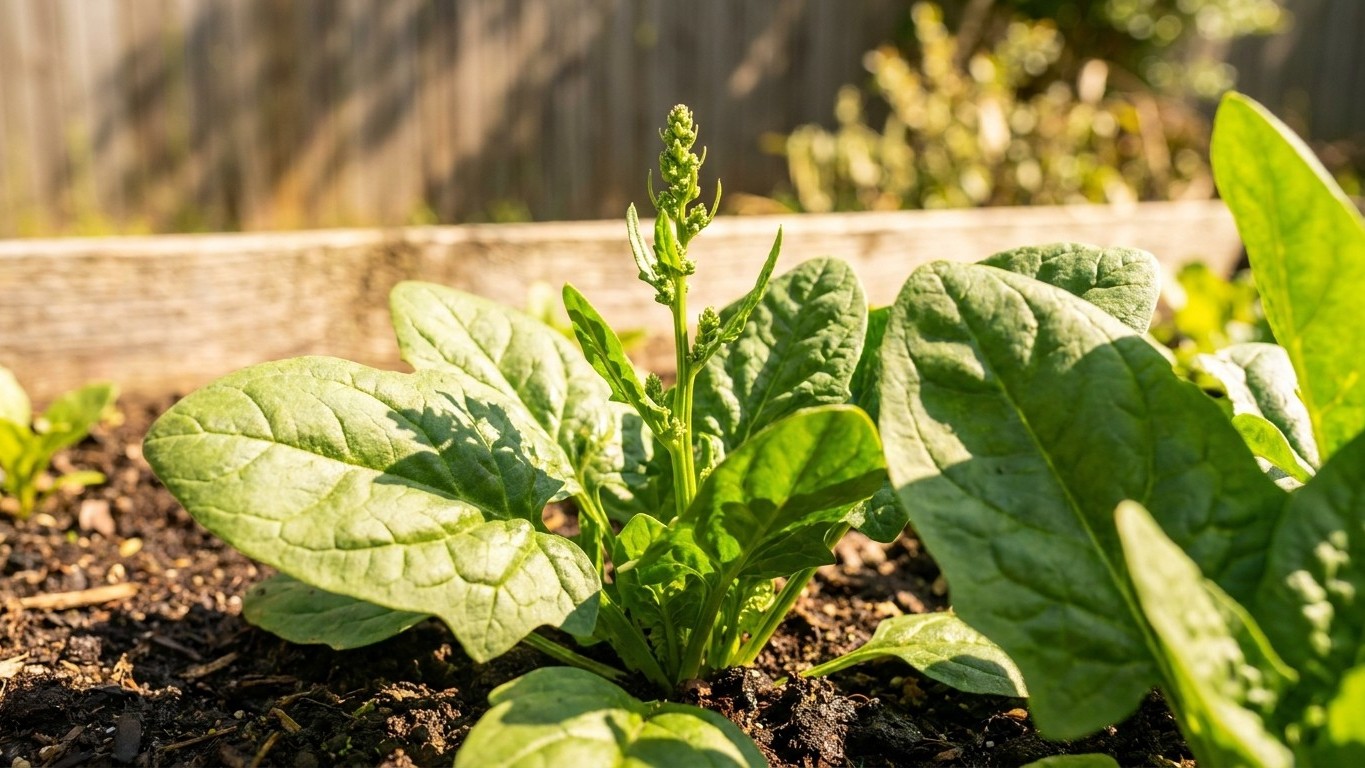

Four of the pests Alaska gardeners ask about most often do target spinach: aphids, cutworms, root maggots, and slugs. All four are active somewhere inside the frost-free stretch that runs from early-to-mid May through late September. None of them explains why a spinach bed suddenly bolts and turns bitter in July, that’s the plant’s own response to daylight, not something with legs or a mouth.
Which pests attack spinach in Alaska

UAF Cooperative Extension documents five pests for Alaska gardens overall: aphids, cutworms, root maggots, slugs, and spruce beetle. Only four of those have any business on a spinach leaf.
Spruce beetle is a bark beetle that attacks mature spruce trees, boring into the trunk under the bark. It has nothing to do with a vegetable bed and shows up on this list because it’s a documented Alaska pest, not because it touches spinach. If something is chewing on a spruce trunk in the yard, that’s a forestry problem, not a garden one.
The other four are worth knowing by what they actually do to the plant. Aphids are small, soft-bodied insects that cluster on the underside of leaves and feed by sucking sap, which is easy to miss on spinach because the crinkled leaf texture of many varieties hides them well until the colony is large. Cutworms are moth larvae that live in the soil and sever seedling stems right at ground level, usually overnight, so the first evidence is a toppled plant rather than a visible insect. Root maggots are fly larvae that tunnel into the root and lower stem of young seedlings, and while they’re best known as a brassica problem, they’re generalist enough to weaken spinach seedlings planted in the same beds. Slugs graze irregular holes in tender leaf tissue and leave a slime trail behind, and they’re most active wherever soil and air stay damp and cool.
The frost-free window itself is the frame that matters here: about May 3 to May 12 on one end and September 22 to October 1 on the other, roughly 143 days total. That’s the entire span in which any of these four can find and feed on a spinach plant outdoors. Outside it, the ground is frozen or the crop isn’t in the garden yet.
UAF Cooperative Extension doesn’t document a longer list than this for spinach specifically, and there’s no reason to pad it. Four generalist feeders, one length of season, is the whole picture as it’s currently recorded for the state.
When each one shows up, and what it does first
Cutworms tend to show up earliest, in the weeks right after the last spring frost passes and seedlings or transplants go into the ground. The first sign isn’t a bug at all, it’s a seedling that was upright the evening before and lying flat, severed clean at the soil line, the next morning.
Root maggots follow a similar early timeline, since they target the same tender, newly-planted stage. What gives them away is a plant that wilts despite moist soil and comes loose with a light tug, roots showing dark, tunneled tissue when the plant is lifted for a look.
Aphids build more slowly and become obvious as the season warms into its longest stretch of daylight. Alaska’s reference city sees 18 hours and 56 minutes of daylight on the longest day of the year, and that same long-day stretch is what pushes spinach toward bolting on its own, regardless of temperature. Aphid numbers tend to climb through this same window, so a gardener checking leaves for the first hint of a flower stalk is often the same gardener who spots curled, yellowing leaves and a sticky residue on the undersides at the same time. The two things are happening together, not because one causes the other.
Slugs don’t follow a single peak the way aphids do. They’re active whenever conditions stay damp and cool, which in much of Alaska means early in the season right after planting and again as the garden heads toward the first fall frost, September 22 to October 1, when cooler, wetter nights return. Ragged holes in the leaves and silvery slime trails, worse by morning than the evening before, are the signature.
Telling the damage apart from everything else
A lot of what looks like insect damage on Alaska spinach isn’t insect damage at all. Bolting is the big one: a plant that suddenly sends up a flower stalk and turns bitter has been triggered by long daylight and by warmth, not by anything eating it. Spinach grows best where temperatures stay under 75 F, and that same 75 F line is also roughly where the leaves start turning bitter — one number, two consequences, and neither one involves a pest.
Nutrient deficiency, drought stress, and plain mechanical damage from wind or hail round out the usual list of look-alikes. A quick comparison helps sort them before assuming an insect is to blame.
| What’s visible | Likely cause | What settles it |
|---|---|---|
| Seedling severed at the base, toppled overnight | Cutworm | Clean cut at soil line; larva often curled in the soil nearby |
| Wilting despite damp soil; plant loosens easily | Root maggot | Tunneled, discolored root tissue when the plant is lifted |
| Ragged holes, slime trails, worse after damp nights | Slug | Visible trail in the morning; feeding happens after dark |
| Curled, yellowing leaves, sticky film underneath | Aphid | Insects visible with a hand lens; no chewed edges |
| Uniform pale or yellow leaves, no holes anywhere | Nutrient deficiency | No insects present; a soil test through the local extension office confirms it |
| Sudden flower stalk, leaves turn bitter overnight | Bolting | No chew marks anywhere; whole plant changes at once |
| General wilting, crisp edges on older leaves | Drought stress | Soil dry below the surface; no insects, no trails |
None of this is a substitute for an actual look at the plant in hand. When the cause isn’t obvious from the pattern, a photo or sample sent to the local extension office is a faster answer than guessing.
What actually works here, and what is a waste of time
On a growing season this short, timing beats almost everything else. A physical barrier installed before seedlings emerge or before transplants go in the ground does more than any treatment applied after the first bite mark shows up. Lightweight floating row cover, put down at planting and sealed at the edges, keeps aphids from ever landing on the crop and keeps cutworm moths from laying eggs nearby in the first place. A simple collar around each transplant stem, pushed an inch into the soil, stops a cutworm cold without any product at all.
Slugs respond better to habitat changes than to anything sprayed or scattered: keeping mulch pulled back from the stem, watering in the morning instead of the evening so the soil surface dries by nightfall, and handpicking after dark when they’re active all reduce damage without guesswork.
What wastes time is treating after the fact. A cutworm that has already severed a seedling is done feeding on that plant; nothing applied afterward brings it back. Broad treatments applied without identifying the actual cause also risk killing the aphids’ natural predators, which tends to make the next generation of aphids worse, not better. And because registered options and legal timing differ by state, the local Cooperative Extension office is the only reliable source for what’s actually approved for use in an Alaska garden, this page isn’t the place to guess at that.
Where to check this for your own county
Alaska is organized into boroughs and census areas rather than counties, so the equivalent stop is a local district office of UAF Cooperative Extension rather than a county extension office. What’s documented at the state level doesn’t say what’s actually present in one particular garden — a Southcentral bed near the coast and an Interior bed with colder nights and a shorter frost-free stretch can have different pest pressure even in the same summer.
The four pests covered here (aphids, cutworms, root maggots, slugs) are the ones UAF Cooperative Extension documents as relevant to Alaska gardens generally. Whether any one of them is actually present, and in what numbers, is a local question best answered by the district office nearest the garden in question, either by phone, in person, or by sending a photo of the damage along with a description of when it appeared relative to planting.
The next useful step for anyone looking at unexplained damage on spinach right now is to reach out to that local office directly rather than trying to match symptoms to a list from a website, however specific the list.
Common questions
Does frost kill off aphids or slugs for the season?
A hard freeze ends active feeding, but it doesn’t need to be discussed as a fixed date beyond what’s documented here: the first fall frost falls between September 22 and October 1 at the reference station, and pest activity drops off as temperatures approach that range.
Can spinach be planted for a fall harvest in Alaska?
Utah State University Extension’s guidance for a fall crop generally is to plant 50 to 75 days before the target harvest date; no separate days-to-maturity figure for spinach is published by that source, so that planting window is the only timing guidance available here.
Are some spinach varieties less appealing to pests?
Bloomsdale, Melody, Teton, and Olympia are varieties named without pest-resistance data attached in the sources used for this page. Choosing among them on pest grounds isn’t something this page can support with actual figures.
Is heat ever the reason spinach fails in Alaska?
Rarely by itself. The reference station averages 0.0 days a year at 90 F or above, so the more common failure is bolting driven by long daylight rather than by heat stress on the plant.