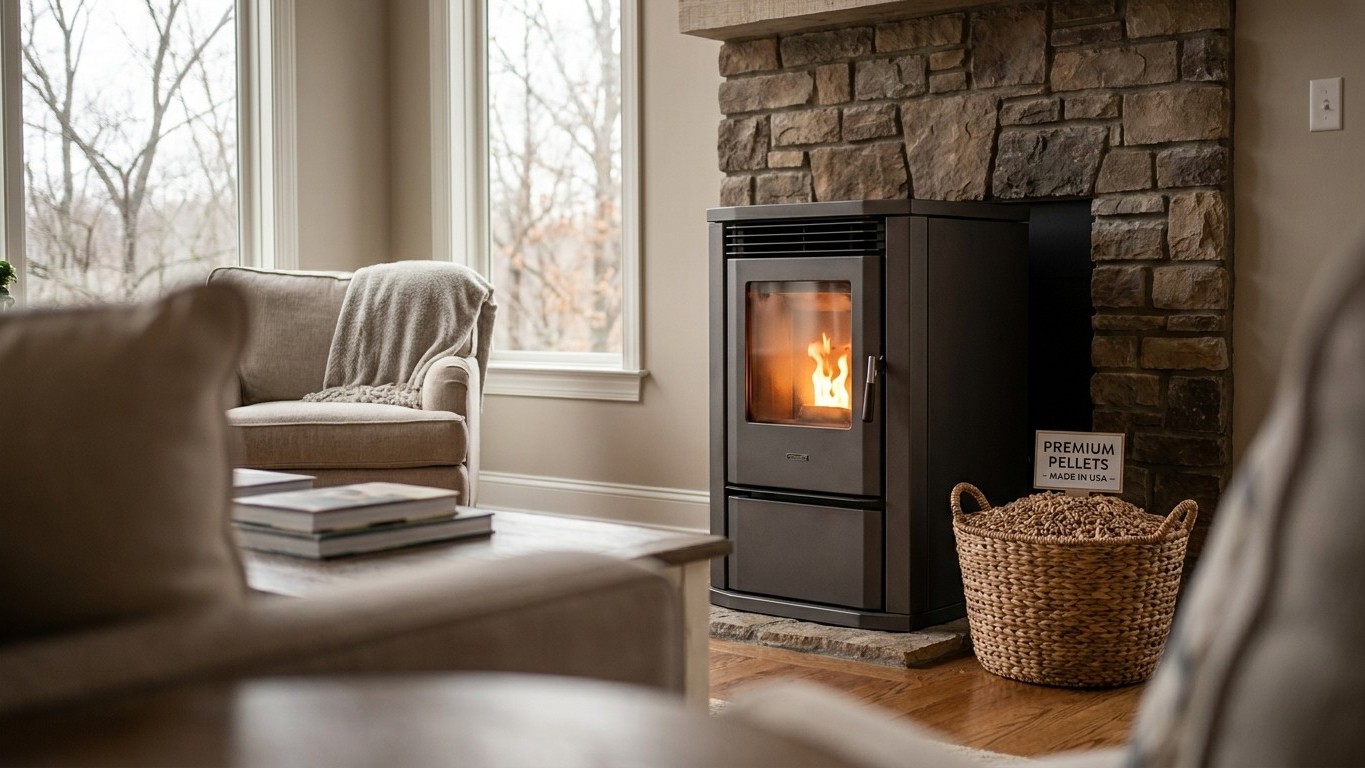

At Honolulu International Airport, NOAA’s 30-year climate normal shows zero heating degree days a year and mean temperatures above 65 F in every single month. A pellet stove in Hawaii isn’t fighting a winter, because by the numbers that define one, there isn’t one here. That doesn’t make the appliance useless, it just changes what it’s for: ambiance and the occasional cool, damp evening rather than a fuel bill that rises and falls with the season.
How hard the winter works here

Zero. That’s the heating degree day figure NOAA publishes for Honolulu Intl AP, HI US, based on the 1991-2020 U.S. Climate Normals. Heating degree days measure how far below 65 F the average daily temperature falls, added up across the year. Twice the degree days means roughly twice the fuel burned to keep a comparable house warm. Honolulu’s total isn’t low, it’s nonexistent, and that single fact is really the whole story for this page.
Compare that to the cooling side of the ledger: the same station logs about 4,767 cooling degree days a year. Hawaii homes spend their energy dollars fighting heat, not cold, and a pellet stove sits outside that equation entirely.
Length matters as much as depth, and here there’s no length to speak of either. NOAA’s monthly product shows the mean temperature at Honolulu stays above 65 F in all twelve months, and the published heating degree days come out to 0.0 for every single month. This isn’t a mild-but-long season the way you’d find in parts of the Pacific Northwest or the Deep South, where degree days pile up slowly across many months without ever spiking. Honolulu doesn’t have a mild season and it doesn’t have a short one. It has no heating season by NOAA’s own measure, full stop.
A pellet stove owner here should treat the appliance as a comfort feature: something to run on a rainy evening when the trade winds die down and the house feels a little clammy, not a system sized to carry a house through months of cold. That’s a legitimate reason to own one, but it’s a different reason than a homeowner in Vermont or Montana would have.
One caution worth repeating: Honolulu is one station on one island. Upcountry areas on Maui, the higher slopes of the Big Island, and other elevated pockets across the state see genuinely cold nights that this airport reading says nothing about. If you’re heating a home above a few thousand feet in elevation, the Honolulu number isn’t your number, and you should look at conditions closer to where you actually live.
How many tons a winter takes here
For most Hawaii households, the honest answer is a fraction of a ton, not tons. But the math behind that estimate is worth walking through, because it’s the same math used everywhere pellet stoves are sold. A standard bag weighs 40 pounds. Fifty bags make a ton. How many bags a household burns depends on how much heat the house actually needs, which is exactly what the degree-day figure above measures. With zero heating degree days at the reference station, the baseline heat demand most of the calculators assume simply isn’t present here.
That said, consumption in any given house still moves on the same three variables that matter everywhere else:
- How well the house holds heat. An older wood-frame house with single-pane windows and no insulation loses warmth faster than a newer, tightly built one, even on a cool Hawaii evening.
- Whether the stove is the only heat source or a supplement. In a state where the RECS survey doesn’t even publish a solid figure for furnace or heat pump use, most stoves here are almost certainly run as an occasional supplement rather than a primary system.
- The setting it runs at. A stove left on a low, ember-like setting for evening ambiance burns a fraction of what the same unit uses on a high setting meant to actually heat a room.
No source publishes a tons-per-winter figure broken out for Hawaii, and it wouldn’t mean much if one did. Two houses on the same street can differ by a factor of two depending on insulation and how the stove gets used, and that gap is even wider in a climate where most owners are running the stove for a handful of evenings rather than a whole season.
The only number worth trusting is the one you generate yourself. Buy a modest supply for the first winter, track how many bags actually get burned by the time the weather turns warm again, and use that count as your baseline going forward. One measured season on your own equipment beats any estimate built from a mainland formula. For the general method behind that calculation, and how it plays out in colder climates, see our national guide on how many pellets a winter takes.
Buying and storing them in this climate
Because Hawaii has no heating season in the NOAA sense, there’s no seasonal window forcing you to stock up before a cold snap the way a mainland buyer would. Pellet demand elsewhere spikes right before the heating months begin, emptying shelves and pushing prices up; that pressure barely exists here, since almost nobody is buying pellets to survive a winter. That actually works in a Hawaii buyer’s favor: you can shop with less urgency and more room to compare.
Comparing well still matters. Never compare bag prices in isolation, since bag sizes and per-bag pricing can mask big swings in what you’re actually paying. Compare per ton, the only figure that lines up apples to apples across brands and retailers.
Storage is where Hawaii’s climate actually works against the pellet owner, and this is the detail that matters most on this page. Pellets are compressed sawdust, held together by the natural lignin in the wood rather than any glue or binder. That means moisture is their enemy: a pellet that absorbs humidity swells, loses its shape, and eventually crumbles into sawdust again, which either jams a stove’s feed mechanism or simply won’t burn cleanly.
Hawaii’s air is humid essentially year-round, and a garage or shed floor in that kind of climate sweats condensation the way a cold glass does on a summer day. Bags stacked directly on a concrete floor, or stored in an uninsulated shed near the coast, are at real risk of soaking up ambient moisture even without a single drop of rain touching them. Keep bags off the floor on pallets or shelving, keep them sealed until use, and store them in the driest interior space available rather than an outbuilding. For the fuller picture on moisture damage and how to judge pellet quality before you buy, see our national pages on pellet storage and pellet quality.
What a winter outage means here
A pellet stove needs electricity to run, full stop. Unlike a traditional wood stove, which burns on gravity and airflow alone, a pellet stove depends on an auger to feed fuel into the burn pot and a fan to move air and exhaust. Cut the power and the stove goes cold within minutes, no matter how many bags sit in the hopper.
In a place with real heating degree days, that’s a genuine safety problem: a power outage during a hard freeze can turn into a heating emergency fast. In Hawaii, where the reference station shows zero heating degree days and mean temperatures above 65 F every month of the year, a power cut affecting a pellet stove is an inconvenience, not a crisis. You lose the atmosphere of the flame on a cool, damp evening. You don’t lose your only source of warmth, because for the overwhelming majority of Hawaii households, the pellet stove was never carrying that job in the first place.
What do Hawaii homes actually fall back on? The RECS 2020 state figures are thin here, several categories including furnace, central heat pump, and boiler use come back suppressed or not reported because too few households use them to produce a reliable estimate. The one hard number available is electricity, reported at 5% of households as their main heating equipment and fuel. Fuel oil or kerosene comes back as none reported. That’s consistent with a state where most homes simply don’t need a dedicated space-heating system, and where whatever electric resistance heating exists is used lightly, the same way most people would use a pellet stove: for comfort on a cool night, not survival through a season.
Don’t guess at a generator size or a battery capacity to keep a stove running through an outage. Check the wattage rating printed on the appliance’s own label, and size any backup power to that figure specifically. For the broader mainland context on planning around outages with a pellet stove, our national power-cut guide covers the sizing question in more depth.