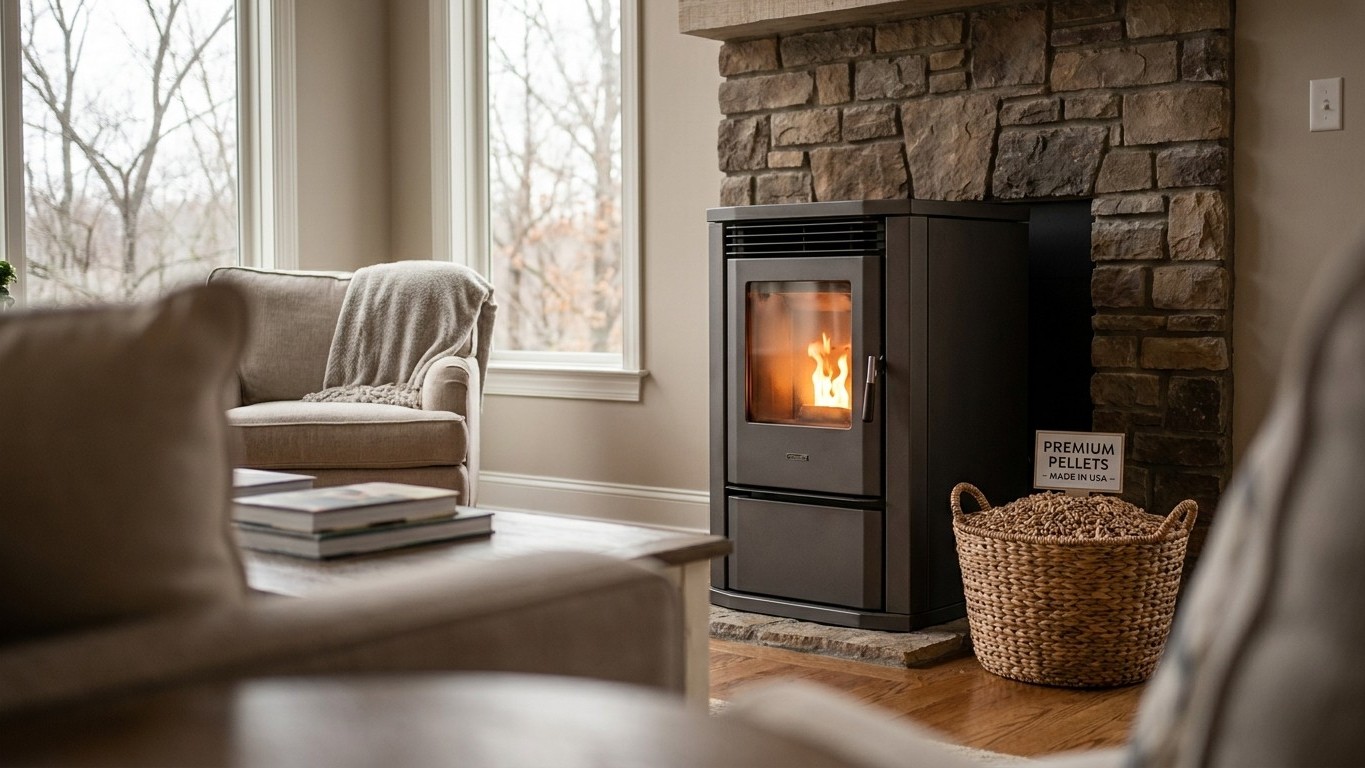

Around Houston, a Texas winter adds up to about 1,266 heating degree days a year, which is a mild number by national standards. That single figure decides almost everything else on this page: how many bags a pellet stove burns, whether it can carry a house through January on its own, and how much a power outage actually costs you in comfort. The short version is that a pellet stove here is real heat, but it’s rarely the only heat a house needs.
How hard the winter works here

The reference number comes from Houston Intercontinental Airport, per NOAA’s 1991-2020 Climate Normals: about 1,266 heating degree days a year, against roughly 3,288 cooling degree days. That ratio alone tells you something Texans already know: this is a state built for air conditioning, not furnaces. A heating degree day counts how far the daily mean temperature falls below 65 F, added up across the year. Twice the degree days means roughly twice the fuel burned for the same house, so 1,266 puts Houston’s heating load somewhere between a mild Gulf Coast winter and a cool Southern one, not in the same conversation as Minneapolis or Denver.
The heating season itself runs about five months. Demand starts in November, the first month whose normal mean temperature (62.0 F) dips below the 65 F baseline NOAA uses for the degree-day count. It peaks in January, with 366 degree days that month alone, then tapers through February (236), March (122), and April (31), where the mean climbs back above 65 F and the heating season effectively ends. That’s the shape of a Texas winter: not brutal, but not a two-week cold snap either. It’s five months of on-and-off need, heaviest in January, with real chances of a hard freeze breaking through the mild average on any given week.
Given a number that low, the honest thing to say is that a pellet stove in most of Texas functions as comfort heat and atmosphere, not as a home’s primary heating system. It’ll take the chill off a living room on a 40-degree morning and it’ll matter during the occasional freeze, but it isn’t replacing whatever furnace or heat pump already does the heavy lifting. That’s not a knock on the appliance, it’s just what the climate calls for, and the rest of this page is written for that reader rather than for someone trying to heat a house through a Midwest winter.
One caution matters here: Houston is one station, not the whole state. Texas stretches from the Rio Grande Valley, where winter barely registers, up through the Panhandle and into higher counties where degree days run considerably higher and freezes hit harder and more often. If you’re in Amarillo, Lubbock, or anywhere north of the I-20 corridor, treat the Houston figure as a floor, not a match, and expect your own heating season to start earlier and demand more.
How many tons a winter takes here
Nobody can hand you a tons-per-winter number that fits your house, because no source publishes one by state or city, and two homes on the same Houston block can burn twice as much as each other depending on how they’re built. What you can do is work the math yourself once you know the pieces. A standard bag of pellets weighs 40 pounds, and a ton is 50 bags. From there, consumption tracks the heat your house actually needs, which is exactly what the degree-day figure above measures: more degree days, more bags burned, for the same stove running the same way.
Three things move that number more than anything else:
- How well the house holds heat — insulation, window quality, and air sealing decide how much of the heat a stove produces actually stays inside instead of leaking out.
- Whether the stove is the only heat source or a supplement — a stove backing up a furnace burns far less than one asked to carry a whole house through January on its own.
- The setting it runs at — a stove left on a low, steady setting for ambiance burns nothing close to one run wide open to hold a room at 72 F during a cold snap.
Given a mild 1,266-degree-day climate and a five-month season that’s front-loaded onto January, most Texas households running a pellet stove as supplemental heat will land on the lower end of what’s typical nationally, but “lower end” still isn’t a number worth quoting as fact. The one method that actually works is counting your own bags. Track what you buy and burn through your first full winter, note how the house felt and how often the stove ran, and that measured total becomes your baseline for every winter after. One real season of counted bags is worth more than any estimate a website can give you. For the national math behind bag counts and burn rates, see our guide on how many pellets a winter takes.
Buying and storing them in this climate
Because the heating season here starts in November, the smart buying window closes before then, in late summer or early fall, when demand is lowest and supply is steadiest. Wait until a cold snap actually arrives, even a mild one by national standards, and you’re competing with every other Texan who just remembered they own a stove. Regional shelves empty fast during a hard freeze, even in a state where hard freezes are the exception rather than the rule. Buying ahead of November isn’t about beating inflation, it’s about beating a shelf that’s suddenly bare in January when you need it most.
Storage matters more here than the mild degree-day count suggests, because of humidity, not cold. Pellets are compressed sawdust held together by nothing but pressure and natural lignin, no glue involved, which means moisture is their real enemy. In a climate with Gulf Coast humidity and long, wet summers, that’s a year-round risk, not just a winter one. A garage that sweats in July, a shed with a dirt floor, or bags stacked directly against a concrete slab that pulls in ground moisture can all turn a solid ton of fuel into swollen, crumbly pellets that jam a feed auger or burn poorly. Keep bags off the floor, on pallets or shelving, in a space with some airflow, and check them periodically through the humid months even when the stove isn’t running.
On cost, the only number worth comparing is price per ton, not price per bag, and never a specific dealer or figure repeated as if it holds statewide. Prices shift by region, season, and supplier, so shop the per-ton comparison locally rather than trusting a number from elsewhere. For the fuller picture on how pellets are made, graded, and stored long-term, see our national guides on pellet storage and pellet quality.
What a winter outage means here
A pellet stove isn’t a wood stove with a different fuel. It needs an electrical supply to run the auger that feeds pellets into the firebox and the fan that pushes heat into the room. Cut the power, and the stove goes cold no matter how full the hopper is. That’s the tradeoff for the convenience pellet stoves offer over splitting and stacking wood, and it’s worth knowing before you’re counting on one during a storm.
Here, that tradeoff mostly stays theoretical. With only about 1,266 heating degree days a year and a mild average winter, a power outage during a cold spell in Houston is usually an inconvenient evening without stove heat, not a survival situation, since the underlying furnace or heat pump most homes already rely on is the bigger loss. But Texas has already shown that mild averages don’t rule out sharp, damaging cold snaps that overwhelm the grid at the exact moment heating demand spikes statewide, so the theoretical risk isn’t purely academic either.
Per EIA’s Residential Energy Consumption Survey, Texas homes lean heavily on furnaces (61%) and central heat pumps (19%) as their main heating equipment, with natural gas (42%) and electricity (51%) as the dominant fuels; propane accounts for a small 2% share, and fuel oil or kerosene wasn’t reported in meaningful numbers. That means most households falling back from a pellet stove during an outage are falling back on a furnace or heat pump that, depending on the model, may itself need electricity to ignite and blow air, even on a gas system. Don’t guess at what backup power you’d need. Check your specific stove’s electrical draw on its appliance label, and see our national guide on pellet stoves during a power outage for how to plan around that number responsibly.