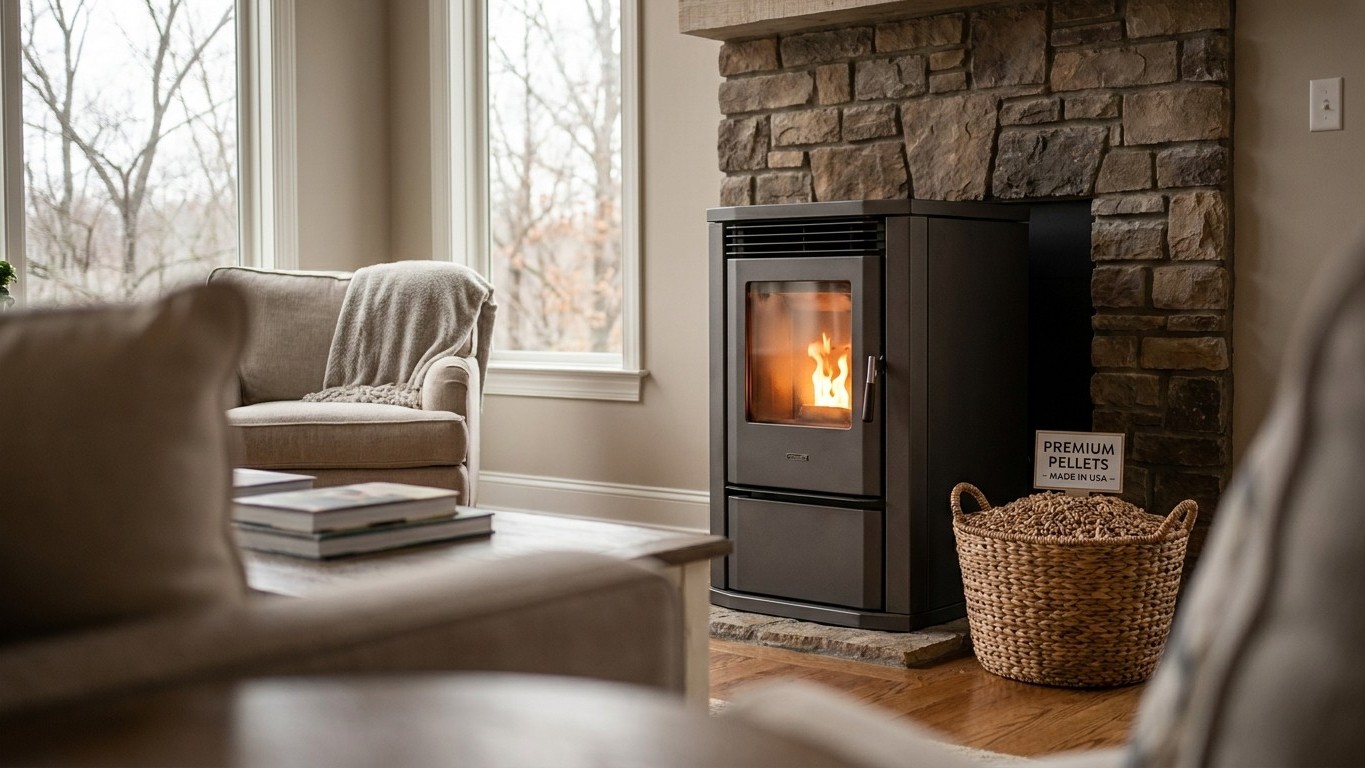

Chicago O’Hare logs about 5,974 heating degree days a year, which places central and northern Illinois among the colder heating markets in the Midwest. That number alone tells you a pellet stove here isn’t decorative: it has to carry real load for most of eight months, and a household running it as a primary source should plan on several tons of fuel, not one or two bags a week bought as needed.
How hard the winter works here

Degree days are the number that turns weather into a fuel bill. Every day of the year, NOAA tracks how far the average temperature falls below 65°F, then adds it all up. At Chicago O’Hare Intl AP, that sum comes to about 5,974 heating degree days annually, based on the 1991-2020 Climate Normals. Compare that to a milder station somewhere in the Southeast running 2,500 or 3,000, and you can see why an Illinois pellet stove burns through fuel at close to double the rate of a stove doing the same job in a warmer state.
The season itself stretches long. Heating demand starts building in October, once the normal mean temperature drops below that 65°F threshold, and it doesn’t fully let go until June. That’s roughly eight months where the furnace, boiler, or stove has some role to play, even if the coldest stretch, January, is where the real burn happens: O’Hare logs 1,234 degree days in that single month, more than a third of what April through September produces combined.
That distinction matters more than people expect. A long, mild season and a short, brutal one can post similar annual totals, but they demand different things from a heating appliance. Illinois isn’t the short-brutal type. It’s long and consistently cold, with real depth in the middle of it. A pellet stove here needs to run steadily for the better part of two-thirds of the calendar year, not just survive a few hard weeks in January.
One caution worth repeating: 5,974 is a station figure, not a statewide constant. It comes from O’Hare, which sits in the Chicago area. A homeowner in far southern Illinois, down near Cairo, is working with a noticeably milder number, while someone up near the Wisconsin border or in a colder microclimate could run higher. Anyone outside the immediate Chicago metro should check the normals for a station closer to home before sizing a stove or a fuel budget around this figure.
Monthly degree days at O’Hare
| Month | Heating degree days |
|---|---|
| January | 1,234 |
| February | 1,015 |
| March | 808 |
| April | 468 |
| May | 198 |
| June | 31 |
| July | 2 |
| August | 4 |
| September | 77 |
| October | 355 |
| November | 713 |
| December | 1,069 |
How many tons a winter takes here
No agency publishes a “tons per winter” figure for Illinois, and anyone quoting one is guessing. What you can do is build your own estimate from numbers that actually mean something. A standard bag of pellets weighs 40 pounds. Fifty bags make a ton. From there, consumption tracks the heat your specific house needs to replace, which is exactly what those degree-day totals above are measuring for the region as a whole.
Three things move that number up or down for any given house, and they matter more than the state you live in:
- How well the house holds heat. A tightly insulated, newer build with sealed windows can burn noticeably less fuel than an older farmhouse with drafty sills, even sitting on the same street.
- Whether the stove is the only heat source or a supplement. A stove asked to carry the whole house through an O’Hare-style winter works far harder than one warming a single room while a furnace handles the rest.
- The setting it runs at. A stove dialed to a low, steady output sips fuel compared to one run wide open to fight a cold snap, and most owners adjust that setting without realizing how much it changes total consumption.
Two houses on the same Illinois block, built in different decades with different windows, can land a full ton apart over a season using the identical stove. That’s why the honest approach isn’t chasing a published average. It’s counting your own bags. Track what you buy through one full winter, from the first bag in October through the last one in April or May, and you’ll have a number specific to your house, your stove setting, and your habits, which beats any regional estimate by a wide margin. For the fuller math behind that method, including how to translate degree days into a rough seasonal range, the national page on how many pellets a winter takes walks through the calculation in more detail.
Buying and storing them in this climate
Timing the purchase matters as much as picking a supplier. Since Illinois heating demand starts climbing in October and doesn’t taper off until June, the window to buy ahead is the stretch before October, when demand is low and dealers aren’t fielding calls from every household in the region at once. Wait until a January cold snap hits and shelves can run thin fast, because a hard freeze across the Midwest pulls buyers into stores at the same moment, and pellets bought in that panic tend to cost more than the same bag purchased in August.
Storage is where the local climate actually bites. Pellets are compressed sawdust, held together by the natural lignin released under pressure during manufacturing, with no added glue or binder. That means moisture is the enemy in a very literal way: a pellet that absorbs humidity swells, loses its shape, and eventually crumbles back into sawdust, which won’t feed properly through a stove’s auger or burn cleanly. Illinois summers run humid, and a garage or basement that isn’t sealed against that moisture can quietly degrade a pallet of pellets over a few warm, sticky months even before winter arrives. A concrete garage floor that sweats condensation on humid days is a particular risk, since bags stacked directly on that surface wick moisture up from underneath.
The fix isn’t complicated: keep bags off bare concrete on a pallet or boards, store them somewhere dry and ventilated rather than sealed in plastic that traps condensation, and buy in a quantity you can actually shelter properly rather than stockpiling more than your storage space can protect. When comparing sources, the only number worth putting side by side is price per ton, since bag counts and packaging vary enough to make per-bag pricing misleading. For a full rundown on stacking, humidity control, and how to judge pellet quality before you buy, see the national storage guide and the pellet quality page.
What a winter outage means here
A wood stove burns whether the lights are on or not. A pellet stove doesn’t work that way: it needs an electrical supply to run the auger that feeds pellets into the burn pot and the fan that pushes heat into the room. Cut the power, and the stove goes cold no matter how full the hopper is, which is the single biggest difference between the two appliances and the one most first-time pellet stove owners underestimate.
Cross that limitation with the O’Hare degree-day figure and the stakes become clear. In a region running nearly 6,000 heating degree days a year, with January alone averaging 1,234 of them, a power outage during a genuine cold snap isn’t an inconvenience. It’s a heating emergency, especially for a household leaning on the stove as a primary or sole heat source through the coldest stretch of the season. In a milder climate, the same outage might just mean an evening without the stove’s ambiance. In Illinois, in January, it can mean a house losing heat fast while outdoor temperatures sit well below freezing.
What most Illinois households fall back on tells you where the real vulnerability sits. According to EIA’s Residential Energy Consumption Survey, 76% of Illinois homes run a furnace as their main heating equipment, and natural gas is the dominant fuel at 78%, with electricity at 17% and propane at 4%. Steam or hot-water boilers, at 11%, remain common in the state’s older housing stock, especially in and around Chicago. Fuel oil or kerosene wasn’t reported in the survey for Illinois in meaningful numbers. What that mix means practically: most furnaces and boilers, even gas-fired ones, still rely on electricity to run their blowers, igniters, or circulator pumps, so a household’s fallback during an outage isn’t automatically safe from the same vulnerability as the pellet stove.
Rather than guess at a generator size or battery capacity, check the wattage listed on your specific stove’s appliance label, since draw varies by model and by whether the fan is running on high or low. The national page on pellet stoves and power outages covers backup options and what size of support actually keeps an auger and fan running through a multi-day cold-weather outage.