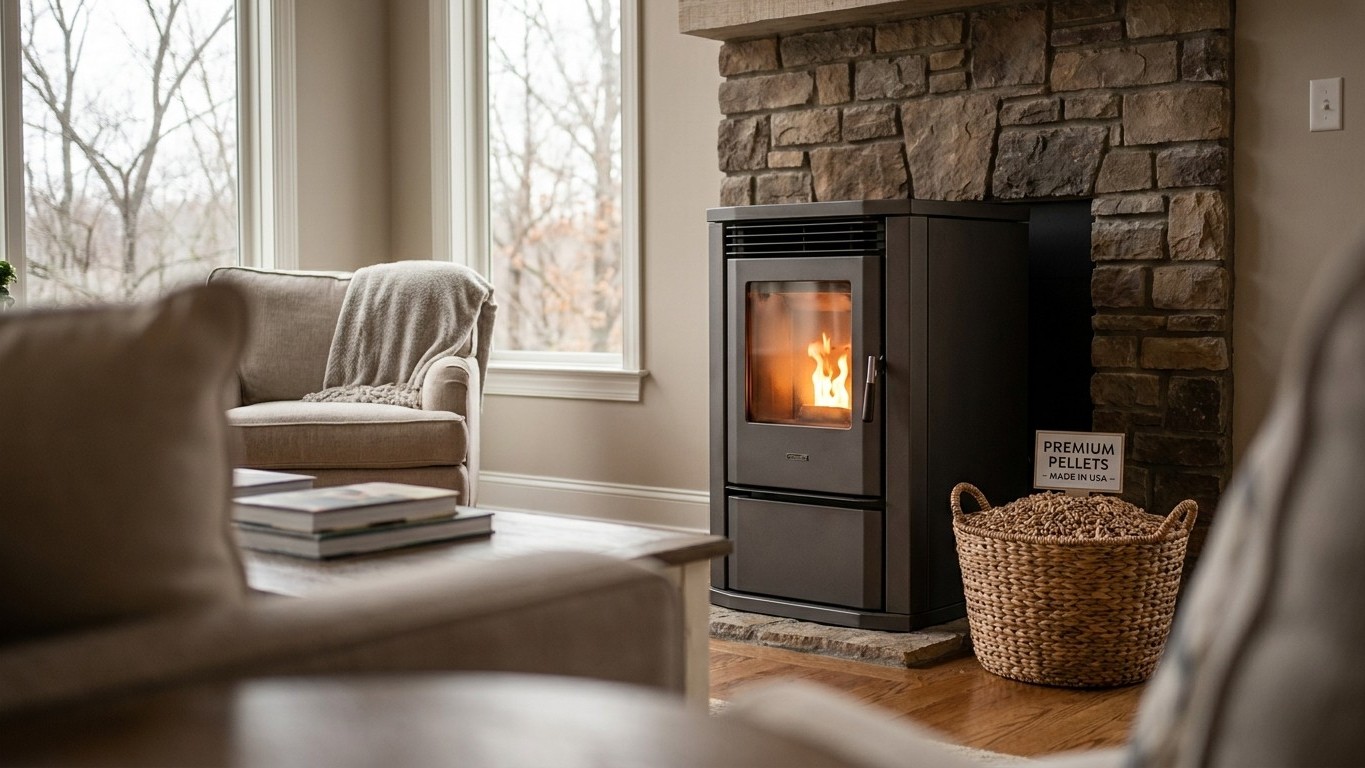

A pellet stove in Portland works about 9 months a year but rarely alone. The reference station shows 4,104 heating degree days annually, a season long on the calendar but moderate in depth compared to the coldest parts of the country. That combination shapes almost everything else: how many tons a stove burns, when to buy them, and what a winter actually costs to heat through.
How hard the winter works here

Portland Intl AP, the NOAA reference station for the Willamette Valley, logs about 4,104 heating degree days a year on the standard 65 F base, alongside roughly 508 cooling degree days. That heating number is the one that actually prices a winter: it sums, day by day, how far the average temperature fell below 65 F. Double the degree days and you’re roughly doubling the fuel a given house needs to stay comfortable. A single figure like this lets you compare Portland with, say, Minneapolis (routinely north of 8,000) or Sacramento (well under 3,000), and it tells you something the average alone hides: whether a place is short and brutal or long and mild.
Portland is the second kind. Heating demand starts in October, the first month whose normal mean temperature (55.6 F) drops below the 65 F threshold, and it doesn’t fully let go until the mean climbs back above 65 F in July. That’s about nine months of the year where a house is, on some level, calling for heat. But the peak itself is not extreme: December is the coldest month at 727 degree days, followed by January at 718, numbers that put Portland’s coldest stretch in the same range as many mid-Atlantic cities, not the Upper Midwest.
Length versus depth
That distinction matters for anyone sizing a stove. A short, hard winter burns through fuel fast in a compressed window. A long, mild one spreads the burn out, with real but modest demand from October through June, dipping to nearly nothing in summer (July sits at just 10 degree days, August at 7). For a homeowner, this generally means a pellet stove here earns its keep as steady, dependable supplemental heat rather than a survival appliance, running through a long shoulder season more than fighting off a brutal cold snap.
One caution worth repeating: this is a single airport station in the Willamette Valley. Head into the Cascades toward Bend or up into the Blue Mountains and the degree-day count climbs sharply, while the coast and the Rogue Valley run milder in their own ways. Anyone outside the Portland metro should check normals for their own city before assuming this figure applies to them.
How many tons a winter takes here
Nobody can hand you a tons-per-winter number that fits your house, and any source claiming to publish one for “Oregon” is guessing. What you can do is work the math yourself, because the chain is simple and transparent. A bag of pellets weighs 40 pounds. Fifty bags make a ton. From there, consumption tracks the heat your house actually needs to replace, which is exactly what the degree-day figure above measures. A house that needs to fight off 4,104 heating degree days over a season burns through pellets at a pace set by how tight that house is, not by a statewide average.
Three things move the number more than anything else:
- How well the house holds heat — insulation, air sealing, window quality, and even ceiling height change fuel use by a wide margin between two homes of the same size.
- Whether the stove is the only heat source or a supplement — a stove backing up a furnace runs far less than one carrying the whole load through an October-to-June season.
- The setting it runs at — a stove left on a high or continuous setting during the December and January peak (727 and 718 degree days respectively) will burn noticeably more than one dialed back and used only on the coldest evenings.
Two identical houses on the same Portland street can differ by a factor of two in seasonal pellet use, depending on those three variables alone. That’s why the only honest number is the one you generate yourself: buy a modest first supply, keep the bags accounted for, and treat that winter’s total as your personal baseline going forward. One measured season on your own thermostat beats any estimate anyone else can offer, including this one. For the national math behind bags, tons, and BTU output, see the guide on how many pellets a winter takes.
Buying and storing them in this climate
Timing matters more than most people expect. Since heating demand here starts building in October, the smart window to buy is before that month, not during it. Once the first real cold snap hits the Willamette Valley, and it doesn’t take much given how quickly October’s 296 degree days ramp toward November’s 538, retailers see a rush and shelves thin out. Pellets are also generally cheapest when demand is lowest, meaning spring and summer, right when almost nobody is thinking about heating season. Buying in June or July for the winter ahead is unglamorous but effective.
Storage against Oregon’s wet side
Pellets are compressed sawdust held together by the wood’s own lignin, with no added glue. That makes them vulnerable to anything damp: humidity swells the wood fiber, the pellet loses its bond, and it crumbles into sawdust that won’t feed properly through a hopper or auger. Western Oregon’s issue isn’t summer humidity so much as a genuinely wet winter, with the rainy season overlapping almost exactly with the heating season described above. A garage that stays dry in August can sweat and drip once the fall rains set in, and pellets stored directly on a concrete floor are especially exposed to that moisture wicking up from below.
Practical storage here means keeping bags off the floor, away from exterior walls that can condense, and under a real vapor barrier if they’re sitting in a garage or shed for the season. Skip pricing comparisons based on a bag or a truckload; the only figure that compares cleanly between sellers is the price per ton. For the deeper rundown on moisture damage and grading, see the national pages on pellet storage in humid and wet climates and on how to judge pellet quality.
What a winter outage means here
This is the line that separates a pellet stove from an old-fashioned wood stove, and it matters more the colder the stretch you’re in. A pellet stove needs electricity to run its auger, its igniter, and its combustion blower. Cut the power and the fire doesn’t just dim, it stops feeding itself entirely. No electrical supply, no heat, regardless of how many tons are sitting in the garage.
Cross that fact against Portland’s 4,104 heating degree days and the risk looks different depending on when the outage hits. An outage in July, sitting at just 10 degree days, is a non-event. An outage during the December peak, at 727 degree days for the month, turns into a real heating emergency for a household that leans on the stove, especially with wind and ice storms being the usual cause of Willamette Valley outages in the first place.
What people fall back on matters too. State data show furnaces as the main heating equipment in about half of Oregon households (50%), with central heat pumps covering another 13%, and natural gas (41%) and electricity (45%) as the leading fuels. Notice that most of those systems, gas furnace included, still rely on an electric blower to move warm air through the house. That means a power outage doesn’t just silence the pellet stove; it can knock out the primary furnace at the same time, leaving the household with neither system running. Boiler, oil, and propane heating shares weren’t reliably reported for the state in the underlying survey, so it’s not accurate to claim those are common backups here.
Don’t guess at a generator size or a battery capacity from a general guide like this one. Check the wattage listed on your specific stove’s rating label, and size any backup power around that number, not around a rule of thumb. For the fuller picture on getting through a cold-weather outage safely, see the national page on what a power outage means for pellet heat.