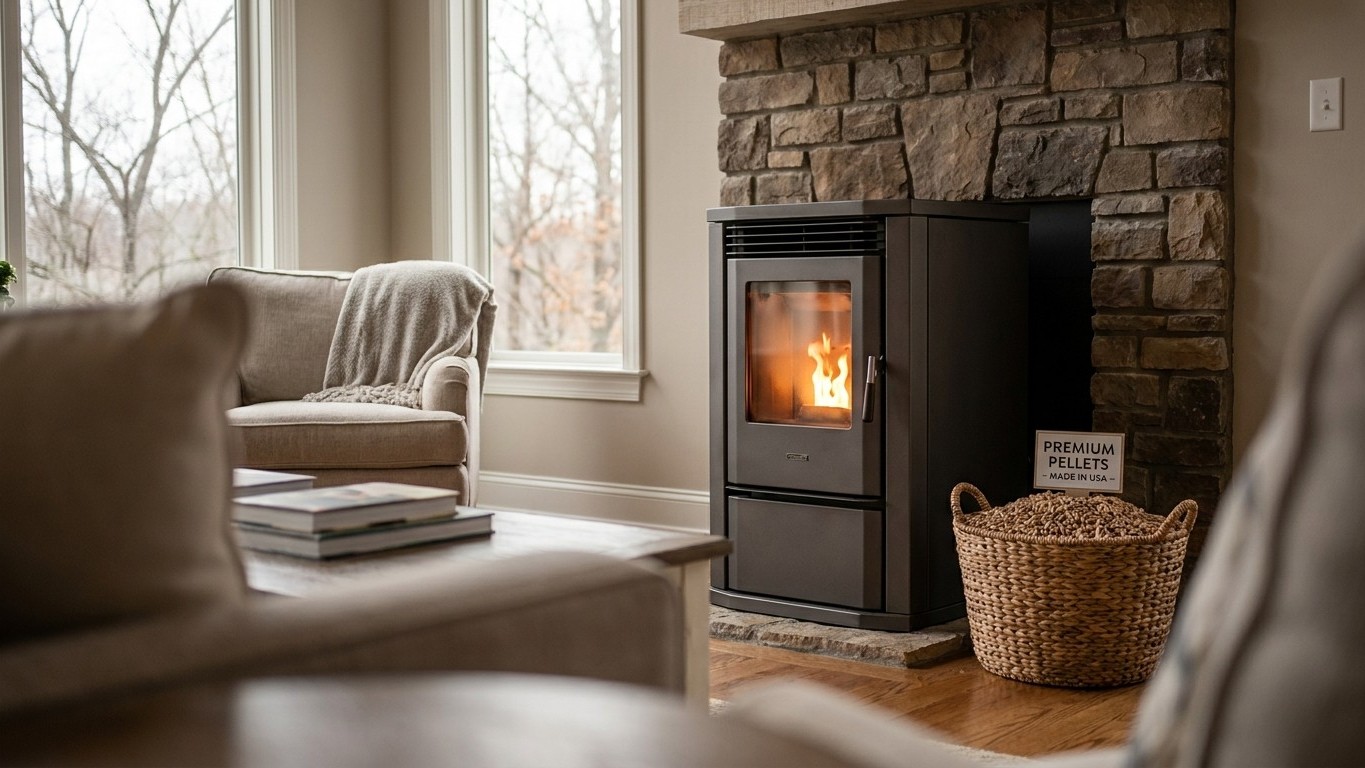

Minneapolis logs roughly 7,399 heating degree days a year, one of the highest totals of any major U.S. metro. That number is the whole answer to what pellet heat costs you here: it sets how many bags a hopper burns, whether the stove carries the house or just supplements a furnace, and how long you’ll be feeding it. Everything below works from that figure.
How hard the winter works here

The 7,399 annual heating degree days come from the Minneapolis/St Paul airport station, NOAA’s 1991-2020 Climate Normal for the metro. Heating degree days measure how far the average daily temperature falls below 65°F, added up across the year. Double the degree days, roughly double the fuel burned to hold the same indoor temperature. At nearly 7,400, Minnesota sits well above the national middle, which means a pellet stove here is doing real work, not just adding ambiance to a room that’s already warm from a furnace.
Depth versus length
Degree days measure depth, but the calendar matters just as much. Heating demand at this station starts in September, the first month whose normal mean temperature (63.5°F) drops below the 65°F baseline, and it doesn’t fully let go until June. That’s about nine months of some heating load. January is the peak, at 1,513 degree days for the month alone, more than a fifth of the entire year’s total packed into thirty-one days. February isn’t far behind at 1,243. Compare that to a state with a shorter but sharper winter: two territories can share the same annual total while feeling completely different to live through. Minnesota’s is long and deep, which is the tougher combination for a heating appliance because the stove doesn’t get much of a break between cold snaps.
One caution worth repeating: this figure comes from one weather station, in the Twin Cities. A house in Duluth or International Falls sits colder and starts its heating season earlier. A cabin near the Iowa border sees a milder version of the same pattern. If you’re not near Minneapolis or St. Paul, check the normal for a station closer to you before you plan fuel around this number.
How many tons a winter takes here
No source publishes a tons-per-winter figure for Minnesota, and anyone who hands you one is guessing. What you can do instead is work the math yourself, because the chain is simple and honest. A standard bag of wood pellets weighs 40 pounds. Fifty bags make a ton. How many tons your house burns depends on how much heat it actually needs to replace, which is exactly what the degree-day figure above measures, translated through your specific house and your specific stove.
Three things move that number more than anything else, and they can push two homes in the same neighborhood a factor of two apart:
- How well the house holds heat — attic insulation, window age, and air sealing decide how much of what the stove produces actually stays inside instead of leaking out through the walls and roof.
- Whether the stove is the main heat or a supplement — a stove asked to carry the whole load through a Minnesota January burns far more than one backing up a furnace on the coldest days only.
- The setting it runs at — a stove left on a low, steady setting for background warmth uses less than one cycling on high to fight off a subzero night.
Given a nine-month heating season and a January that alone accounts for over a fifth of the year’s degree days, don’t be surprised if your fuel use is heavily front-loaded toward December through February, then tapers fast by April. The honest method for your own house is to count the bags in your first winter and use that as your baseline going forward. One measured season on your own equipment beats any estimate built from someone else’s climate, someone else’s insulation, and someone else’s stove. For the general math on bag counts and burn rates, the national page on how many pellets a winter takes walks through the calculation in more detail.
Buying and storing them in this climate
With heating demand starting in September at the Minneapolis/St Paul station, the buying window that matters is late summer, before that ramp-up begins. Pellets are typically cheapest in the off-season, and a hard cold snap anywhere in the upper Midwest can clear dealer shelves fast once real winter sets in. Buying in July or August, rather than scrambling in November, is less about saving money and more about making sure fuel is sitting in your garage instead of on a waiting list when the January degree-day numbers hit.
Storage is where Minnesota’s climate asks for real attention. Wood pellets are compressed sawdust held together by lignin released under heat and pressure, with no added glue. That means damp doesn’t just dampen them, it swells the wood fiber and breaks the pellet apart, turning fuel back into sawdust and dust. A Minnesota summer brings enough humidity to matter, and a Minnesota winter brings the opposite problem: a garage floor that sweats with condensation when temperatures swing, or snowmelt tracked in and left to sit near a pallet of bags. Either one is a slow way to ruin fuel you paid for months in advance.
Keep bags off a bare concrete floor, on pallets or shelving, and under cover even if you think the garage is dry. Don’t buy more than you can store somewhere genuinely protected. And when you’re comparing options, compare price per ton, since that’s the only figure that holds up across bag sizes and retailers. The national storage guide covers container choices and moisture protection in more depth, and the quality page explains what to check in a bag before you commit a garage’s worth of space to it.
What a winter outage means here
A pellet stove is not a wood stove, and the difference shows up the moment the power goes out. Every pellet stove needs electricity to run the auger that feeds fuel into the burn pot and the fan that moves warm air into the room. Cut the power, and the stove stops, regardless of how full the hopper is. That’s the tradeoff for the convenience of automatic feeding and thermostat control that makes pellet stoves easier to live with day to day than splitting and stacking cordwood.
Cross that limitation with a January that averages 1,513 heating degree days at the reference station, and an outage here is not a minor inconvenience. In a state where the heating season runs roughly nine months and the coldest stretches are genuinely dangerous, losing stove heat during a storm-driven power cut is a real problem, not just a chilly evening. That’s a different situation than in a mild climate where an outage just means skipping the stove for one comfortable night.
What most Minnesota households fall back on tells you where the real backup capacity sits. State data shows 73% of homes here use a furnace as their main heating equipment, and 68% run on natural gas specifically, with another 15% on steam or hot-water boilers. Propane accounts for 15% of homes, and electricity as a primary fuel sits at 14%. Central heat pumps and fuel oil don’t have a reliable published share for the state, the survey doesn’t report enough households on those to publish a number, which isn’t the same as saying nobody uses them, just that the data can’t confirm a figure. What that mix means practically: most Minnesota homes have a gas or electric furnace as their real winter safety net, and a pellet stove is the supplement, not the sole source of survival heat if the grid goes down for an extended stretch. Don’t guess at a generator size or battery capacity to bridge that gap. Check the wattage draw printed on your stove’s appliance label, and see the national guide on power cuts and pellet stoves for how to size backup power around what your specific unit actually needs.