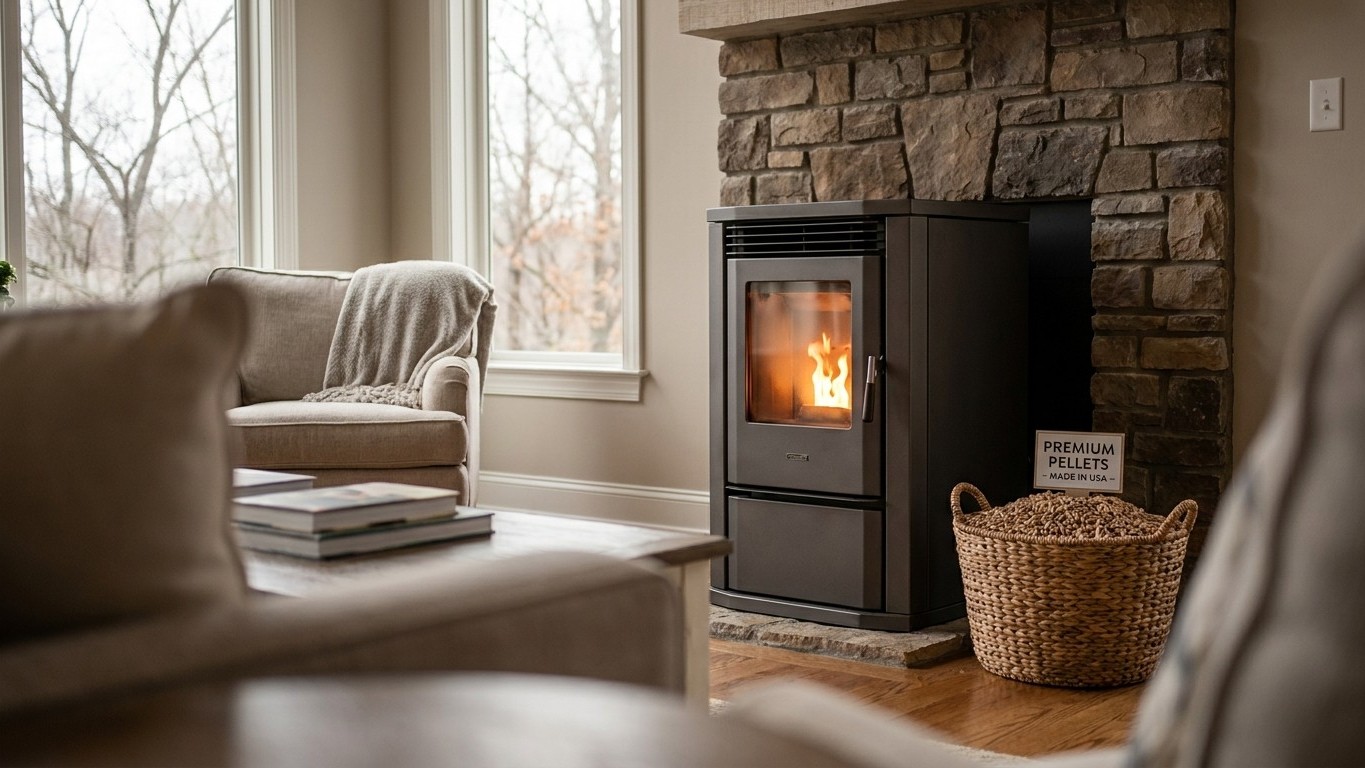

In Burlington, Vermont, winters run up about 6,960 heating degree days a year, one of the coldest tallies in the Northeast. That number means a pellet stove here isn’t a cozy accessory. It’s a real heat source, and a winter’s worth of pellets runs into tons, not bags. Expect to burn through fuel from September into June, with January doing the heaviest lifting.
How hard the winter works here

Start with the number that decides everything else on this page: about 6,960 heating degree days a year, base 65 F, recorded at Burlington International Airport. That figure comes from NOAA’s 1991-2020 Climate Normals, and it’s the standard way climate scientists turn a season into a fuel bill. Every day the average temperature sits below 65 F, the shortfall gets added to the pile. Twice the degree days, roughly twice the fuel burned to keep a given house at a given temperature. Burlington’s total puts it well above most of the country, in the range where heating is the dominant line item in a home energy budget, not a seasonal add-on.
The length of the season matters as much as its depth, and the two aren’t the same thing. Burlington’s heating demand starts in September, the first month whose average temperature (62.7 F) dips below the 65 F baseline. It builds through fall, peaks hard in January at 1,367 degree days for that month alone, and doesn’t fully let go until June. That’s roughly nine months where a pellet stove could plausibly be running, even if only in the shoulder months for a few hours in the morning. A short, brutal winter and a long, moderate one can land on the same annual total. Burlington’s is neither short nor especially moderate. It’s long and deep, which is the tougher combination for anyone budgeting fuel or firewood.
Why the reference station matters
Burlington sits in the Champlain Valley, which is about as mild as Vermont gets. Head up into the Northeast Kingdom, into higher elevations in the Green Mountains, or into any of the state’s colder pockets, and the degree-day count climbs well past this figure. If you’re reading this from Newport, Stowe, or anywhere above roughly 1,500 feet, treat Burlington’s number as a floor, not your actual climate. The mechanism doesn’t change, but the total does, and it can change enough to add real weight to a winter’s pellet order.
How many tons a winter takes here
No agency publishes a per-state or per-town figure for how many tons a pellet stove burns in a season, and it would be misleading if one did. Two houses on the same Burlington street, same size, same stove, can differ by close to a factor of two depending on insulation, air sealing, and how the household actually runs the appliance. What you can do is work the math yourself, using the same logic behind the degree-day figure above: fuel consumption tracks heating demand, and heating demand is what those degree days measure.
The units are simple. A standard bag of hardwood pellets weighs 40 pounds. Fifty bags make a ton. From there, the number that actually determines your winter’s total isn’t a published average, it’s how much heat your specific house needs to stay comfortable through those roughly nine months of demand described above. Three things move that number more than anything else:
- How well the house holds heat — insulation, air sealing, window quality, and whether the stove is heating one open floor plan or fighting to push warmth through a chopped-up older Vermont farmhouse.
- Whether the stove is the sole heat source or a supplement — a stove backing up a furnace or boiler (common here, see below) burns far less than one carrying the whole load through a January cold snap.
- The setting it runs at — a stove left on a low, steady burn all day uses less total fuel than one cranked high for a few hours and left cold the rest of the time, even if the peak burn rate looks similar.
Given that spread, the honest approach isn’t to chase a number that doesn’t exist. It’s to count. Track every bag or ton delivered in your first winter, note how the house felt and whether the stove ran alone or alongside another heat source, and use that tally as your baseline going forward. One measured season in your own house, in Burlington’s actual weather, beats any estimate built from a state average. For the general math behind bag counts, burn rates, and how other regions compare, the national page on how many pellets a winter takes walks through the calculation in more depth.
Buying and storing them in this climate
Heating demand here starts building in September, which is exactly when you don’t want to be shopping for pellets. Buy ahead of that window, ideally over summer, when demand is low and supply is steady. Wait until a hard cold snap hits the region, and you’re competing with every other Vermont household reaching for the same limited stock at the same time, often at the worst possible price. Buying out of season isn’t just about avoiding empty shelves. It’s typically when pellets are cheapest, since dealers aren’t pricing against panic demand.
Storage matters just as much as timing, and it matters more in a climate like this one. Pellets are compressed sawdust, held together by the wood’s own lignin under heat and pressure, with no added glue or binder. That means they have no resistance to moisture. Damp air swells the wood fibers, and once a pellet absorbs enough water it doesn’t just get harder to light, it physically crumbles back into sawdust and dust, which can jam an auger feed or foul a burn pot.
Vermont runs humid summers and wet, often slushy winters, and a lot of pellet storage ends up in garages or basements where a concrete floor sweats with seasonal humidity swings. Bags stacked directly on that floor, or against an uninsulated exterior wall, are the ones most likely to show damage by spring. Pallets, shelving, or anything that keeps bags off concrete and away from a damp wall does more for pellet quality than almost any other single storage decision.
Skip the price talk with any individual dealer, since costs shift with the season and with fuel markets generally. The one number worth comparing across suppliers is price per ton, not per bag. It’s the only unit that lets you compare offers on equal footing. For the fuller storage rundown and how to judge pellet quality by bag, the national storage and quality pages cover the details that apply the same way everywhere, including here.
What a winter outage means here
A pellet stove isn’t a wood stove with a different fuel. It needs electricity to run, full stop. An auger motor feeds pellets from the hopper into the burn pot on a timed cycle, and a fan pushes combustion air in and heated air out into the room. Cut the power, and the fire doesn’t just dim, it stops being fed and goes out, generally within minutes. That’s the tradeoff for the convenience and steady burn a pellet stove offers over a wood stove: it depends entirely on the grid, or on a backup power source, to keep working.
Cross that dependency with Burlington’s degree-day total, and the stakes come into focus. In a climate averaging 6,960 heating degree days a year, with January alone racking up 1,367 of them, a winter power outage during a stretch of single-digit temperatures isn’t an inconvenience. It’s a real heating emergency, especially in a house where the pellet stove is doing meaningful work rather than sitting as a supplement.
Vermont’s own heating mix, from the U.S. Energy Information Administration’s Residential Energy Consumption Survey, shows what most households actually fall back on. Furnaces are the state’s most common primary heating equipment, reported in 51% of homes, and steam or hot-water boilers show up in another 25%. On fuel, fuel oil or kerosene leads at 46% of Vermont homes, with natural gas at 21% and propane at 13%; electric heating sits at 6%, and the survey doesn’t publish a usable estimate for central heat pumps in the state. It’s worth noting that most furnaces and boilers also depend on electricity for their blowers, circulators, or ignition systems, so a power outage in Vermont often means the primary system is down too, not just the pellet stove.
Don’t guess at a generator size or a battery backup capacity based on any of this. Every stove has its own load listed on the appliance’s data label, and that’s the number to size a backup power source against. The national page on power-cut planning covers how to think through generator and battery options in more detail, without pretending a one-size answer fits every model or every home.