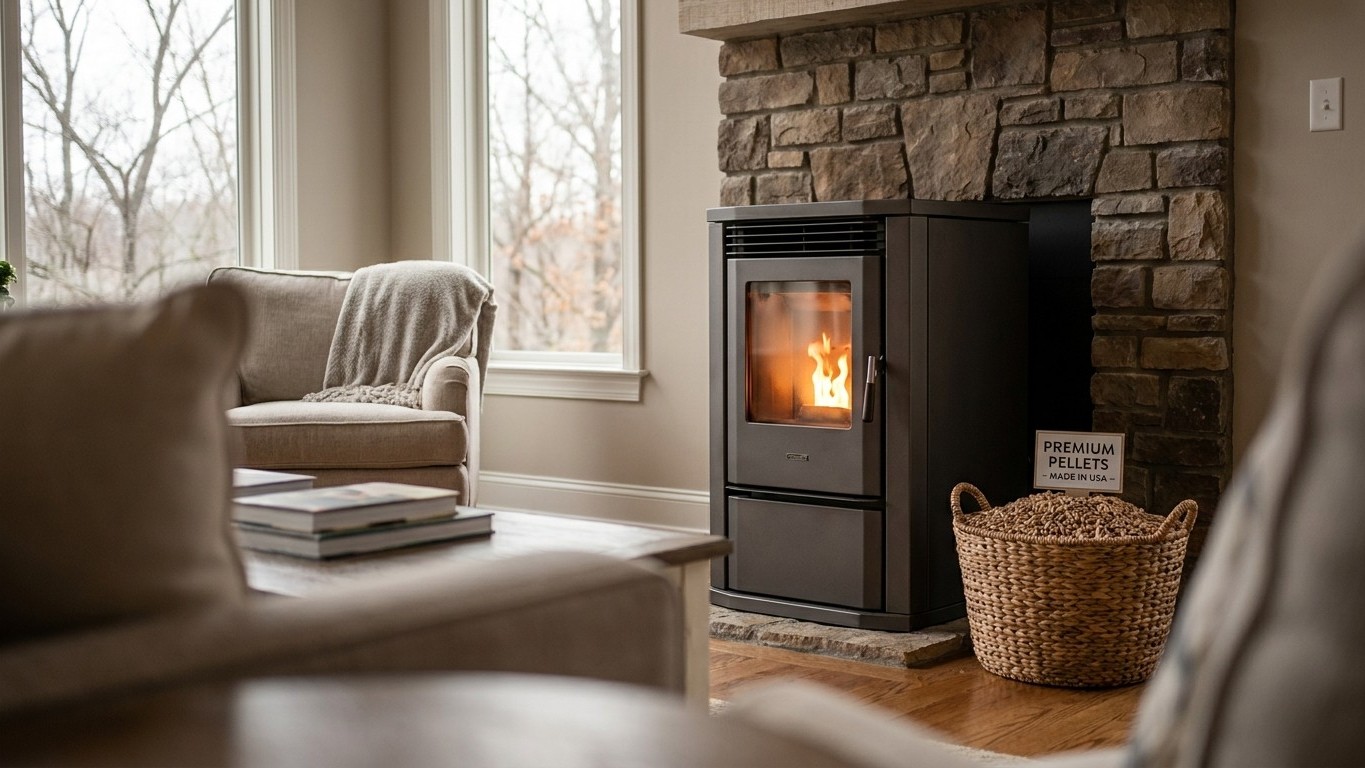

In Yellowknife, a pellet stove almost never works alone. With roughly 8,147 heating degree days a year at the local weather station, and heating demand that never fully drops to zero even in July, most Northwest Territories homes run a hot-air or hot-water furnace as the backbone of their heat and treat the stove as a supplement, a way to zone-heat the main room and cut furnace runtime, not a replacement for a full heating system.
How hard the winter works here

The number that defines this territory is 8,147 heating degree days a year, measured at Yellowknife A and reported by Environment and Climate Change Canada in the 1981-2010 Canadian Climate Normals. That figure is calculated below a base of 18 degrees Celsius, which is 64.4 Fahrenheit, and it comes from a different averaging period than the American degree-day figures used elsewhere on this site. Never set this number next to a US city’s degree-day count and call it a comparison. The base differs, the unit differs, the period differs. What the figure tells you, on its own terms, is that Yellowknife asks for roughly twice the heating fuel of a location with 4,000 degree days, for the same house built to the same standard.
The monthly breakdown is where the real shape of the season shows up. January leads at 1,349 degree-days, December follows close behind at 1,233, and February holds at 1,153. But the striking part is the shoulder months: even May carries 414 degree-days, and September, often thought of as early fall, already runs 323. July, the warmest month on record at Yellowknife A, has a mean daily temperature of 16.9 degrees Celsius, still under the 18-degree base. In practical terms, there is no month at this station where the mean temperature clears the threshold. The heating season here does not open and close the way it does farther south; it simply intensifies and eases.
That has a direct consequence for how you should read the rest of this page. A pellet stove in a region with 2,500 or 3,000 degree-days can plausibly run as the only heat source for a well-built, well-sealed house. At 8,147 degree-days, that math changes. The stove becomes the heater for the room you live in most, while a furnace or boiler carries the load through the coldest stretches and through the hours nobody wants to be feeding a hopper. If you’re near Yellowknife, this figure describes your winter closely. If you’re at the far north of the territory, above the treeline, or well south near the Alberta border, your local station will read differently, and it’s worth checking your own nearest normals rather than assuming Yellowknife’s numbers travel.
How many tons a winter takes here
There’s no published figure for tons-per-winter in the Northwest Territories, and there shouldn’t be one you trust if you find it. Consumption depends on the heat a specific house actually loses, and that varies enough between two homes on the same street that a single number would mislead more than it would help. What you can do is build the estimate yourself, using the same chain everyone in the industry uses.
A standard bag of wood pellets weighs 40 pounds. Fifty bags make a ton. From there, consumption tracks the heat your house needs to replace, which is exactly what the degree-day figure above measures: more degree-days, more fuel burned to hold the same indoor temperature. A house that needs to fight 8,147 degree-days a year is working harder, ton for ton, than one facing half that load, assuming similar construction.
Three things move your actual number away from anyone else’s:
- How well the house holds heat. Insulation levels, air sealing, and window quality change fuel use by a wide margin between two houses of the same size.
- Whether the stove is the only heat or a supplement. In a territory where most homes run a furnace as primary heat, as the equipment data below shows, many stoves here are only asked to cover part of the load, which cuts pellet use sharply compared with a stove running as sole heat.
- The setting it runs at. A stove left on a low or medium setting through the shoulder months, then pushed to high through December and January, burns a very different total than one run flat-out all season.
The honest method, and the only one that actually fits your house, is to count bags through your first winter. Track every delivery or every bag purchased, note it against how the stove was set and how much it carried the heating load, and you have a baseline specific to your address, your wood supply, and your habits. One measured season beats every estimate on this page or any other. For the national methodology behind this math, including how climate zone and house size interact, see our guide on how many pellets a winter takes.
Buying and storing them in this climate
Given that Yellowknife’s degree-day count barely dips even in summer, there’s no true off-season here the way there is farther south, but demand for pellets still follows the calendar, not the thermometer reading in July. Buy before the stretch running roughly October through March, when degree-days climb fast and household demand across the territory spikes at once. A regional cold snap, or a supply hiccup on the single road or barge route serving many northern communities, can empty local shelves fast. Pellets are also typically cheapest when demand is lowest, in the summer months when the degree-day load, while never at zero, is at its yearly floor.
Storage against this climate
Wood pellets are compressed sawdust held together by the wood’s own lignin, with no added glue. That construction is exactly why moisture is the enemy: dampness swells the pellet, breaks the bond, and leaves you with crumbled sawdust that won’t feed properly through an auger. In a territory with long, deep-cold winters and short summer thaws, the storage risk isn’t so much humid air as it is meltwater and condensation. A garage or shed floor that sits on permafrost or on ground that freezes and thaws unevenly can sweat or pool water during spring breakup, and pellets stored directly on that floor, or against an exterior wall that condenses in a cold snap, absorb enough moisture to ruin a pallet before it’s burned.
Keep bags off the floor, on pallets or shelving, away from exterior walls, and under cover even indoors if there’s any chance of a leak or a burst pipe overhead. Buy by the pallet where that option exists, since it’s more efficient to move and store in bulk than in bags one at a time, and always compare price per ton rather than per bag, since bag sizes and pallet counts aren’t always identical between suppliers. For the full national breakdown on moisture, shelf life, and where to store a season’s supply, see our pellet storage guide, and for what separates a pellet that burns clean from one that clogs an auger, our pellet quality guide.
What a winter outage means here
A wood stove burns without electricity. A pellet stove does not. The auger that feeds fuel into the burn pot, the igniter, and the fan that pushes heat into the room all run on household power, and when the grid goes down, the stove goes cold no matter how full the hopper is. That single fact separates a pellet stove from a wood stove more sharply the colder the climate gets, and few Canadian climates get colder on paper than this one.
Set against 8,147 heating degree days a year, an outage here isn’t a minor inconvenience. In January, when degree-days peak at 1,349 for the month, losing the stove during a power cut means losing your main supplemental heat source during the coldest stretch of the year, at the exact moment a furnace under strain most needs the help. In July, with the load at its lowest, the same outage is closer to an evening without the stove and nothing more. The stakes here move with the calendar as much as anywhere the degree-day figure varies month to month.
What most households fall back on is the primary furnace itself. Statistics Canada’s 2012 survey of territorial dwellings, the only year that data is broken out for the three territories, found hot-air furnaces heating 56 percent of homes and steam or hot-water furnaces heating another 30 percent, meaning the large majority of Northwest Territories homes already lean on a furnace-based system rather than a stove as their primary heat. Electric baseboard heating and wood stove use weren’t reported separately in that survey, which means suppressed or unavailable data, not zero, so don’t assume either is common or absent based on this figure alone. And note the year: 2012 is now over a decade old, and the heating stock has shifted since, heat pumps in particular, so treat this as a baseline rather than today’s exact mix.
Because most furnaces also need electricity to run their blowers and ignition systems, a power cut in the Northwest Territories often takes down the primary heat and the pellet stove at the same time, which is worth planning around rather than assuming a furnace will simply keep going where a stove stops. For backup capacity, check your specific appliance’s power draw on its own label rather than guessing, and see our power outage and pellet stove guide for how to plan around a grid failure without over- or under-sizing a backup power source.