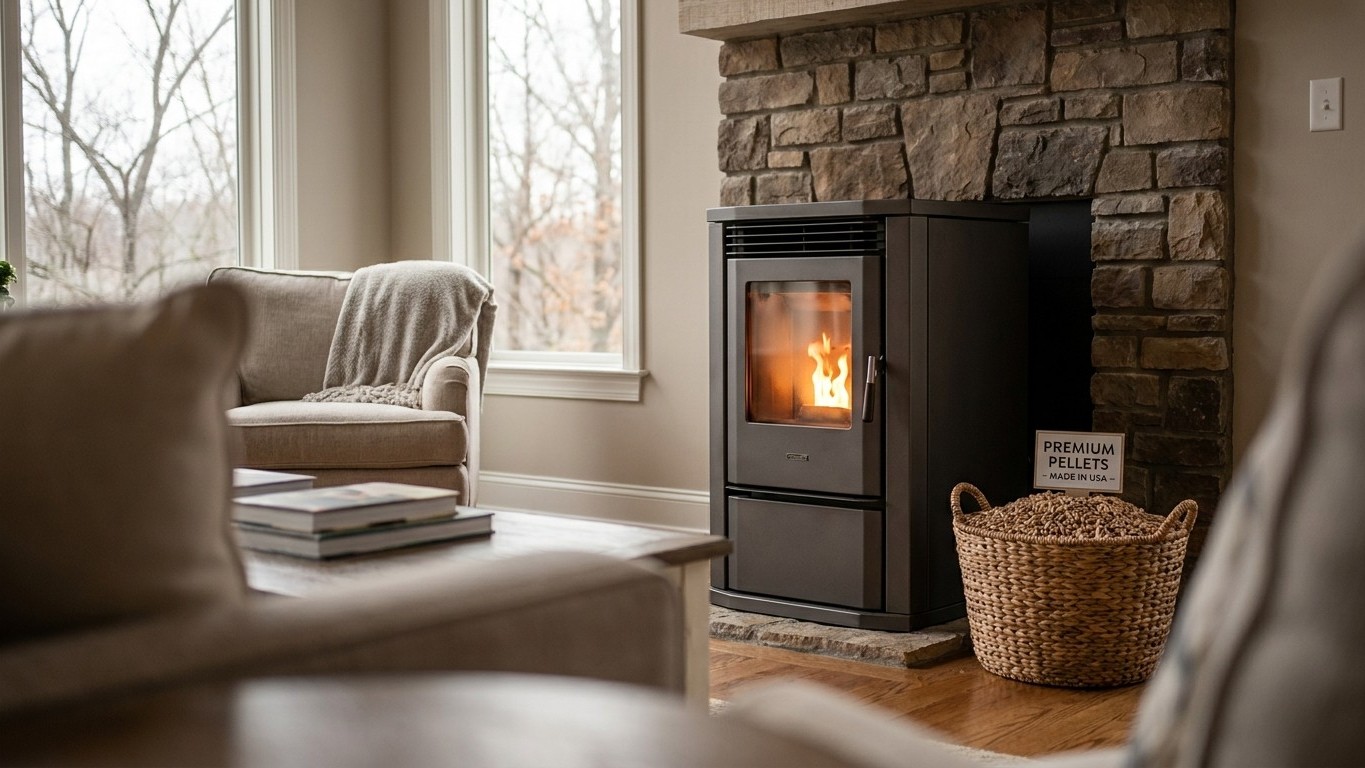

At Rankin Inlet, the reference weather station for Nunavut, the climate racks up about 10,376 heating degree days a year. That number, not the calendar, is what decides everything else here: how many tons a pellet stove burns through, whether it can carry the house alone, and how long the hopper has to keep working. In a climate this demanding, a pellet stove is rarely a lifestyle choice. It’s a heating decision with real consequences.
How hard the winter works here

Environment and Climate Change Canada’s Canadian Climate Normals (1981-2010) put Rankin Inlet A at roughly 10,376 total degree-days below 18°C a year. That figure is the whole story in one number: double the degree days, and you’re roughly doubling the fuel needed to hold a given house at a given temperature, all else being equal. A stove sized comfortably for a place with half that load will spend a Nunavut winter working at or past its rated output, night after night, for months.
This figure cannot be lined up against an American degree-day number. The base temperature differs (18°C here versus 65°F, or about 18.3°C, in U.S. tables), the unit differs, and the reference period differs (1981-2010 at Rankin Inlet versus 1991-2020 for U.S. stations). Multiplying by 1.8 gets you into the right order of magnitude in Fahrenheit degree-days and nothing more precise than that. Treat the number as a Nunavut number, full stop.
A season that never really lets up
What makes Nunavut different from almost anywhere else covered in this series isn’t just the size of the number, it’s the shape of the year. At Rankin Inlet, the normal mean daily temperature stays below the 18°C heating base in every single month, including July, the warmest month, which normals put at 10.5°C. There’s no month where the heating load drops to zero. Demand peaks hardest in January, at 1,514 degree-days for that month alone, but even the shoulder months carry real load: 1,008 in April, 736 in May, and a rebound to 1,050 in November as the dark comes back.
That’s depth and length showing up as two separate facts. A place can have a brutal January and a genuinely short season either side of it; Rankin Inlet has the brutal January and a season with no real off-switch. For a homeowner, that means a stove here isn’t cycling on for six months and idle for six. It’s in near-constant service, at varying intensity, all year. And Rankin Inlet is one station on one coast of a territory that stretches across multiple climate zones, a household further north or on Baffin Island should check normals for their own community rather than assume this figure applies uniformly.
How many tons a winter takes here
Nobody can hand you a tons-per-winter number that fits your house, and any territorial figure that claims to is guessing. What you can do is work the math the way it actually behaves, then adjust with real numbers once you’ve burned through a season.
Start with the units. A standard bag of wood pellets weighs 40 pounds, and a ton is 50 bags. From there, consumption is driven by the heat the house actually loses, which is exactly what the degree-day figure above measures. A well-sealed, well-insulated home in Rankin Inlet’s climate will burn through fewer bags per degree-day than a drafty one, but both are working against a load that never fully goes away.
Three things move the number more than anything else:
- How well the house holds heat — insulation, air sealing, and window quality decide how many BTUs escape for every degree of outdoor cold, which is the difference between a stove that keeps up and one that struggles.
- Whether the stove is the only heat source or a supplement — a stove backing up a furnace burns a fraction of what one carrying the whole house does, even in the same building.
- The setting it runs at — a stove run near its top output through January burns pellets at a very different rate than one idling on low through a milder shoulder month.
Given how much those three variables swing the total, and how extreme the local degree-day load already is, the only genuinely useful number is the one you generate yourself. Count the bags you buy and burn across one full season, note roughly how the stove was set through January versus October, and you have a baseline specific to your house that no published estimate can match. One measured winter beats every calculation on this page. For the general math behind bag counts and ton estimates, see the national page on how many pellets a winter takes.
Buying and storing them in this climate
Because the heating season at Rankin Inlet never fully closes, “buying ahead” here means something different than it does further south. There’s no clear month where demand drops to zero and shelves refill at leisure. What that means practically is buying during whatever window your community’s supply chain has open, rather than waiting for a lull that doesn’t reliably come. A regional cold snap, or a delay in a seasonal shipment, can empty local stock fast in a territory where resupply isn’t a quick truck run. Pellets bought and moved outside the peak-demand crunch also tend to run cheaper than pellets bought when everyone else is scrambling for the same limited supply.
Storage is the other half of the equation, and it matters more in a climate of extremes than almost anywhere. Wood pellets are compressed sawdust held together by the natural lignin in the wood, with no added glue. That means they have no tolerance for moisture: damp air swells the pellets, and once that happens they crumble back toward sawdust and lose their burn quality. In a territory with a long, hard winter and short, variable summer conditions, the risk isn’t a humid August so much as condensation. A concrete garage or shed floor that sweats when temperatures swing, or a storage space that isn’t sealed against blowing snow finding its way in through gaps, can ruin a pallet of pellets before they ever reach the hopper. Keep pellets off bare concrete, in a dry, enclosed space, and check bags for any sign of dampness or swelling before they’re stacked for the season.
On price, the only number worth comparing is cost per ton, not per bag and not per pallet, since packaging and bag count vary between suppliers. For the fuller picture on storage conditions and how to judge pellet quality before you buy, see the national storage guide and quality guide.
What a winter outage means here
A pellet stove needs electricity to run. An auger motor feeds pellets from the hopper into the burn pot on a timed cycle, and a blower moves both combustion air and heated air through the room. Cut the power, and the stove stops feeding itself and stops pushing heat out, regardless of how many tons of fuel are sitting in the hopper. That’s the fundamental difference from a wood stove, which keeps burning through a blackout because gravity and a damper don’t need a wall outlet.
Cross that dependency with a degree-day load of roughly 10,376 a year, in a place where every month of the year sits below the heating base, and an outage stops being an inconvenience. In January, with 1,514 degree-days of demand for that month alone, a power failure that knocks out a pellet stove is a heating emergency, not an evening without ambiance. There’s no mild season here to soften the timing of when the power might go out.
Statistics Canada’s 2012 survey of territorial dwellings, the most recent year that data covers Nunavut, found that among the main heating equipment in use, 53% of households relied on a steam or hot-water furnace and 39% on a hot-air furnace. Figures for electric heating, wood stoves, and other equipment were not published for the territory, which means suppressed, not zero. What that points to is a heating stock built primarily around central furnaces rather than stoves, which for most homes puts a pellet stove in the role of supplement rather than sole heat source, and it means the fallback during an outage for most households is whatever keeps that furnace running, not the pellet stove itself. That data is now well over a decade old, and the equipment mix has likely shifted since, heat pumps in particular, so don’t treat it as current fact for any specific home. Rather than guessing at a generator size or battery capacity here, check the wattage and startup draw listed on your stove’s data plate, and see the national power-cut guide for how to plan backup power around those numbers.