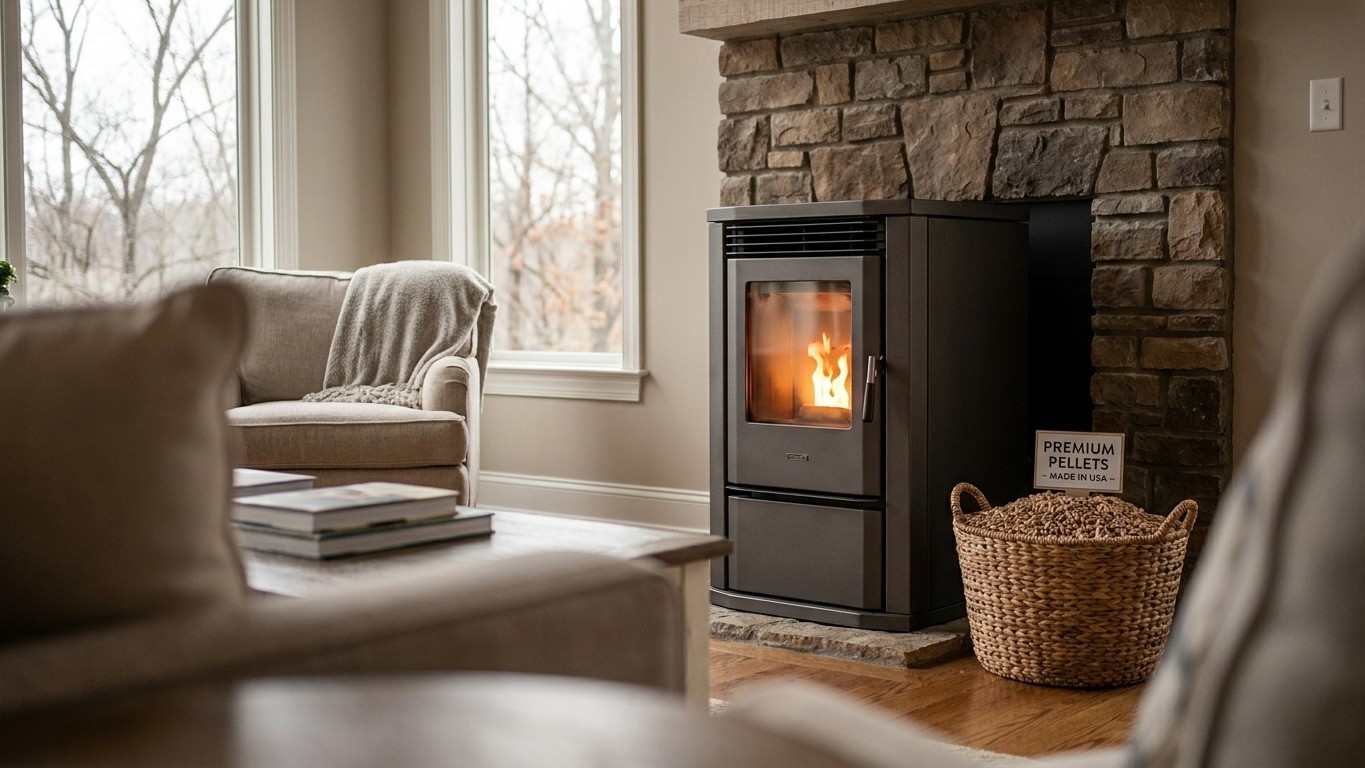

A Quebec winter isn’t a cold snap you ride out with the thermostat down. It’s a nine-month heating season built on one of the highest degree-day totals of any market on this site, and it changes every number that matters: how many bags you’ll burn, when to buy them, how to store them, and what happens when the power drops mid-storm. Here’s how that plays out for a pellet stove specifically.
How hard the winter works here

Montreal’s Pierre Elliott Trudeau International Airport station logs about 4,363 heating degree days a year below 18°C, based on the 1981-2010 Canadian Climate Normals from Environment and Climate Change Canada. That single figure is the whole story for anyone running a pellet stove in this province. Degree days measure how much heating a building needs over a year, and they scale almost linearly with fuel burned: a house facing 4,363 degree days works roughly twice as hard as one facing 2,200. This is not a marginal, take-it-or-leave-it heating climate. It’s a demanding one, and a pellet stove here is doing real work, not just adding ambiance to a living room that’s already warm from something else.
The depth of the cold is only half the picture. The length of the season is the other half, and it’s easy to miss because the two don’t move together. Using the same Montreal data, the mean daily temperature drops below the 18°C heating threshold in September and doesn’t climb back above it until June, a season that stretches across roughly nine months. January carries the heaviest load, at 862 degree-days for the month alone, more than double April’s 348. February and December aren’t far behind. What that means in practice: this isn’t a short, brutal cold snap followed by mild shoulder seasons. It’s a long, sustained demand that starts before most people think about firewood or pellets at all, tapers slowly through spring, and barely lets up for three or four months in the dead of winter.
One caution matters here: Montreal is one station, not a stand-in for the whole province. A reader heating a home in the Gaspésie, Abitibi-Témiscamingue, or the Laurentians north of the city is very likely looking at a colder, longer season than what Trudeau Airport records. Someone closer to the Ontario border or in the milder pockets of the Eastern Townships may see somewhat less. If you want a number that actually applies to your address, Environment and Climate Change Canada’s climate normals tool lets you look up the nearest station rather than relying on a provincial average that smooths over real regional differences.
How many tons a winter takes here
Nobody can hand you a tons-per-winter figure and have it mean anything for your specific house, and any source that tries is guessing. What you can do is work the math yourself, starting from the same units the industry uses everywhere. A standard bag of wood pellets weighs 40 pounds. Fifty of those bags make a ton. From there, consumption tracks the heat your house actually needs to shed, which is exactly what that Montreal degree-day figure above is measuring: more degree-days, more pellets, in something close to a straight line.
Three things push that number up or down for any given household, and they can easily double or halve the total between two houses on the same street:
- How well the house holds heat — insulation, air sealing, window quality, and even how exposed the home is to wind all change how many BTUs escape per hour, and pellets exist to replace those BTUs.
- Whether the stove is the only heat source or a supplement — a stove asked to carry the whole house through a Montreal January burns dramatically more than one that’s just taking the edge off while electric baseboards or a heat pump do most of the work.
- The setting it runs at — a stove left on a high or continuous setting through the coldest stretches consumes noticeably more than one dialed back and used only in the evenings or in the coldest rooms.
Because those three variables interact, published averages tend to be close to useless for an individual home. The honest approach is to treat your first winter as a measurement, not a guess. Track every bag you bring in and every bag you burn, note roughly how cold it got and how you ran the stove, and by spring you’ll have a number that’s specific to your house, your habits, and this exact climate, which beats any estimate on this page or anywhere else. For the general math on translating a heating season into a bag or ton count, the national page on how many pellets a winter takes walks through the calculation in more detail.
Buying and storing them in this climate
Timing matters more here than in milder markets, because the season starts early and stays long. Since heating demand in the Montreal area begins climbing in September, the smart window to buy is before that month, ideally over the summer when demand is low and dealers are moving inventory ahead of the rush. Wait until a January cold snap grips the province and shelves can run thin fast, because everyone else waiting for a “good deal” is now buying at the same panicked moment you are. Buying early also tends to land you the lowest per-ton price of the year, since pellets, like a lot of heating fuel, get more expensive as demand peaks.
Storage is where Quebec’s specific climate becomes a real factor rather than a footnote. Wood pellets are compressed sawdust held together by the natural lignin in the wood, with no glue or binder, which means they’re only as strong as they are dry. Any moisture, whether from humid summer air or a damp storage space, swells the wood fibers and breaks the pellets down into fine dust and mush. Quebec’s summers along the St. Lawrence valley run humid enough to matter, and winters bring their own moisture problem through freeze-thaw cycles that leave garage floors and basement slabs sweating with condensation. A bag sitting directly on a concrete floor through one of those thaw periods can pull in enough moisture to ruin the bottom layer of pellets before you ever load the hopper.
Skip the temptation to compare prices per bag, since bag sizes and packaging vary between suppliers. Compare per ton instead, since that’s the only unit that lines up apples to apples regardless of how the pellets are bagged. For the deeper mechanics of why moisture destroys pellets and how to keep a stockpile dry through an entire season, the national storage guide and the pellet quality page cover that ground without repeating it here.
What a winter outage means here
A pellet stove is not a wood stove with a different fuel. It needs a working electrical outlet to run the auger that feeds pellets into the firebox and the blower that pushes heat into the room. Cut the power, and the stove goes cold within minutes, no matter how full the hopper is. That single design fact separates pellet heat from a cast-iron wood stove in a way that matters more the harder the winter gets, and with 4,363 degree-days stacked up over a Montreal-area season, this isn’t a small detail.
Context changes what an outage actually costs you. In a mild climate, losing power for an evening might just mean skipping a cozy fire. Here, with January alone carrying 862 degree-days of demand, an outage during a deep-cold stretch is a genuine heating emergency, especially for anyone leaning on the stove as a significant part of their heat.
Statistics Canada’s 2023 data on primary heating systems shows what most Quebec households actually fall back on: electric baseboard heaters lead by a wide margin at 54%, followed by heat pumps at 16%, forced-air furnaces at 11%, boilers with hot-water or steam radiators at 4%, and heating stoves as a primary system at just 2%. That matters for outage planning in a way that isn’t obvious at first: because more than half the province’s homes already depend on electricity as their main heat source, a grid outage here doesn’t just silence a supplemental pellet stove, it often knocks out the primary furnace too, for the same household, at the same time. Sizing a generator or battery backup is a decision for your specific appliance’s electrical draw, listed on its rating label, not a one-size figure. For the broader picture on riding out a cold-weather power failure, the national page on power cuts and pellet stoves covers what to plan for before the next storm knocks the lines down.