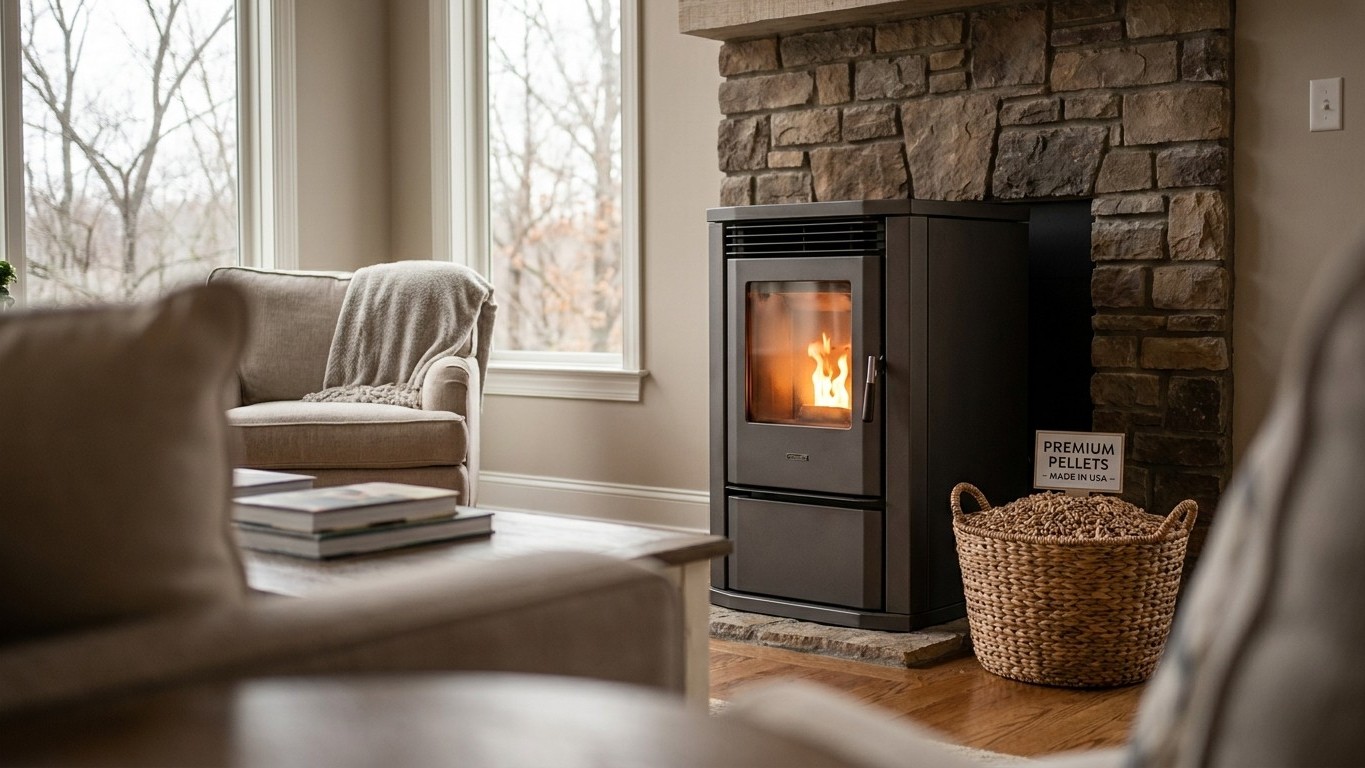

A pellet stove in Rhode Island works through a genuinely long heating season, but the state’s degree-day numbers put it closer to a moderate New England winter than a brutal one. That combination changes how you plan: expect the stove to matter from October well into spring, budget for a real tonnage of fuel each year, and treat storage and backup power as more than an afterthought given the coastal humidity and the length of the cold months.
How hard the winter works here

The reference station at Providence T F Green Airport logs about 5,478 heating degree days a year (base 65 F), against roughly 812 cooling degree days. That gap tells you almost everything: Rhode Island spends far more of the year fighting cold than heat, and a pellet stove here has real work to do rather than serving as a fireside accessory. For comparison, a mild coastal climate might sit closer to 2,000-3,000 heating degree days a year; Providence runs nearly double that, which means roughly double the fuel burn for an equivalent house compared to those milder regions.
The length of the season matters as much as its depth. Heating demand starts in October, the first month whose normal mean temperature (54.4 F) drops below the 65 F threshold NOAA uses to count degree days. It builds through the fall, peaks in January at 1,079 degree days, and stays substantial through February (924) and March (808) before tapering. The mean temperature doesn’t climb back above 65 F until June, which makes for an eight-month heating season stretching from October through May. That’s a long, steady demand rather than a short, sharp cold snap, and it’s worth noting those are different things: a place can average out to the same annual total as somewhere with three brutal months and nine easy ones, but the day-to-day experience of feeding a stove is completely different.
Because the annual figure lands in a moderate-to-substantial range rather than a low one, a pellet stove in most of Rhode Island can reasonably serve as a significant heat source, not just ambiance, especially paired with the furnace or boiler that already heats most homes in the state. That said, Providence T F Green sits in the coastal, moderated part of the state. Woonsocket and the Blackstone Valley to the north, or the inland pockets of Washington County, run measurably colder in a hard winter, so a household away from the coast should treat the 5,478 figure as a floor rather than a ceiling for its own fuel needs.
How many tons a winter takes here
Nobody can hand you a single tons-per-winter number for your house, because pellet consumption follows heat demand, and heat demand depends on the building as much as the climate. What you can do is work the math yourself. A standard bag of pellets weighs 40 pounds, and fifty of those bags make a ton. From there, consumption tracks the same degree-day logic that shapes the season above: a house that needs to make up 5,478 heating degree days over eight months burns through fuel at a pace no flat estimate can capture, because three things move that number independently.
- How well the house holds heat — insulation, air sealing, and window quality can shift fuel use by 30% or more between two homes of similar size.
- Whether the stove is the only heat source or a supplement — a stove backing up an existing furnace or boiler runs far less than one carrying the whole house through January and February.
- The setting it runs at — a stove left on a high, constant setting through the coldest stretch (that January peak of 1,079 degree days) will chew through pallets faster than one cycled down overnight or when the house is empty.
Any published figure claiming to know “how many tons Rhode Island uses” is guessing, because two houses on the same street can differ by a factor of two depending on those three variables alone. The only number worth trusting is the one you generate yourself: count the bags burned in your first full winter, from the October start of the heating season through the tail end in May, and use that as your baseline going forward. One measured season on your own stove, in your own house, beats every regional estimate you’ll find online. For the general math behind bag-to-ton conversions and typical ranges by house size, the national page on how many pellets a winter takes walks through the calculation in more detail.
Buying and storing them in this climate
Timing the purchase matters more in Rhode Island than the calendar might suggest. Heating demand starts climbing in October, so buying ahead means having pellets in the garage or shed before that month, not during it. Once a regional cold snap hits, and given a season that peaks hard in January, local shelves can empty fast, and pellets bought in the scramble of a cold week almost always cost more than the same fuel bought in August or September, when demand is flat and suppliers are stocking up rather than drawing down.
Storage is where the coastal climate becomes a real factor. Pellets are compressed sawdust held together by natural lignin, with no glue or binder, which means they’re vulnerable to moisture in a way firewood simply isn’t. A bag that gets damp doesn’t just get harder to burn; it swells, crumbles, and can turn to sawdust mush before you ever load the hopper. Rhode Island’s summers run humid, and a garage floor in a coastal town can sweat condensation on muggy August nights even when no rain has fallen in days. That’s enough to ruin the bottom layer of a pallet stacked directly on concrete.
The practical response is straightforward: keep pellets off the floor on pallets or shelving, keep them under cover, and avoid airtight plastic that traps whatever ambient moisture is already in the bag. None of that changes because you’re in Rhode Island specifically, it changes because Rhode Island’s summers and coastal air make the general storage rules matter more than they would in a dry inland climate. If you’re comparing suppliers, compare by price per ton, since that’s the only unit that lets you line up one seller against another honestly. For a full rundown on moisture control and how to judge pellet quality before you buy, see the national storage guide and the pellet quality page.
What a winter outage means here
A pellet stove is not a wood stove, and the difference shows up the moment the power goes out. Pellet stoves rely on an auger to feed fuel into the burn pot and a fan to move combustion air and distribute heat; both need household electricity to run. Cut the power and the stove stops working within minutes, regardless of how full the hopper is. That’s a real constraint in a state carrying 5,478 heating degree days and an eight-month season, because an outage in January, sitting near that seasonal peak of 1,079 degree days, is a heating emergency in a way the same outage in October or April simply isn’t.
What a household falls back on during that outage depends on what’s already heating the house, and Rhode Island’s numbers are specific. Furnaces are the main heating equipment in 51% of homes, steam or hot-water boilers in another 33%, and natural gas fuels 53% of homes while fuel oil or kerosene fuels 31%. Electricity as a primary fuel sits at 13%. Central heat pumps and propane don’t have published figures for the state in this survey, meaning the estimate exists but was suppressed as unreliable, not that no one uses them.
That equipment mix matters for outage planning because a furnace or boiler running on electricity for its blower or circulator pump can fail in a power cut just as surely as a pellet stove does, even if the fuel itself (gas or oil) keeps flowing. Sizing a generator or a battery backup is a decision for the appliance label on your specific stove and furnace, not a guess based on state averages. The national page on pellet stoves and power outages covers what capacity and runtime actually require before you buy anything.