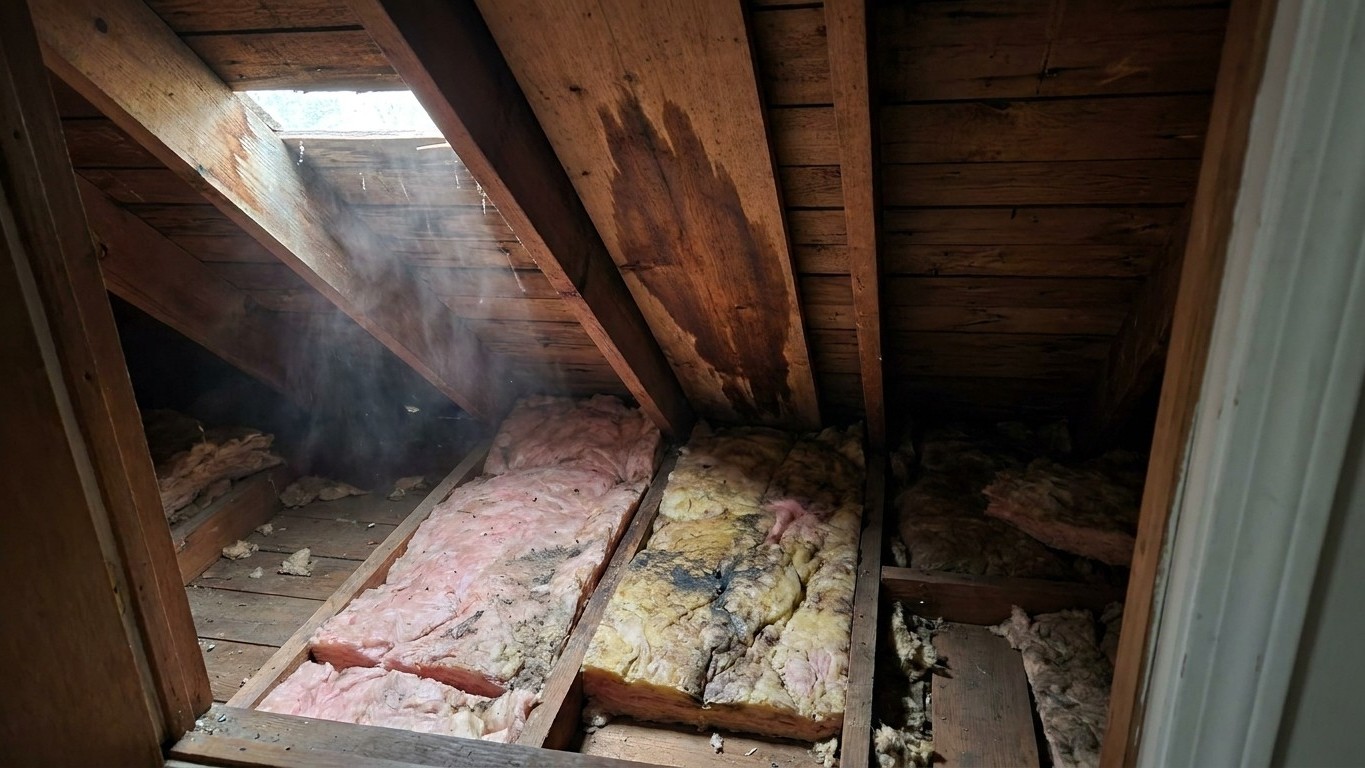

Water rarely announces itself on the roof surface. It shows up first in the attic, as a stain on a rafter, a patch of daylight where there shouldn’t be any, or Insulation that feels damp instead of dry and springy. Catching those attic leak signs early, from inside the house, tells you far more than staring up at shingles from the yard ever will.
What is actually happening
A roof deck is built to keep water on one side and a dry house on the other. When that separation fails, it rarely fails all at once. Water finds a gap, a nail hole, a cracked flashing seam, or a spot where a shingle has lifted, and it travels along the underside of the decking before it drips anywhere visible. That’s why the first sign of trouble is almost never a puddle on the floor below. It’s a dark trail on a rafter, sometimes a foot or more from where the water actually entered.
Wood reacts to moisture before it reacts to failure. A rafter or piece of decking that’s been damp for a while darkens, sometimes with a faint ring pattern where water has dripped and dried repeatedly. That staining is the roof’s own record of what’s been happening above it, and it’s readable long before any structural damage sets in. The color and shape of a stain,, gives a rough sense of whether the leak is a one-time event or an ongoing path.
Why daylight matters more than stains
Daylight coming through the roof deck is a more urgent sign than a stain, because it means there’s an actual gap, not just old moisture. Standing in the attic during the day, with the lights off, and looking up along the slope of the roof will reveal any pinpricks of light. Those points are exactly where wind-driven rain or melting snow will get in. A stain tells you what already happened. A pinhole of daylight tells you it’s still happening.
Insulation is the third clue, and it’s often the one people miss because it doesn’t look dramatic. Fiberglass batts or loose-fill insulation that’s matted down, discolored, or noticeably heavier than the insulation around it has absorbed water at some point. Wet insulation stops doing its job as a thermal barrier almost immediately, which is part of why an attic leak often shows up first as an oddly cold or damp-smelling room below, before anyone spots a stain on the ceiling drywall itself.
None of this requires guessing at how old the roof is or what it’s made of. The deck, the rafters, and the insulation are telling a story you can read directly, using nothing more than a flashlight and a few minutes of attention.
What you can see without climbing
A full check of attic leak signs can be done without ever setting foot on the roof itself. It works best as a two-part routine: a look from the ground, then a look from the attic.
- Scan from the ground first. Using binoculars or a phone camera zoomed all the way in, walk around the perimeter of the house on a dry day and look at the roof slopes for anything obviously out of place: shingles that look curled, lifted, or missing, dark streaking running down from a valley or a chimney, or moss and debris built up in one concentrated area. This step tells you where to point your attention once you’re inside.
- Go up into the attic with a flashlight, not the overhead light. Attic bulbs, when they exist, are usually too dim and too centrally placed to catch fine detail near the eaves. A handheld flashlight or headlamp lets you point light along the underside of the roof deck at a low angle, which makes stains and gaps far easier to spot than overhead lighting does.
- Check for daylight with the attic lights off. Any pinpoint of light coming through the deck is a location worth marking, even if it seems minor. It’s easiest to see this on a bright, sunny day, and hardest on an overcast one, so timing the check matters.
- Run a hand along rafters and along the underside of the decking. Look specifically near chimneys, plumbing vents, skylights, and valleys, since these penetrations are where flashing failures Concentrate. Dark, discolored wood or a texture that feels soft rather than solid are both signs of past or ongoing moisture.
- Press gently on insulation in a few spots. Compare how it feels near the eaves versus near the center of the attic. Insulation that’s compressed, darker than its surroundings, or noticeably damp to the touch has been wet, whether recently or in the past.
Doing this walk-through twice a year, and again after any major storm, is usually enough to catch a developing problem while it’s still small. If any of these checks turn up something concrete, that’s the point to move from observation to a proper roof inspection rather than trying to diagnose the cause yourself from inside the attic.
What it costs to leave it
An attic leak that goes unaddressed doesn’t stay contained to the roof deck. Water follows gravity and the path of least resistance, which usually means it travels along a rafter, drips onto insulation, and eventually reaches the ceiling drywall of the room below. That’s when a homeowner typically notices something: a yellowish-brown stain spreading across a ceiling, or paint that starts to bubble and peel in one corner of a room.
Wet insulation is the first real casualty, and it’s a quieter one than a ceiling stain. Once fiberglass or cellulose insulation gets saturated, it compresses and loses much of its ability to trap air, which is the entire mechanism behind how insulation works. A section of attic insulation that’s been wet repeatedly can end up performing significantly worse than dry insulation right next to it, even after it dries out again, because the fibers have matted down and lost loft.
Wood doesn’t fail quietly, but it fails slowly
Rafters and roof decking are structural wood, and repeated wetting followed by drying is what eventually leads to rot, not a single leak event. Rot softens wood fiber by fiber, and by the time it’s visible as a soft or spongy spot you can push a finger into, the damage has usually been building for a while under the surface. The exact timeline depends heavily on climate, ventilation, and how often the area gets wet, which is exactly why this article won’t put a number of months or years on it. What’s true everywhere is that the wood tells you before it fails outright: darkening, then softening, then visible sagging or crumbling are the progression.
Mold and mildew often show up alongside sustained moisture, particularly in attics with poor airflow. A musty smell noticed in an upstairs room, especially one that gets stronger after rain, is frequently traceable to a damp attic space rather than anything happening at floor level. That smell is worth taking seriously even before any visible stain appears.
If the leak is connected to storm damage such as hail or high wind, insurance may be part of the picture. Coverage details, documentation requirements, and any deadlines for filing a claim vary by policy and by state, so the specific policy language is what governs, not a general rule. What’s consistent is that photographing the damage, including the attic-side evidence, as soon as it’s found strengthens any claim that follows.
What is not a householder job
Everything described above, the ground scan, the flashlight check in the attic, feeling for damp insulation, can be done safely without a ladder ever leaving the garage. That’s deliberate. The moment the plan involves getting up on the roof itself, the calculation changes, and it changes in ways that matter more than most people expect.
Anything above a single story is not a reasonable homeowner task. The fall risk on a two-story roof is categorically different from a one-story ranch, and it’s not a difference that better shoes or more caution can offset. The same goes for any roof surface that’s wet, mossy, steep, or frosted, all of which reduce footing to a degree that isn’t always obvious just from looking up at it from the ground. Moss in particular holds moisture and stays slick long after the rest of the roof has dried.
Any task that requires both hands while standing on a slope, holding a tool, repositioning a tarp, prying up a shingle, also crosses the line. A roofer working a slope has training, harness anchors, and rubber-soled boots built for the surface. A homeowner with a hammer in one hand and no free hand to catch a slip does not have the same margin for error.
Falls from roofs are a leading cause of serious home-maintenance injuries, which is the entire reason this article stops at the attic hatch. Once ground-level and attic-level checks point to a specific problem area, whether that’s a stain near a chimney or a spot of visible daylight in a valley, the next step is a proper look at the roof surface itself, done by someone equipped for it. Our guide to how to inspect a roof safely covers what a professional inspection actually involves, and if the findings point toward repair rather than just monitoring, the article on how to hire a roofer walks through what to ask before anyone climbs a ladder on your behalf.
Common questions
Can I see a roof leak from inside the attic even if there’s no ceiling stain yet?
Yes, and that’s usually the point where catching it is easiest. Daylight through the deck, a dark streak on a rafter, or damp insulation typically appear well before water soaks through enough layers to stain the ceiling drywall below.
What’s the difference between an old stain and an active leak?
An old stain is usually dry to the touch, with a defined edge and a consistent dark color. An active or recent leak tends to leave a damp feel, a softer texture underneath, and sometimes a faint musty smell that a long-dry stain won’t have.
Is it normal to have some moisture in the attic without a leak?
Some seasonal condensation can occur, particularly in poorly ventilated attics during temperature swings. But damp insulation concentrated in one spot, or wood that’s darkened in a specific pattern, points to a localized entry point rather than general humidity.
Should I patch a small attic leak myself before calling anyone?
Anything inside the attic, like moving insulation to inspect it or noting the location of a light gap, is fine to do yourself. Anything that involves getting onto the roof surface to seal or replace material is a job for a roofer, since it involves fall risk that isn’t worth taking on alone.