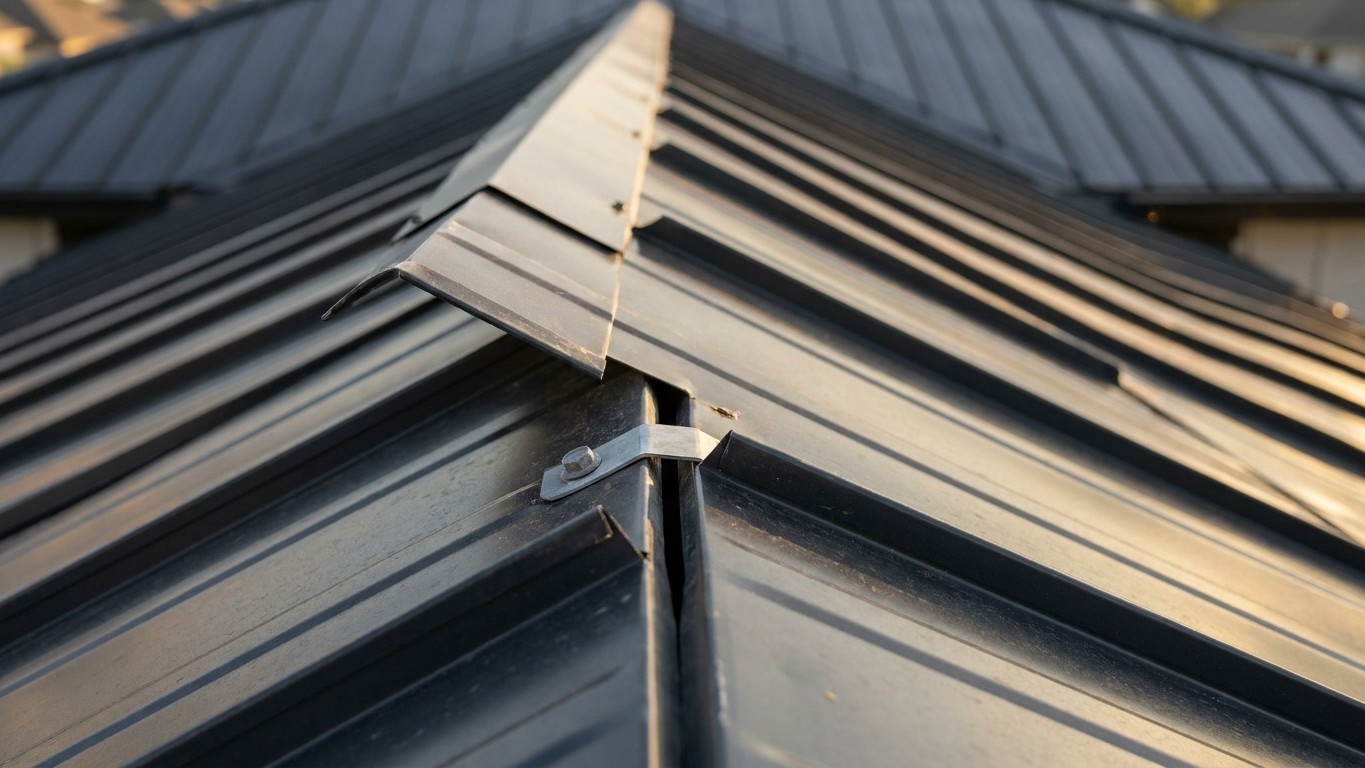

A metal roof doesn’t fail the way a shingle roof fails. It doesn’t wear down granule by granule under UV light. Instead, the whole surface expands and contracts with temperature, the fasteners either flex with that movement or fight it, and water either sheets off cleanly or finds the one seam that wasn’t sealed right. Understanding those mechanics tells you more about what’s happening over your head than any spec sheet ever will.
What is actually happening

Metal panels grow and shrink with temperature swings far more than asphalt shingles do. A steel or aluminum panel baking in direct sun can be many degrees hotter than the surrounding air, and it lengthens slightly as it heats, then pulls back as it cools at night. Multiply that daily cycle across the length of a panel that runs from ridge to eave, and you get real, measurable movement at every fastening point and every seam.
This is why the fastening system matters more with metal than with almost any other roofing material. Some panel systems use exposed fasteners driven straight through the metal into the deck below, each one sealed with a washer designed to compress and stay watertight as the panel moves around it. Other systems use concealed clips that hook the panel to the deck without penetrating the panel face at all, letting the whole sheet slide slightly as it expands, rather than dragging against a fixed screw. Both approaches work. Both also fail in predictable ways when the wrong fastener spacing or the wrong washer material meets years of thermal cycling.
Where the small failures start
Oil-canning, that slightly wavy or rippled look you sometimes see on a flat panel, is one visible sign of that constant expansion and contraction working on thin metal. It’s usually cosmetic. What isn’t cosmetic is a washer that has hardened and cracked, or a screw that has backed out slightly because the panel kept moving against it. Once a fastener loosens, the hole around it becomes a path for water, especially where wind drives rain sideways under a panel edge.
Sealant at penetrations, chimneys, vent stacks, skylights, valleys, does the same job differently. It has to stay flexible enough to move with the metal without splitting, and it has to bond to a surface that’s expanding and contracting daily. That’s a harder job than sealing a static shingle joint, and it’s the main reason most metal roof problems start at a penetration or a seam rather than in the middle of an open panel field. Condensation on the underside of the panel, where warm interior air meets cold metal, is a separate issue entirely, and it shows up as damp decking rather than a visible leak from outside.
What you can see without climbing
None of this requires getting on the roof. A pair of binoculars, or a phone camera zoomed all the way in from the yard, tells you most of what you need to know, and the attic tells you the rest.
- Scan from the ground first. Walk the perimeter of the house and look at the roof plane from several angles, morning and afternoon if you can, since low sun shows shadows and irregularities that flat midday light hides. Zoom in on ridges, valleys, and anywhere a pipe, vent, or chimney passes through the metal.
- Look for movement, not just rust. A washer that looks crushed flat or has a visible crack around a fastener head is worth noting. So is a panel edge that looks slightly lifted compared to its neighbors, or a seam where the metal looks like it’s separating rather than sitting flush.
- Check the sealant lines. Around any penetration, sealant that looks chalky, shrunken, or pulled away from the metal on one side is an early sign, long before it becomes an active leak.
- Move to the attic with a flashlight. Go up on a bright day and turn the flashlight off first. Any pinpoint of daylight coming through the deck, even a faint one, marks a spot where something below the metal has failed.
- Check rafters and Insulation, not just the deck. Water travels sideways along framing before it drips straight down, so a stain on a rafter several feet from where you’d expect a leak is normal, not a sign you’re looking in the wrong place. Damp or matted insulation, or a musty smell that wasn’t there before, points to moisture that’s been sitting for a while.
This routine, done a couple of times a year and after any severe storm, catches almost everything that actually matters. It’s also the safest possible way to monitor a metal roof, since none of it puts you anywhere near the edge of the building.
What it costs to leave it
The word “leak” undersells what actually happens when a fastener loosens or a sealant joint fails on a metal roof. Water rarely announces itself with a dramatic drip in the middle of a ceiling. It moves along the underside of the deck, follows a rafter, and soaks into whatever it touches first, usually insulation, sometimes the top plate of a wall, sometimes the sheathing itself.
Wet insulation loses most of its ability to slow heat transfer, which shows up as a slightly harder-working furnace or air conditioner long before anyone connects it to the roof. Wood framing that stays damp for extended periods starts to soften, and fungal growth doesn’t need much moisture or much time to establish itself once conditions are right. None of this happens on a fixed schedule. A small gap at a single fastener might sit there through several dry seasons without incident, then turn into a real problem after one wind-driven storm pushes water sideways under a panel edge that was already marginal.
Hail, wind, and your insurance policy
Hail and wind events are where metal roofing intersects with insurance in ways that are easy to get wrong. A dented panel, a lifted seam, or fastener damage from a windstorm may or may not be covered, and the details, deadlines, and documentation requirements all depend on the specific policy and the state it was written in. What matters most in the immediate aftermath is documentation: photos of the damage, dated and specific, taken from the ground using the same zoomed-camera approach described above, before any repair work begins. The policy itself governs what happens next, and that’s a conversation with the insurer or an agent, not something a general rule can settle.
The practical takeaway is that small, ignorable-looking issues on a metal roof don’t stay small forever, and they don’t send a clear warning before they stop being small. Catching a loosened fastener or a cracking sealant bead during a routine ground-and-attic check is far cheaper, in every sense, than discovering the same problem after it has already reached the framing.
What is not a householder job
Everything described so far, the binocular scan, the zoomed photo, the attic check with a flashlight, can be done safely without ever setting foot on the roof itself. That’s deliberate. Metal roofs are slicker than shingle roofs in almost every condition, and the line between a reasonable homeowner task and a job for a professional is worth stating plainly rather than leaving to judgment in the moment.
Anything above a single story is not a homeworker task. A ladder tall enough to reach a second-story roofline changes the physics of a fall completely, and metal’s smooth, often coated surface offers less grip than it looks like it should. A wet roof, a mossy or algae-streaked section, anything with real pitch, or anything with frost or dew still on it in the morning falls into the same category, regardless of the height of the house. Metal that looks dry from the ground can still be damp enough underfoot to take a foot out from under someone, and coated panels in particular can be far more slippery than the texture suggests.
Any repair that needs both hands, a hammer, a caulking gun, or a replacement panel, while standing on a sloped metal surface, belongs to a roofer, not a homeowner with a weekend free. That’s true even for people who are otherwise comfortable with ladders and heights, because metal roofing adds a slip risk that plywood decking and asphalt shingles don’t carry in the same way.
Once the ground-and-attic check turns up something worth a closer look, whether that’s daylight through the deck, a stained rafter, or a section of panel that looks off from the yard, the next step is a proper inspection, covered in more detail on the roof inspection page. If that inspection points to actual repair or replacement work, the guide to hiring a roofer covers how to find someone qualified to work on metal specifically, since not every roofing contractor has the same familiarity with panel systems that they do with shingles.
Common questions
Does a metal roof make more noise in rain than a shingle roof?
It can sound different, particularly in an open attic space or where the roof deck sits close to living space, but a properly installed metal roof over solid decking and insulation typically muffles rain noise close to what a shingle roof produces. The perception of extra noise usually comes from installations without a solid deck underneath.
Can I walk on a metal roof to check it myself?
Walking directly on metal panels risks both a fall and denting or deforming the panel underfoot, especially on unsupported spans between framing members. The ground-and-attic routine described above is the safer and, in most cases, sufficient way to monitor a metal roof’s condition.
Is rust always a sign of a problem?
Surface staining or light discoloration around a cut edge or fastener isn’t automatically a structural issue, but any spot where rust has visibly broken through a coating and is spreading, or where it coincides with a soft or crumbling area, is worth a closer professional look rather than a wait-and-see approach.
What should I photograph after a hailstorm?
Wide shots of each roof plane from the ground, followed by zoomed-in shots of any visible dent, lifted seam, or displaced panel, all with a timestamp if your camera supports it. That documentation is what an insurer will ask for first, and having it ready before making a claim call, under the terms of your specific policy, makes the process considerably smoother.