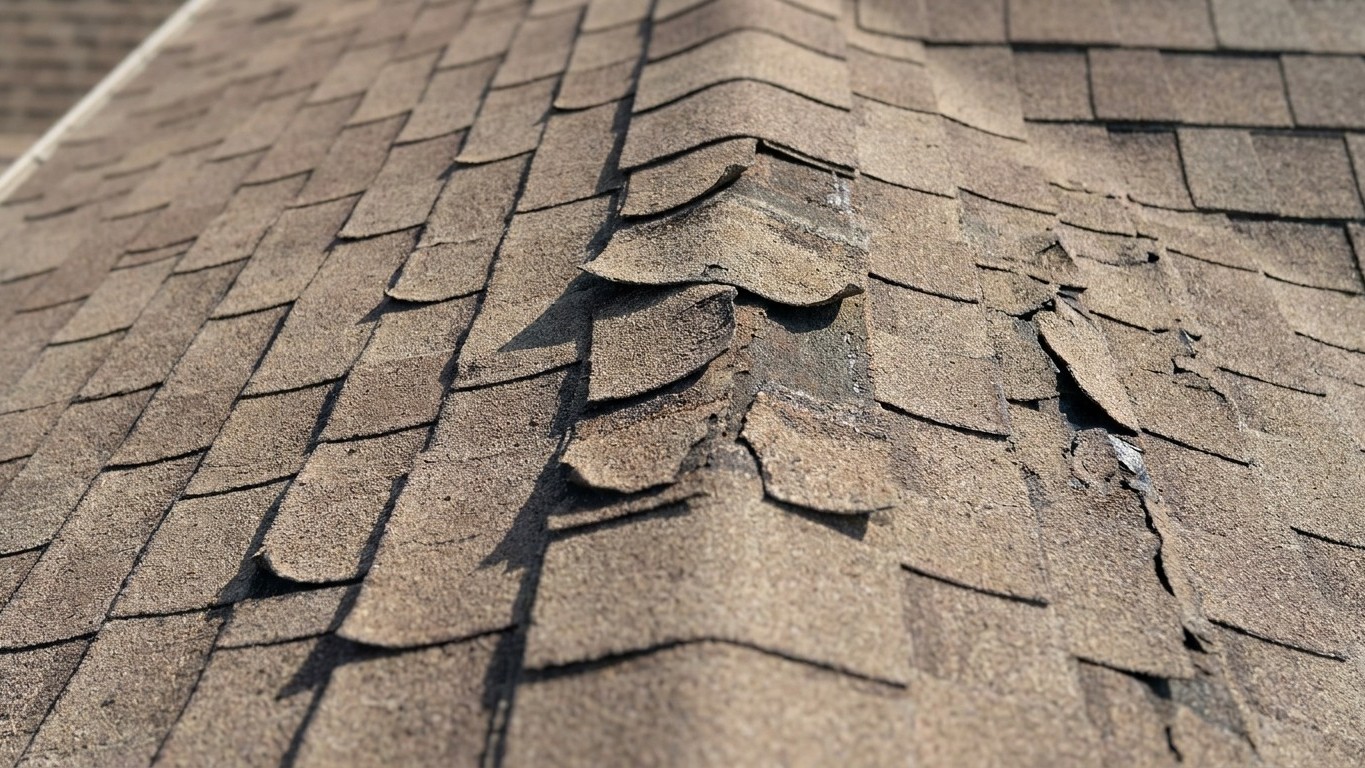

Curled, cupped or lifted edges on shingles mean one of two things: the shingle itself has aged past flexibility, or something under it, usually trapped heat or moisture, is pushing it out of shape from below. From the street both look like a wavy, uneven roof surface. The difference matters because one is a materials issue and the other is a ventilation or leak issue, and mixing them up leads to fixing the wrong thing.
What is actually happening
A shingle is a flat laminate meant to lie tight against the one next to it. When it curls, cups or lifts, that flatness has failed, and there are really only two mechanisms behind it. The first is straightforward weathering: sun, freeze-thaw cycles and years of expansion and contraction dry out the asphalt and cause the mat inside the shingle to shrink unevenly. The edges, having less material holding them down than the center, are the first to lose their grip and curl upward. This shows up as a fairly uniform pattern across a whole slope, especially the side that gets the most direct sun through the day.
The second mechanism is heat or moisture trapped underneath the shingle, usually because the attic below isn’t venting properly. A roof deck that can’t release warm, moist air acts like a low oven under the shingles. That heat softens the asphalt from beneath, and the shingle edges lift or claw upward even though the shingle itself might otherwise still have plenty of life in it. This pattern tends to be patchy rather than uniform: worse over a bathroom exhaust that dumps into the attic instead of outside, worse near a soffit vent that’s been blocked by insulation, worse near a ridge that doesn’t actually vent at all.
Cupping versus clawing
Roofers distinguish two visual patterns. Cupping is when just the edges of the shingle turn upward, like a shallow bowl, and it’s more commonly tied to ordinary weathering. Clawing is more severe: the edges turn up and the middle of the shingle also distorts, often twisting slightly. Clawing is the pattern most associated with heat buildup underneath, because it reflects stress from both above and below at once, not just surface drying.
Algae and moss can complicate the picture further. A shingle that stays damp longer because moss is trapping water against it will weather unevenly compared to the rest of the roof, curling in that one section while the surrounding shingles look fine. That’s a clue worth noting when you’re trying to figure out.
What you can see without climbing
None of this requires a ladder. A careful look from the ground and a quick check in the attic will tell you almost everything you need to know before deciding whether the situation is worth a professional visit.
- Scan each slope with binoculars or a zoomed phone camera. Stand back far enough to see the whole roof plane and look for where the curling is concentrated. Uniform curling across an entire south- or west-facing slope points toward sun exposure and ordinary aging. Patchy curling, especially in one section only, points toward a localized issue like a vent blockage, a moss patch, or a repair area that was never properly ventilated.
- Check the roofline and gutters for granule loss. Curling shingles often shed granules as the surface flexes and cracks. A buildup of gritty, sand-like material in the gutters or at the base of downspouts is a secondary sign that the shingle surface is breaking down, not just deforming.
- Look at the ridge and soffit vents from the ground. Soffit vents (the vents under the roof overhang) and ridge vents (along the peak) should look open and unobstructed. Vents that are painted over, stuffed with debris, or covered by insulation you can partly see from below are a red flag for trapped heat.
- Go into the attic with a flashlight during daylight hours. Turn off the attic light and look up at the underside of the roof deck. Pinpricks or larger gaps of daylight showing through mean the deck has separated or a fastener has backed out, both of which follow curling shingles that have let water underneath.
- Check the rafters and decking for staining. Dark streaks running down a rafter, or a discolored patch on the underside of the decking, mean water has already traveled along the wood at some point. Note whether the wood feels damp to the touch or looks dry but stained, since dry staining suggests an older, resolved leak while damp wood suggests an active one.
- Feel the insulation near any stain. Compressed, damp, or matted insulation under a stained area confirms moisture has been sitting there, not just passing through once.
This routine takes fifteen minutes and answers the two questions that matter most: is this widespread aging or a local problem, and has water already gotten past the shingle layer.
What it costs to leave it
A curled or lifted edge isn’t just a cosmetic issue. It’s a gap. Wind-driven rain, and even ordinary rain running down the slope, can catch under a raised edge and work its way past the shingle into the underlayment beneath it. From there it follows the path of least resistance, usually along a nail line or a seam in the decking, until it finds a spot to soak in.
The decking itself, generally an engineered wood panel, absorbs that moisture over repeated exposures. Wood swells when wet and shrinks again as it dries, and repeating that cycle enough times softens the fibers and weakens the panel’s structural integrity. Long before the deck fails outright, you’ll usually see a darker, slightly spongy patch if you press on it from the attic side, or a soft feel underfoot if a roofer walks that section.
Insulation below a leak point absorbs water and compresses, losing much of its ability to slow heat transfer, and stays damp long after the roof surface has dried in the sun. Damp insulation and damp wood together create the conditions mold needs, and mold on rafters or the underside of decking is a common attic finding once a curling problem has gone unaddressed for a while.
The visible sign homeowners usually notice last is a ceiling stain inside the living space. By the time water shows up on drywall, it has typically already traveled through the deck, the insulation, and often a vapor barrier, meaning the problem has existed for some time before it became obvious indoors. How long that progression takes varies enormously with slope, local rainfall, and how the attic is ventilated, so no single timeline applies to every roof.
If the curling followed a hailstorm or a windstorm rather than gradual weathering, the situation may involve an insurance claim. The homeowner’s policy governs what’s covered and how damage needs to be documented, and those terms differ by insurer and by state. Photographing the damage as soon as it’s safely visible, and keeping a record of the storm date, is generally useful groundwork regardless of what the specific policy requires.
What is not a householder job
Looking is fine. Climbing usually isn’t, and it’s worth being direct about where that line sits. Anything above a single story is a fall risk that isn’t offset by familiarity with a ladder or confidence on a rooftop. A steep pitch, a surface with visible moss or algae, anything wet from recent rain or morning dew, and any frost are all conditions where a roof deck offers far less traction than it appears to from the ground.
Any inspection or repair that requires both hands free while standing on a sloped surface, such as replacing a shingle, resealing a flashing, or clearing a vent, falls into the same category. Roofers work on slopes routinely because they use harnesses, roof jacks and footwear built for that surface, none of which substitute for a homeowner’s regular shoes and a Saturday afternoon.
The ground-level and attic checks described above are genuinely enough to decide whether a problem exists and roughly how serious it looks. For anything beyond that, the next step is a proper roof inspection carried out by someone equipped for the surface, followed by a conversation about hiring a licensed roofer if repair or replacement turns out to be necessary.
Common questions
Does curling always mean the shingles need to be replaced?
Not necessarily. Isolated curling tied to a blocked vent or a moss patch can sometimes be resolved by fixing the underlying cause, while widespread curling across an entire slope usually reflects the shingle material itself reaching the end of its serviceable condition.
Can curling shingles be flattened back down?
Asphalt shingles that have curled have generally lost the flexibility and granule protection that kept them flat in the first place. Pressing a curled edge back down rarely holds for long and can crack the shingle, so a roofer typically evaluates whether the affected shingles need replacing rather than reshaping.
Is curling more common on one side of the roof?
Yes, when the cause is sun exposure. Slopes facing south or west generally take the most direct sunlight through the day and often show weathering-related curling before shaded or north-facing slopes do.
What’s the difference between curling from age and curling from a leak?
Age-related curling tends to be uniform across a slope and appear alongside granule loss. Curling tied to a leak or trapped heat is often patchy, concentrated near a vent, chimney, or valley, and paired with signs inside the attic like staining or damp insulation in that same area.