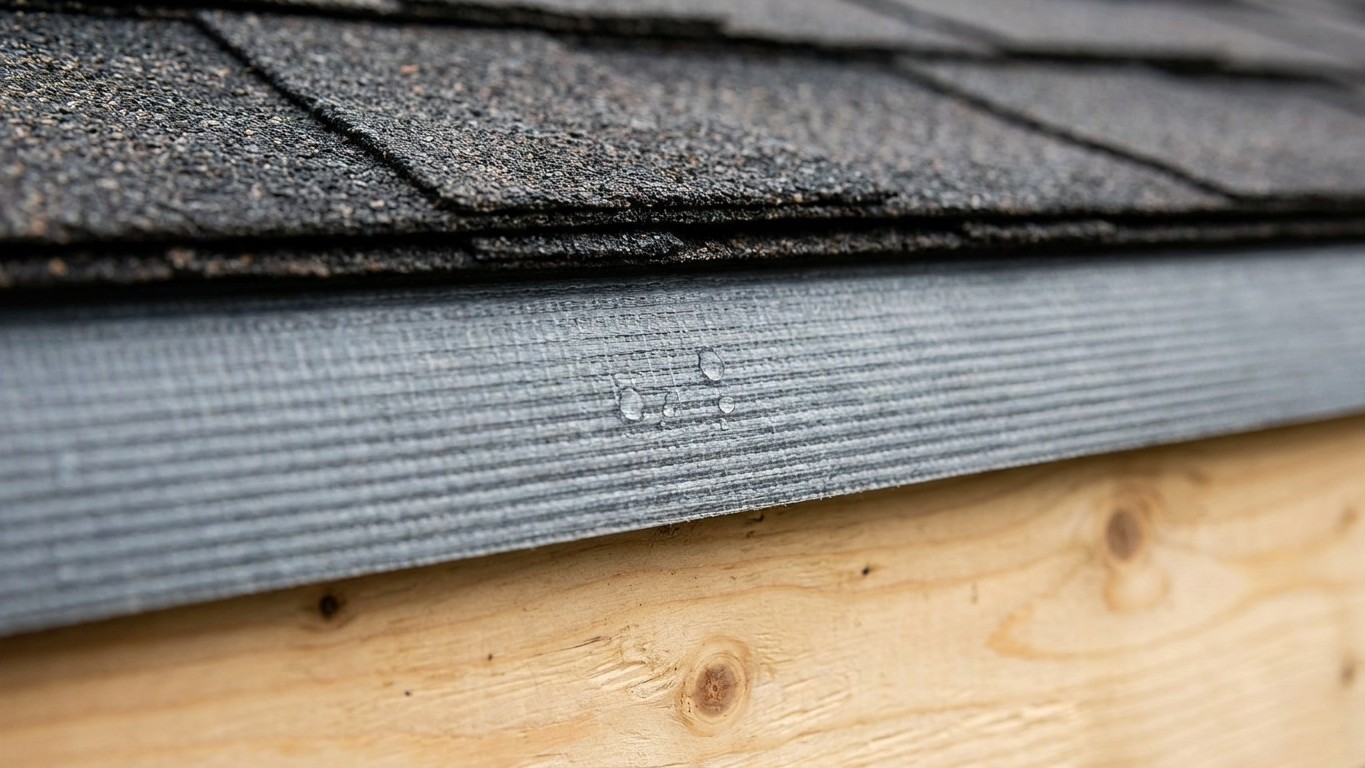

Underlayment is the water-resistant layer installed directly on the roof deck, under the shingles or other surface material. It’s the roof’s backup system: shingles shed most rain and shed it fast, but wind-driven rain, ice, and small gaps in coverage happen constantly. When they do, underlayment is what keeps that moisture from reaching the wood deck and, eventually, your ceiling. Homeowners rarely see it, which is exactly why understanding it matters.
What is actually happening
Every shingle roof is really two systems stacked together. The top layer, the one you see from the street, is designed to shed the vast majority of water before it goes anywhere near the wood underneath. But shingles are not sealed to each other like a membrane. They rely on overlap, gravity, and wind behaving reasonably. The moment wind pushes rain sideways, or a shingle lifts at the edge, or ice forms at the eave and backs water uphill, that top layer stops being the only thing standing between weather and your house.
That’s the job underlayment does. It’s a continuous water-resistant layer fastened to the deck before shingles ever go down, so if water gets past the surface layer, it hits something that still sheds it away from the wood rather than into it. Roofers sometimes describe it as the roof’s second chance: shingles are the plan, underlayment is what happens when the plan doesn’t hold perfectly, which on a real roof, in real weather, is often.
Why the deck is the part that matters
The wood deck under a roof is structural. It’s what the rafters, the insulation, and eventually the ceiling drywall all depend on staying dry and rigid. Wet decking doesn’t fail instantly, but it stops being a stable base, and everything built on top of an unstable base eventually shows it, from a soft spot underfoot to a sagging section visible from the attic. Underlayment’s whole purpose is to keep that specific piece of lumber dry, not to look good, not to add curb appeal, just to be the thing between “shingle failed” and “deck got wet.”
This is also why underlayment gets replaced whenever shingles get replaced, rather than being reused. Once a roof is opened up, a roofer can actually see the condition of that layer and the deck beneath it, which is information you can’t get any other way without removing shingles. That inspection, done by a professional at tear-off, is a different thing than looking for shingle damage from the ground, and it’s the only way to know for certain what shape the underlayment and deck are actually in.
What you can see without climbing
You don’t need to get on the roof to pick up on most of the warning signs that the layer under the shingles has been compromised. The signs show up either from a distance, using magnification, or from inside the house, in the attic, where problems tend to announce themselves before they reach the living space below.
- From the ground, with binoculars or a zoomed phone camera: scan the roof plane in daylight for shingles that look lifted, curled, or missing outright, and for dark streaking or discoloration concentrated in one area rather than spread evenly, which often signals a spot where water has been sitting or seeping repeatedly.
- Still from the ground, check the valleys and edges: these are the sections where water concentrates as it runs off, so any granule buildup in gutters, sagging along the roofline, or a valley that looks uneven compared to the rest of the roof is worth noting and photographing for later reference.
- From the attic, with a flashlight, on a dry day: turn off the attic light and look up at the underside of the deck for any pinpricks of daylight, since a roof deck should be completely dark when the sun is up outside; any visible light coming through the wood usually means a gap has opened somewhere above.
- Still in the attic, look at the rafters and sheathing: run your eyes (and a flashlight beam) along the wood for staining, dark streaks, or a chalky white residue, all of which indicate water has passed through at some point, even if it’s not actively dripping right now.
- Check the insulation directly beneath any suspicious rafter: damp, compressed, or discolored insulation is one of the clearest signs of an active or recent leak, and it’s far easier to spot from the attic floor than to guess at from a stain on a ceiling below.
This routine takes fifteen minutes and answers the question that matters most: is there a reason to call someone out for a closer look, or does the roof look and feel the way it should. None of it requires a ladder against the gutter or a foot on the shingles, which is the point. The attic in particular tells you more than the exterior ever will, because it’s where the consequences of a failed underlayment first become visible, long before they reach a bedroom ceiling.
What it costs to leave it
Nothing about a failed underlayment layer announces itself loudly at first. Water finds the path of least resistance, and in a roof, that path usually runs downhill along a rafter or a piece of framing before it ever reaches a spot where a homeowner would notice a stain on drywall. That’s the uncomfortable part of this whole system: the delay between the actual problem and the visible symptom.
What gets wet first is the deck itself, the plywood or board sheathing that shingles are nailed into. Wood that stays damp doesn’t need to be soaked to start degrading. Repeated cycles of wetting and drying are often worse than a single soaking, because they slowly break down the wood fibers and any adhesive holding layered sheathing together. Left long enough, that deck can go from solid to spongy, and a spongy deck can’t hold fasteners the way it’s supposed to, which is part of why a single failed section of underlayment can eventually affect shingles well beyond the original leak point.
Where the water actually goes
Once past the deck, water tends to travel along the rafters rather than drop straight down, which is why a stain on a ceiling is frequently not directly below the point where water entered the roof. It follows the wood, pools where framing members meet, and soaks into whatever insulation sits in its path. Wet insulation loses most of its ability to insulate, and it stays wet far longer than the wood around it, creating a damp pocket that’s an ideal environment for mold growth in the exact spot where nobody is regularly checking.
Left unaddressed, that combination, damp wood, saturated insulation, and mold in a hidden cavity, is what eventually turns a roofing question into a structural and air-quality question. None of this happens on a fixed schedule. It depends on climate, on how much rain or snow load the roof sees, and on how large the original gap in the underlayment was. What’s consistent is the order of events: deck first, framing next, insulation and interior finishes last. The earlier a problem is caught in that sequence, the smaller and simpler the fix.
Insurance sometimes covers roof damage from specific events like hail or wind, but every policy differs on what’s covered, what documentation is required, and how quickly a claim needs to be filed after the damage occurs. If a storm is suspected as the cause, the policy itself, not general assumptions, determines what applies, so photographing damage as soon as it’s noticed and keeping a written record is worth doing regardless of what a policy eventually covers.
What is not a householder job
Everything described in the observation routine above is meant to be done with both feet on the ground or standing on a stable attic floor. Getting onto the roof itself to inspect or repair underlayment is a different category of task, and for most homeowners it isn’t one worth taking on personally.
Any roof section above a single story puts a fall at a height that routinely causes serious injury, and that risk doesn’t scale down just because the job looks small. A roof that’s wet, mossy, or covered in algae loses traction almost entirely, even for footwear designed for the job, and the same is true of any steep pitch or any surface with frost on it, where a single misstep has nothing to grab onto. Underlayment work in particular often requires both hands, prying up shingles, checking deck condition, laying material flat, while standing on a sloped surface, which is exactly the combination that turns a manageable repair into a fall.
None of this is meant to discourage homeowners from staying informed about their own roof. It’s meant to draw a clear line between the parts of the job that are genuinely safe to do yourself, looking, photographing, checking the attic, and the parts that call for someone with the training, harness, and footing to work at height safely. A professional roof inspection can confirm what the ground-level and attic checks only suggest, and it’s the right next step whenever something looks off. If the roof needs actual repair work, hiring a licensed roofer is the appropriate move rather than attempting the fix personally, particularly for anything involving the underlayment layer itself, since that work happens under the shingles and requires them to be lifted or removed correctly.
Common questions
Can underlayment fail without any shingle damage visible from the ground?
Yes. Underlayment sits beneath the shingles, so a small gap or tear in that layer can exist even while the shingles above it look intact. This is exactly why the attic check matters as much as the exterior scan: daylight through the deck or staining on rafters can reveal a problem that the roofline alone won’t show.
Does every type of roofing material use the same kind of underlayment?
The general purpose stays the same across roofing types, providing a water-resistant layer between the deck and the exterior surface, but the specific material and installation method can vary by roof type and by manufacturer specification. Details like that are best confirmed with the product documentation or a roofer familiar with the specific roofing system installed.
If I see a small stain in the attic, does that mean the whole underlayment needs replacing?
Not necessarily. A stain indicates that water has passed through at some point, but the extent of the problem,, can only really be confirmed by someone inspecting the deck and underlayment directly. That’s a judgment call for a roofing professional, not something to estimate from a single stain.
Is it worth checking the attic even if the roof looks fine from outside?
Yes, and it’s the more useful of the two checks. Underlayment problems often start small and stay invisible from the exterior for a while, but the attic tends to show early signs, daylight, staining, damp insulation, well before anything is noticeable from the street or ground level.