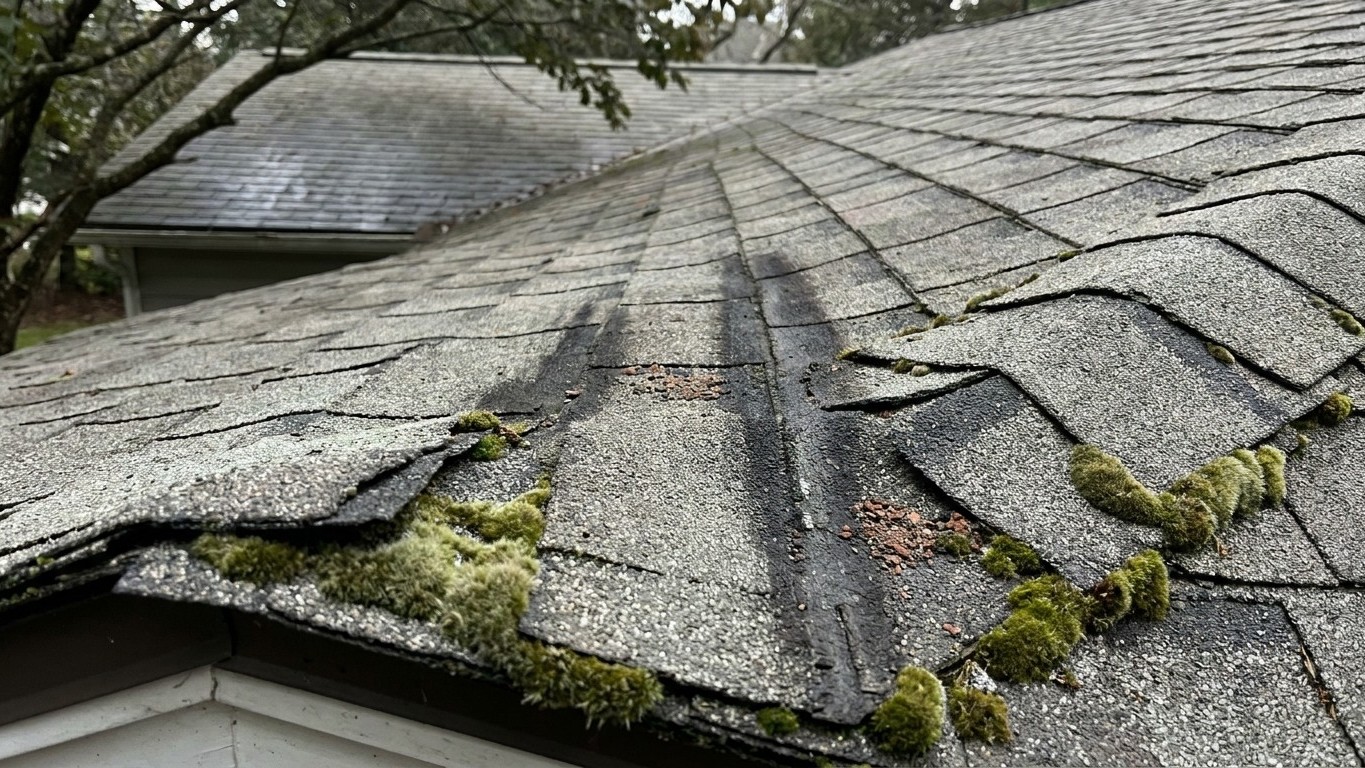

Moss and algae get lumped together because they both show up as dark patches on a roof, but they behave nothing alike. Algae is a stain, a colony of microorganisms feeding on minerals in the shingle surface, and it doesn’t threaten the roof deck underneath. Moss is a plant. It grows a root structure, holds water against the shingle, and over time can lift shingle edges enough to open a path for water. Telling the two apart from the ground changes what you do next, and whether a professional needs to get involved at all.
What is actually happening
The black streaks running down from a ridge or a roof vent are almost always algae, a colony that feeds on the limestone filler mixed into asphalt shingles. It spreads the way water spreads, following the path rain takes down the slope, which is why the streaking often looks like it’s dripping from a single point near the ridge or a plumbing stack. Algae favors shade, humidity, and slopes that stay damp longer than others, so a north-facing roof under tree cover will almost always show it first and worst. This is a surface condition. It doesn’t dig into the shingle material, and it doesn’t lift anything.
Moss works differently because it’s alive in a way algae isn’t. It needs a foothold, usually a rough patch of shingle where granules have already thinned, and once established it sends root-like structures into the gaps between shingle tabs and the spaces where granules have worn away. Those roots hold water directly against the shingle surface like a sponge pressed flat against it. In freezing climates, that trapped moisture expands and contracts through freeze-thaw cycles, which loosens granules and works shingle edges upward. A lifted edge is the real danger here, not the moss cushion itself. Once an edge curls up even slightly, wind-driven rain can get underneath it instead of running off the surface the way the shingle was designed to shed water.
Both problems tend to cluster in the same spots for the same reason: shade, poor airflow, and slower drying after rain. Valleys, north-facing slopes, and areas under overhanging branches dry out slower than the rest of the roof, so that’s where you’ll typically find green cushion-like moss growth alongside or near black algae streaking. Seeing both in the same area isn’t unusual, and it doesn’t mean one caused the other. It means that section of the roof stays wet longer than the rest, which is worth noting because it tells you where to look first and where any future problem is most likely to start again.
The distinction matters because it changes urgency. Algae is a cosmetic issue that affects how the roof looks, not how it performs. Moss is a mechanical issue, because a lifted shingle edge is a functional opening in a system that depends on every layer overlapping correctly to shed water downhill.
What you can see without climbing
Nearly everything you need to know about moss and algae can be observed without a ladder. A pair of binoculars, or a smartphone camera zoomed in, does the job from the ground, and a flashlight does the rest from inside the attic.
- From the ground, at a few different times of day. Walk the perimeter of the house and look at each roof slope in turn, since low morning or evening light shows texture and shadow better than midday sun. Look for black or brown streaks running down from the ridge, vents, or chimney flashing (that’s algae). Look separately for green, cushion-like growth sitting in valleys, along the north-facing edge, or in any section shaded by trees (that’s moss). Check the gutters and the ground below downspouts for a buildup of granules, which look like coarse dark sand and signal that the shingle surface is wearing faster in that spot than elsewhere.
- From the attic, with a flashlight, ideally on a bright day. Turn off the attic light and look up at the underside of the roof deck. Any pinpoints of daylight showing through are gaps that shouldn’t be there. With the flashlight on, scan the rafters and the underside of the decking for dark rings, streaking, or discoloration, which mark where water has been getting through repeatedly rather than just once. Press a gloved hand or a screwdriver handle gently against any insulation that looks darker or matted compared to the rest, since damp insulation compresses and loses its loft. A musty smell in the attic on a dry day is another sign worth noting even if you can’t see an obvious stain yet.
Cross-referencing the two views helps more than either one alone. If you spotted moss sitting in a valley from the ground, go check the attic directly below that valley first, since that’s the section most likely to already show a stain on the decking or a rafter if water has started getting through. If the attic check comes back clean, that’s a genuinely useful data point. It means the moss, at that point, is still a surface issue rather than one that’s already reached the wood underneath.
What it costs to leave it
Leaving algae alone mostly costs you curb appeal. It doesn’t have a mechanical consequence on its own, though a heavily stained roof can make an otherwise sound roof look neglected, which matters if you’re planning to sell the house or just don’t want to look at it every day.
Leaving moss alone is a different story, and the progression follows a fairly predictable order even without a fixed timeline attached to it. First, granules dislodge under the moss’s root structure and the freeze-thaw cycling described earlier, exposing more of the asphalt layer underneath to direct UV and weather. Second, and this is the part that actually matters structurally, the lifted shingle edges stop shedding water the way they’re designed to. Wind-driven rain gets pushed sideways under the tab instead of running off the surface, and it reaches the underlayment, the water-resistant layer sitting directly beneath the shingles.
Once water is past the underlayment consistently, it starts saturating the roof decking itself, usually plywood or oriented strand board. Wet decking doesn’t fail the first time it gets damp. It fails after repeated soaking and drying cycles weaken the wood fibers and the fasteners holding the decking to the rafters. That’s a gradual process, and it’s exactly why the attic check described above matters: staining on a rafter or damp insulation is the visible early sign that this process has already started, well before anything looks wrong from inside the living space.
The last stage, and the one most homeowners actually notice on their own, is a stain on a ceiling below the affected area, or a musty smell that doesn’t go away with normal ventilation. By the time water shows up on drywall, it has typically been finding its way through the decking and insulation for a while already. None of this happens on a fixed schedule. Moss, tree cover, roof slope, and local rainfall all move that progression faster or slower, which is exactly why catching it at the attic-stain stage, rather than the ceiling-stain stage, makes the eventual repair smaller and simpler than it would otherwise be.
What is not a householder job
Everything described above is about looking, not touching, and that line matters. Once moss or algae is confirmed, the removal and repair work itself falls outside what most homeowners should be doing themselves, for reasons that have nothing to do with skill and everything to do with the surface you’d be standing on.
Anything above a single story is not a householder job. A fall from a second-story roof carries a different set of consequences than a fall from a one-story garage, and moss makes the surface underneath your feet unpredictable in a way dry shingle isn’t. Anything on a roof that’s wet, mossy, steep, or frosted is not a householder job either, and moss-covered sections are, by definition, exactly the surfaces that stay damp and slick longest after rain or morning dew. Anything that requires both hands to manage a pressure washer, a scrub brush, or a chemical treatment while also balancing on a slope is not a householder job, because you no longer have a free hand to catch yourself or hold a safety line.
There’s also a technical reason to bring in a roofer rather than attempt cleaning yourself: pressure washing at the wrong angle or distance strips granules off shingles just as effectively as years of moss growth does, which trades one problem for another. A roofer or inspector can also tell you, from the attic side, whether the decking has already started absorbing water, which isn’t something a visual check from the ground can confirm with certainty.
If you suspect the moss or algae situation is compounded by storm or wind damage, document everything with photos before any cleaning or treatment begins. Homeowners insurance policies vary by insurer and by state on what’s covered and what documentation and deadlines apply, so check your specific policy rather than assume a general rule applies. For the next step, use our roof inspection checklist to organize what you’ve already observed, and see our guide on hiring a roofer when you’re ready to bring in someone to confirm what’s happening above the attic line.
Common questions
Can I treat moss or algae myself without hiring anyone?
Store-bought treatments applied from the ground with a hose-end sprayer are generally low-risk for single-story sections you can reach safely without a ladder. Anything requiring you to stand on the roof itself, especially a mossy or shaded section, falls outside a safe do-it-yourself job for the reasons described above.
Does a black streak automatically mean the shingles are failing?
No. Algae streaking is a surface stain and, on its own, doesn’t indicate structural failure. It’s worth checking the attic underneath the streaked area anyway, since shaded, algae-prone sections are often the same sections where moss and granule loss show up over time.
Will moss come back after a roof is cleaned?
Moss tends to return in the same spots because the underlying conditions, shade and slow drying, haven’t changed. Trimming back overhanging branches and improving airflow to that section of roof reduces how quickly it comes back, though it doesn’t eliminate the conditions entirely on a heavily shaded lot.
Are algae or moss stains covered by homeowners insurance?
Coverage depends entirely on your specific policy and, in some cases, your state’s rules. Algae and moss are generally treated as maintenance issues rather than sudden damage, but if you believe storm damage is involved as well, document conditions with photos and check your policy directly rather than assume either way.