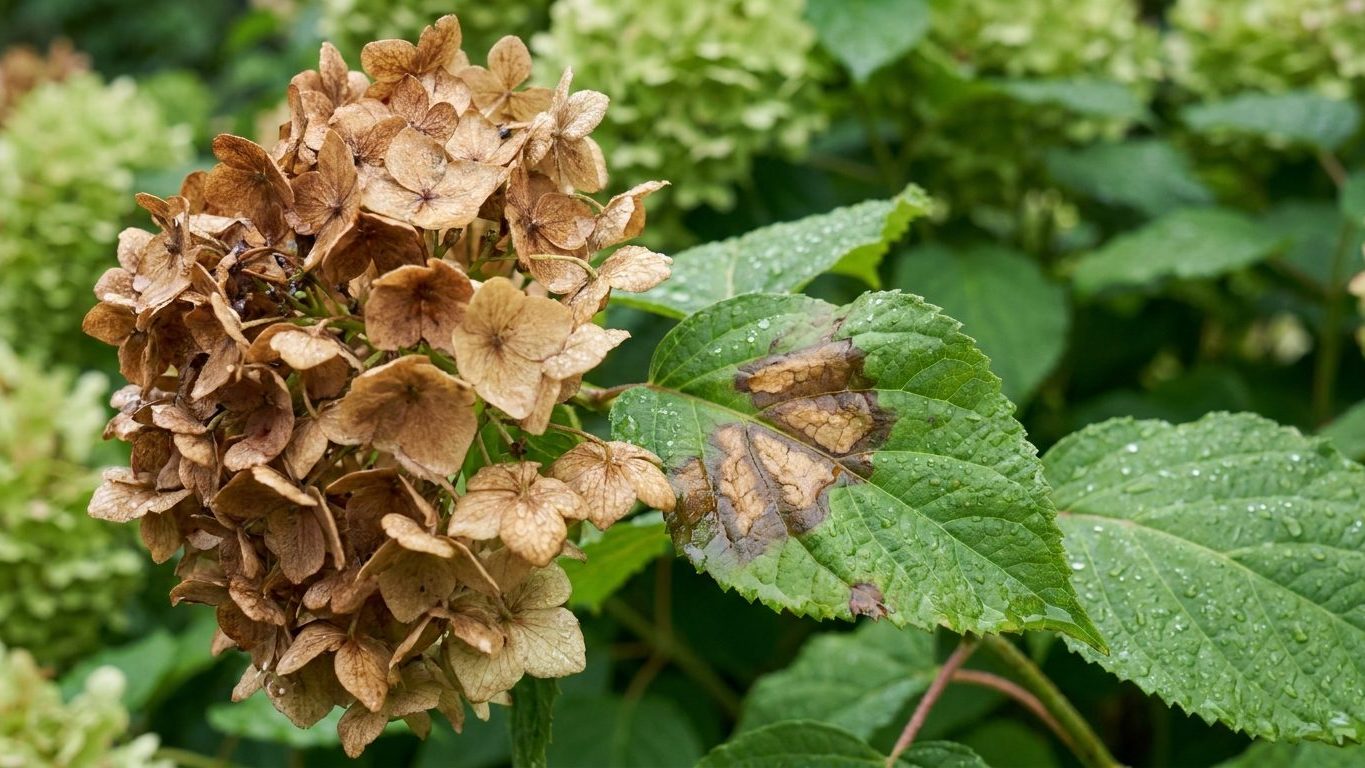

Brown, water-soaked blotches that begin on a fading flower cluster and creep into the leaf beneath it are almost always botrytis blight, also known as gray mold. It moves fast once the weather turns cool and damp, but it rarely kills an established hydrangea outright. The fungus feeds on dying tissue first, then pushes into healthy leaf and stem, which is why the damage looks like it started at the flower and spread inward rather than appearing on the leaf itself.
What you are looking at
This is a fungus problem, not a bacterial or viral one, and on most Hydrangeas it stays cosmetic rather than fatal. The lesion starts exactly where a spent flower, dropped petal, or wounded floret touches a leaf, then expands outward from that contact point, so the oldest, wettest part of the plant goes first. Given cool, humid weather, a single small blotch can widen across a leaf within a few days.
A brown, mushy flower cluster
Individual florets on an aging bloom turn tan to dark brown and go soft, almost slimy, rather than drying out cleanly the way a flower normally fades. Whole sections of the cluster can collapse at once.
A leaf blotch that touches the dying bloom
Where that mushy petal rests against foliage, an irregular tan-to-brown patch forms with a slightly darker, water-soaked ring at its edge. The shape is uneven, never a neat circle, and it always traces back to a point of contact with dying plant material rather than starting in the middle of an otherwise healthy leaf.
Gray, fuzzy mold after a humid night
Check the blotch early in the morning after a stretch of damp weather and you may find a soft, grayish-brown, dust-like coating over the surface. That’s the spore layer, and it brushes off easily if you touch it, which is a useful confirmation if you’re unsure what you’re looking at.
Stem lesion at a wound or pruning cut
Less common, but worth checking: a sunken brown lesion at a pruning cut or a spot where two stems rub together. If it circles the entire stem, it can girdle and kill that one shoot, which is the single situation where botrytis does real, permanent damage.
Field note: the tell most gardeners miss on their own plants is timing, not shape. A blotch that showed up within a day or two of cool, rainy weather and traces back to a spent flower cluster is almost always botrytis. The same blotch appearing during a dry week with no flower contact nearby points somewhere else.
What it is not
Three other problems land on the same photo search, and mixing them up costs real time. The fastest way to sort them out is to check where the lesion sits relative to a flower and whether it forms rings.
Anthracnose
Anthracnose lesions form directly on the leaf blade, often nowhere near a flower, and mature into rings of alternating light and dark tissue, almost like a target. Botrytis blotches stay a single uneven brown, with an edge that traces back to a rotting petal rather than a ring pattern. Treating anthracnose spots as botrytis means you keep removing flowers instead of pruning out the leaf lesions that are actually spreading the disease, and the spotting keeps coming back. See the full anthracnose page for the ring pattern up close.
Powdery mildew
Powdery mildew coats the leaf surface in a white to gray, flour-like film that wipes off on a finger. It shows up on healthy leaves without needing a dying flower nearby, and it spreads across the whole leaf surface rather than radiating out from one wound. Spraying a botrytis fungicide on a mildew problem treats the wrong pathogen with the wrong timing, since the two products are not interchangeable.
Hydrangea virus
Virus symptoms show up as ringspots, mosaic mottling, or puckered, distorted leaf tissue that persists through dry weather, since a virus doesn’t need moisture the way a fungus does. There’s no cure for a virus-infected hydrangea, and removing the plant is the only real answer, a very different outcome from botrytis, which a shrub usually shakes off once conditions dry out. Confusing the two means either giving up on a plant that just needs better airflow, or nursing along one that will never recover. More on that distinction on the hydrangea virus page.
| Condition | Where it starts | Key visual tell |
|---|---|---|
| Botrytis blight | On a spent flower or wound | Brown blotch, gray fuzzy spore layer after damp nights |
| Anthracnose | Directly on the leaf blade | Concentric light-and-dark rings |
| Powdery mildew | Anywhere on the leaf surface | White, flour-like coating that wipes off |
| Hydrangea virus | Throughout the plant, moisture-independent | Ringspots, mosaic mottling, puckered leaves |
Where it comes from and when it strikes
How the fungus overwinters
Botrytis cinerea survives between seasons as tough, dark resting structures called sclerotia, tucked into dead leaves, spent flower debris, and fallen petals left in the bed. It doesn’t need a living wound to get started, only dying tissue, which is exactly what a fading hydrangea flower provides.
The weather that lets it spread
Spores travel two ways: on the wind, sometimes over real distance, and in splashing water that bounces spore-laden debris up from the soil onto the lowest leaves. A spore that lands on damp, dying petal tissue germinates and starts feeding, then pushes into the adjoining healthy leaf. Cool, humid weather with long stretches of leaf and petal wetness is what allows that to happen, and so is a dense planting where foliage stays wet long after rain because air can’t move through it. Warm, dry, breezy weather does the opposite. It dries tissue out before infection can complete, even where spores are present.
Infected transplants are another common way in. A grower’s greenhouse can hold the same cool, humid conditions the fungus favors, and a plant can arrive with sclerotia already present on browning lower leaves before it ever reaches a home garden. A shrub bought late in the season, past bloom, with wilted flower heads still attached, is worth a closer look before it goes in the ground.
What to do about it now
Sanitation does more here than any spray. Cut off and bag every blotched flower head and any leaf it touches, then remove that material from the property rather than tossing it on a compost pile that won’t get hot enough to kill the sclerotia. Done promptly, this one step stops most home garden outbreaks from spreading further.
- Remove and destroy infected flower clusters and any leaf they touch
- Water at the soil line instead of overhead, so petals and foliage dry faster
- Thin crowded stems to open the canopy, since still, damp air inside dense growth keeps infection going
- Refresh mulch at the base to cut down on splash from bare soil
Once a leaf or flower is fully blotched and collapsing, it isn’t coming back, and no fungicide reverses that damage. What a fungicide labeled for botrytis or gray mold can do is protect the flowers and leaves that are still healthy, which is worth doing on a shrub that has already shown symptoms once cool, wet weather returns. Timing matters more than product choice: an application after damage is visible mostly protects next season’s growth, not this one.
The right time to cut out affected wood also depends on which hydrangea you’re growing. Bigleaf and mountain hydrangeas set next year’s flower buds on the current summer’s growth, so a heavy cut now can remove next year’s blooms along with the disease. Panicle hydrangea flowers on new wood, so it tolerates a harder cut without giving up next year’s show.
Hydrangeas are ornamental shrubs, not a food crop, so there’s no harvest at risk here. One safety note is still worth passing along: NC State Extension documents bigleaf hydrangea (H. macrophylla) as toxic if a person or pet eats a large quantity of bark, leaves, flowers, or stems, healthy or diseased. Bagging the trimmings rather than leaving them in a pile is good practice for that reason alone.
Keeping it out next season
There’s no published list of hydrangea cultivars bred specifically for botrytis resistance, and no letter code on a nursery tag flags one as immune, the way disease codes work for tomatoes or squash. What actually keeps this fungus out is sanitation and airflow, repeated every season, not a resistant variety.
Clear fallen petals and dead leaves from under the plant through fall and winter, since that debris is exactly where sclerotia ride out the cold. Because macrophylla and paniculata hydrangeas are both shallow-rooted, per NC State Extension, a fresh mulch layer each spring does double duty: it keeps roots cool and moist, and it puts a physical barrier between soil-borne spores and the lowest leaves.
Space new plantings with their mature width in mind rather than how small they look in a nursery pot. A paniculata that will reach 8 to 25 feet wide needs far more room than a bigleaf topping out at 3 to 6 feet. Prune for an open center so air moves through the canopy after rain instead of sitting there, and buy transplants with clean, green foliage and no lingering brown flower heads.
One tension worth naming: leaving 12 to 24 inches of hollow dead stems standing over winter gives native bees a place to nest, which is good for the garden overall, but old stem stubs can also hold overwintering fungal debris. The reasonable middle ground is to clear fallen leaves and flower debris promptly while still leaving cut stem stubs standing for the bees, since ground debris is the bigger disease risk of the two.
For every other look-alike this fungus gets mistaken for, the hydrangea diseases hub lays out symptoms for each one side by side.
Common questions
Does botrytis blight kill a hydrangea?
Rarely. It disfigures flowers and can blotch leaves, but an established shrub almost always pushes through it once the weather dries, especially a type that blooms on new wood and can simply grow fresh flowering stems the following year.
Can I still cut flowers from a hydrangea that has botrytis on some blooms?
Yes, as long as you choose clean, unblemished flower heads and avoid handling infected ones first, since spores can transfer on hands or shears from a rotting bloom to a healthy one.
Will a fungicide cure the brown blotches already on the plant?
No. Fungicides labeled for botrytis or gray mold protect healthy tissue that hasn’t been infected yet; they do nothing to reverse a blotch or a flower cluster that’s already collapsed.
Is botrytis on hydrangea the same fungus that causes gray mold on strawberries or grapes?
Yes, Botrytis cinerea is a broad host-range fungus that infects many ornamental and food plants, which is why sanitation around a mixed garden bed matters for more than just the hydrangea.