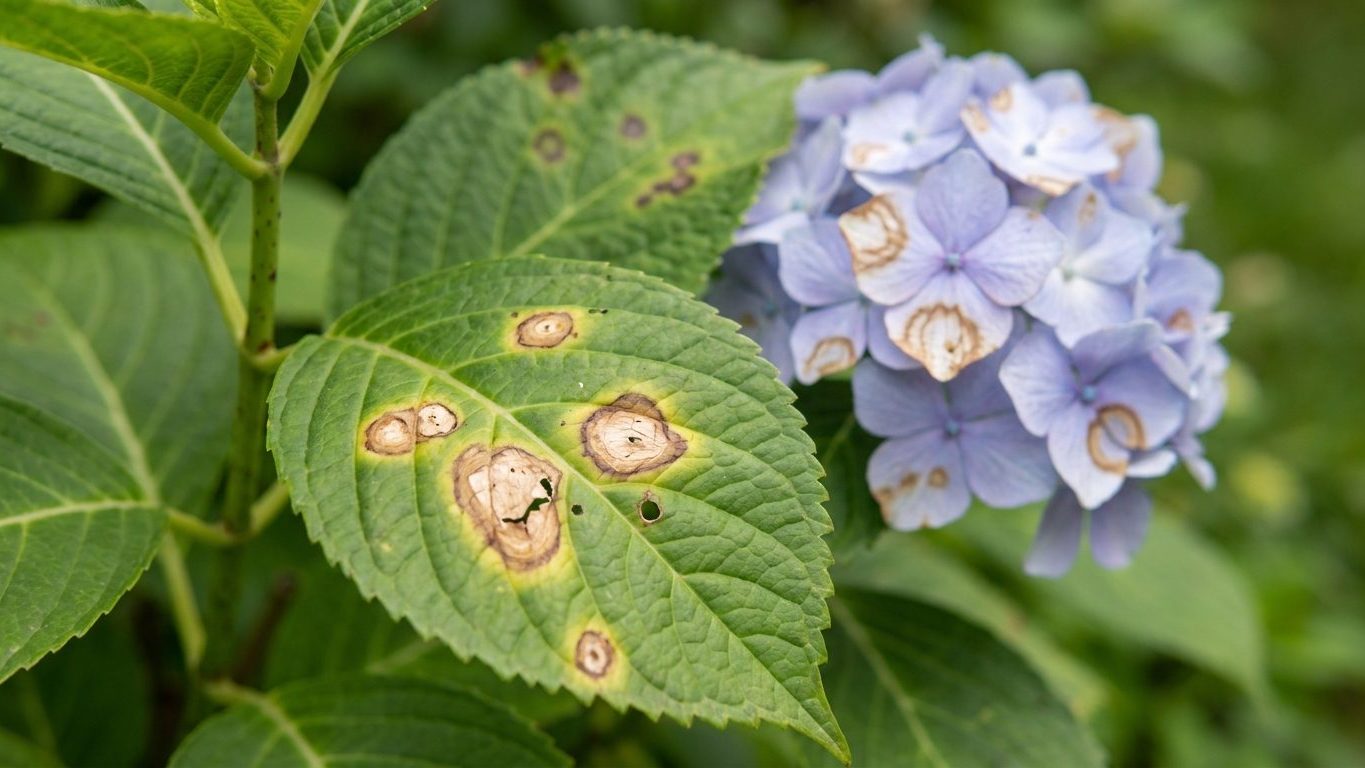

Concentric rings on a hydrangea leaf, brown blotches ringed like a target on the bloom itself: that’s anthracnose, a fungal leaf and flower spot that moves fast in warm, wet weather but rarely kills an Established shrub. It disfigures more than it destroys. Left alone in a humid week, it can strip a plant of its show without touching the roots.
What you are looking at
The disease shows up first on the lower, older leaves, the ones closest to the soil and slowest to dry after rain or overhead watering. From there it climbs upward as spores splash onto the foliage above, so a shrub that looks fine at eye level can already be infected at the base. Given a stretch of warm, humid days, new lesions appear within about a week of infection, and a single wet season can mark most of the canopy.
Leaf lesions with concentric rings
Look for tan to brown spots, often with a darker ring inside a lighter one, giving the classic target pattern the disease is named for. The rings can be irregular rather than perfectly round, and the center sometimes dries out and falls away, leaving a ragged hole. A narrow yellow border frequently surrounds the whole spot before it turns papery brown.
Bloom blotching
On the flower heads, especially the white or pale florets of panicle and smooth types, the same brown, ring-marked blotches appear on individual petals. Infected blooms can look scorched or water-stained in patches rather than uniformly discolored, and severely hit flower heads brown prematurely and drop bits of petal tissue.
Stem lesions on new growth
Sunken, elongated brown lesions sometimes form on soft, current-season stems, particularly where a leaf has already died back and the fungus has moved into the tissue behind it. These are secondary to the leaf and bloom symptoms and show up later in a bad outbreak, not as a first sign.
The pattern to remember: it starts low, it starts on older leaves, and it announces itself with rings, not solid blotches. That last detail is what separates it from almost everything else a hydrangea gets.
What it is not
Three other hydrangea problems get mistaken for anthracnose often enough that the mix-up is worth walking through one at a time. Mistaking any of them changes what you’d do next, and doing the wrong thing wastes a season.
Cercospora Leaf Spot
This leaf spot produces small, round, purplish-brown spots with tan centers, scattered across the leaf rather than concentrated near a target ring. There’s no concentric banding, and the spots stay small and numerous instead of merging into large blotches. It’s a cosmetic nuisance more than a threat, and it rarely reaches the bloom the way anthracnose does. Treating it as anthracnose isn’t harmful, but it means you’ll be watching for bloom damage that this particular disease won’t cause.
Powdery Mildew
Powdery mildew coats the leaf surface, and sometimes the stems and flower buds, with a dusty white to gray film that looks like it was sprinkled on. There’s no ring pattern, no brown center, and the leaf tissue underneath is often still green rather than dead. Wipe a finger across it and the powder smears; anthracnose lesions don’t. Spraying for a fungal leaf spot when the real problem is mildew wastes product and lets the mildew keep spreading, since the two respond to different timing and different products.
Bacterial Wilt
Bacterial wilt behaves nothing like a leaf spot. Instead of ringed blotches, whole leaves or entire stems go limp and dull, often on just one side of the plant, while the rest of the shrub stays turgid and green. Cut a wilting stem and the vascular tissue inside often shows discoloration, a sign no leaf-spot disease produces. This is the distinction that matters most: a wilt cannot be treated with the sanitation and airflow measures that help against anthracnose, and confusing the two means losing time on a plant that needed a completely different response, including removal, rather than pruning and cleanup.
Line the three up side by side on a leaf and the difference is visual before it’s anything else: rings versus scattered spots, brown versus white powder, wilted versus intact. That’s usually enough to settle it without a lab test.
Where it comes from and when it strikes
Anthracnose on hydrangeas is caused by fungi in the Colletotrichum group, organisms that survive the off-season in fallen leaves, old flower debris, and infected stem tissue left on or under the plant. When the growing season resumes, spores form on that leftover material and wait for a way to travel. Rain and overhead irrigation do the traveling for them, splashing spores from soil and debris up onto the lowest leaves, which is why infection almost always begins near the ground.
Wind can carry spores over greater distances once an infection is established nearby, and infected transplants or cuttings brought in from another source can introduce the fungus to a bed that never had it before. None of this requires unusual weather, just the ordinary combination that most fungal leaf diseases favor: warm temperatures paired with extended periods where the leaf surface stays wet, whether from rain, dew, or a sprinkler running in the evening. The longer a leaf stays damp after wetting, the more time spores have to germinate and penetrate the tissue, and a string of humid days back to back does more damage than a single hard rain followed by dry sun.
Crowded plantings make the problem worse simply because they slow drying. A shrub packed tightly against its neighbors holds humidity in its own canopy long after an open-grown plant nearby has dried off, which is one reason spacing shows up again in the prevention advice below.
What to do about it now
Start by removing what’s already infected. Pick off spotted leaves and clip out blotched flower heads, and clear fallen leaf litter from underneath the shrub rather than leaving it to reinfect the plant next time it rains. This won’t cure tissue that’s already lesioned, but it does stop that tissue from producing more spores to spread further. Bag or discard the debris away from the planting bed rather than composting it, since home compost piles rarely get hot enough to kill the fungus.
Switch off overhead watering if that’s how the bed has been irrigated, and water at the base instead. This single change does more for a leaf-spot disease than almost anything else available to a home gardener, because it removes the wet-leaf window the fungus depends on. Thin out crowded stems and prune neighboring shrubs back enough that air can move through the planting; a breeze that dries leaves an hour sooner cuts the infection window by that same hour.
A layer of mulch under the shrub helps by physically blocking splashback from bare soil onto the lowest leaves, which is exactly where the disease gets its start. Fungicide treatments exist for anthracnose and can slow an active outbreak when applied early and repeated on schedule, but they protect healthy tissue going forward rather than reversing damage already done. There’s no harvest-safety question here since hydrangeas are ornamental, not edible, though it’s worth remembering that bigleaf hydrangea foliage and flowers are documented as toxic if eaten in quantity, a separate issue from anthracnose but one more reason to keep fallen debris cleaned up around pets.
Keeping it out next season
Sanitation carries most of the weight going forward. Clear leaf litter and spent blooms every fall regardless of whether this season’s outbreak was bad, since the fungus overwinters on exactly that debris. Disinfect pruning tools between cuts if you’re working on a plant that showed symptoms, so you’re not dragging spores from a diseased stem onto a clean one with the same blade.
Spacing and pruning timing both depend on which hydrangea you’re growing, because the types differ in how and when they set their flower buds:
| Type | Flowers on | Typical size |
|---|---|---|
| Bigleaf / mop-head / lacecap | Last year’s wood | 3-6 feet tall and wide |
| Panicle / peegee | Current season’s growth | 8-25 feet |
| Smooth (e.g., Annabelle) | New wood | Medium shrub, hardiest of the group |
| Oakleaf | Old wood | To about 5 feet |
| Mountain | Old wood | Similar to bigleaf |
| Climbing | Old wood | 15 feet or more |
Because pruning timing and the exact hardiness picture change by type and by zone, the safest move is to check the guide for your specific hydrangea and region before cutting, rather than applying one rule to all of them. What holds true everywhere is the spacing principle: give each shrub enough room that its canopy dries within a reasonable window after rain, and avoid planting a new hydrangea where a previous one showed anthracnose without first clearing all the old debris. Source new plants from a nursery bed that showed no leaf or bloom spotting, since infected transplants are one of the ways this fungus travels into a bed that never had it.
Common questions
Does anthracnose kill a hydrangea?
Rarely on its own. It disfigures leaves and blooms and can weaken a shrub over repeated bad seasons, but an established plant typically survives and leafs out again the following year once sanitation and airflow improve.
Can I still cut flowers for a vase if they have a few spots?
Spotted blooms hold up poorly in a vase regardless of the disease, since the damaged tissue browns further once cut. Choose unaffected flower heads instead and dispose of the trimmed spotted material away from the bed.
Will removing infected leaves stop the spread completely?
It reduces the source of new spores but won’t undo an infection already underway elsewhere on the plant, especially if wet weather continues. Removal works best combined with better watering habits and improved airflow, not as a standalone fix.
Is anthracnose the same thing as leaf spot on hydrangeas?
Anthracnose is a specific type of leaf spot disease, distinguished by its ringed, target-like lesions. Other leaf spot diseases on hydrangea produce smaller, unringed spots and don’t typically damage the flowers the way anthracnose does.