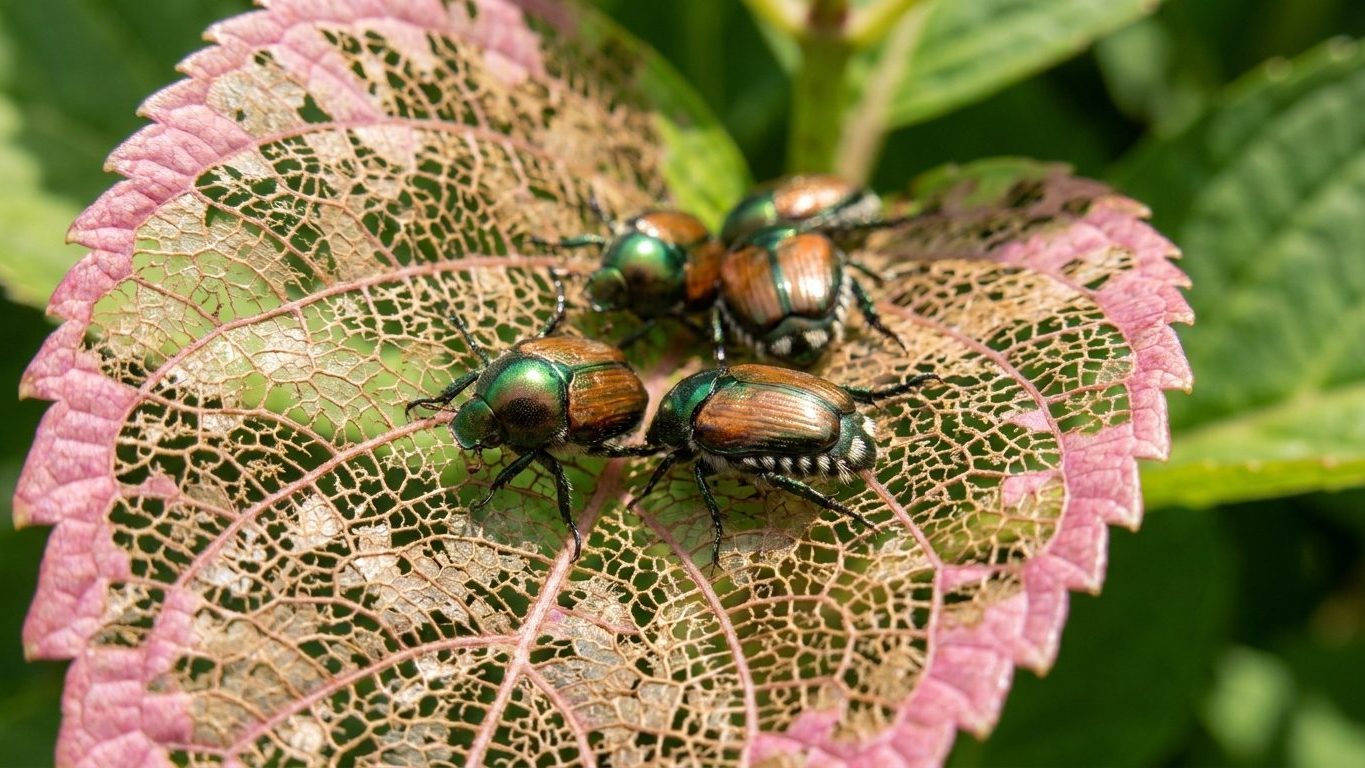

Skeletonized leaves on a hydrangea, the kind that look like brown lace with only the veins left standing, mean Japanese beetles. If you’re seeing shiny green-and-copper beetles clustered on the upper leaves during the day, that confirms it. On an established shrub this is almost always cosmetic. On a young, first-season planting it can matter more, because the plant has fewer leaves to spare.
What the damage looks like
The giveaway isn’t a hole. It’s a window. Japanese beetles chew the soft tissue between the leaf veins and leave the veins themselves untouched, so the damaged area turns papery, tan, and see-through, like a leaf skeleton held up to the light. That’s the discriminating detail that separates this pest from almost everything else that visits a hydrangea: aphids and mites cause stippling or curling, scale causes yellow blotches and sticky residue, but nothing else on this plant leaves that distinctive lace pattern.
The insect doing it
The adult is about the size of a raisin, with a metallic green head and thorax and copper-bronze wing covers. Look closely at the sides of the abdomen and you’ll usually spot small tufts of white hair peeking out from under the wing covers, a detail that matters when you’re trying to rule out a similar-looking beetle. They feed in groups, often a dozen or more on a single leaf or flower cluster, because the first beetles to arrive release a scent that pulls in more. That’s why damage on a hydrangea tends to show up in patches rather than spread evenly across the whole shrub.
They feed during daylight, favoring the leaves in full sun rather than the shaded interior of the plant. Since panicle hydrangea is the only type in the genus that takes full sun well, a panicle hydrangea planted in an open, sunny bed can end up showing heavier feeding than a shade-grown bigleaf hydrangea nearby, simply because more of its foliage sits in the beetles’ preferred light. They’ll also chew on the flower petals themselves, leaving ragged, browned edges on the blooms in addition to the leaf damage.
Making sure it is this and not something else
Three things get mistaken for Japanese beetle feeding on Hydrangeas, and each has one clear tell.
Rose chafer
Rose chafer produces a similar lacy, skeletonized leaf, and the two insects sometimes overlap in range. The test is color and build: rose chafer is a uniform tan or fawn color with noticeably long, spindly legs, not the metallic green-and-copper look of a Japanese beetle. If the beetle on the leaf is dull tan rather than shiny green, it’s the chafer, not the beetle covered here.
Leaf spot disease
Leaf spot, one of the diseases documented on hydrangea, causes brown or black blotches on the leaf surface, but it does not remove tissue. Hold the leaf up to the light: a disease spot is a dead, discolored patch with the tissue still intact underneath, while beetle feeding leaves an actual gap, a true window in the leaf where the material is gone. That difference is the single fastest way to rule disease in or out.
Other chafers and June beetles
Several duller brown beetles in the same family also chew foliage, but they’re nocturnal, hiding in soil or turf by day and feeding at night. If you only ever see the damage and never the insect during daylight hours, checking the plant after dark with a flashlight will usually turn up the culprit and settle the question.
When it shows up
There’s no calendar date for this one, because the trigger is soil warmth and plant stage, not a month on the wall. Adults emerge from the turf below once the soil has warmed enough after the grub stage, and they begin feeding as soon as the hydrangea is in full leaf and pushing active new growth, the same period when a panicle hydrangea is putting on the current season’s wood that its flowers will form on.
A pattern that compounds
Once a few beetles land and start feeding, the aggregation behavior means more arrive within the same stretch of warm, sunny weather, so damage that looks minor on day one can look much heavier a week later if nothing is done. A hydrangea bed near turf grass or open lawn, where the grubs spend their earlier life stage in the soil, tends to see beetle pressure build faster and sooner than a bed surrounded by mulch, gravel, or groundcover. Full sun exposure during this active feeding window matters too: the same beetles that ignore a shaded bigleaf hydrangea in a partly-shaded spot will settle readily on the top growth of a panicle hydrangea grown out in the open.
What to do now
- Hand-pick in the cool part of the morning. Beetles are sluggish before the day warms up, which makes them easy to knock straight into a bucket of soapy water. This costs nothing and, on a small or moderate infestation, is genuinely the most effective step a home gardener can take.
- Skip the pheromone traps. Commercial Japanese beetle traps use the same scent the beetles use to call in reinforcements, and they tend to draw in more beetles from the surrounding area than they actually capture. Placed near a hydrangea, a trap can make the local problem worse rather than better.
- Cover young or newly planted shrubs. A lightweight insect netting or row cover over a first-season hydrangea during the active feeding period keeps beetles off the limited foliage a young plant depends on to establish. Remove it once the pressure passes so pollinators can reach the flowers.
- Try insecticidal soap or neem oil first, if a spray feels necessary. Neither is a strong direct killer of adult beetles, but both can reduce feeding and are far gentler on the bees, predatory insects, and other beneficials that a broad-spectrum product would also wipe out.
- Reserve a labeled contact insecticide for heavy, established infestations. Products labeled for Japanese beetle on ornamental shrubs are sold at most garden centers, but read the label for the specific plant and check state restrictions before buying, since availability varies by state. Apply directly to beetles on the foliage rather than as a routine preventive spray, and avoid spraying open flowers or applying during the hours when bees are most active, since these products don’t distinguish a beetle from a pollinator.
Stopping it coming back
- Start checking the plant daily as soon as the growing season’s new leaves are fully out, since removing the first few beetles before they call in others limits how bad the cluster gets.
- Hold off on broad-spectrum insecticide unless the infestation is genuinely heavy, so that birds, predatory wasps, and other natural beetle enemies stay in the yard to help.
- Keep the turf near the hydrangea bed healthy and monitored, since the grub stage of this beetle develops in lawn soil before adults emerge nearby.
- Mulch around shallow-rooted types like bigleaf and panicle hydrangea to keep the plant vigorous, so cosmetic leaf loss from a beetle cluster doesn’t add real stress on top of it.
- If beetle pressure in the area is consistently heavy, favor a partly shaded planting spot for sun-tolerant types when the site allows it, since beetles concentrate on sun-warmed foliage first.
Common questions
Will Japanese beetle damage kill my hydrangea? On an established shrub, no. The feeding is cosmetic and the plant typically pushes new growth the following season without lasting harm. A young, first-year planting with few leaves to spare is the case where it’s worth acting quickly and considering a cover.
Do Japanese beetles prefer certain hydrangea types? They’re drawn to sun-exposed foliage rather than to one species specifically, so a panicle hydrangea grown in full sun, which is the type built to take that exposure, can show more visible feeding than a shaded bigleaf hydrangea nearby.
Do Japanese beetle traps help? Generally not near the plant you’re trying to protect. The scent lure pulls beetles in from the surrounding area, and a trap placed close to a hydrangea bed tends to concentrate more beetles there rather than fewer.
Are Japanese beetles a risk to pets or people? The beetles themselves aren’t documented as toxic. Separately, bigleaf hydrangea (and only bigleaf) is documented as toxic if large quantities of the plant are eaten, causing nausea, stomach pain, vomiting and sweating in people, dogs, cats and horses, so that risk comes from the plant, not from the insect feeding on it.