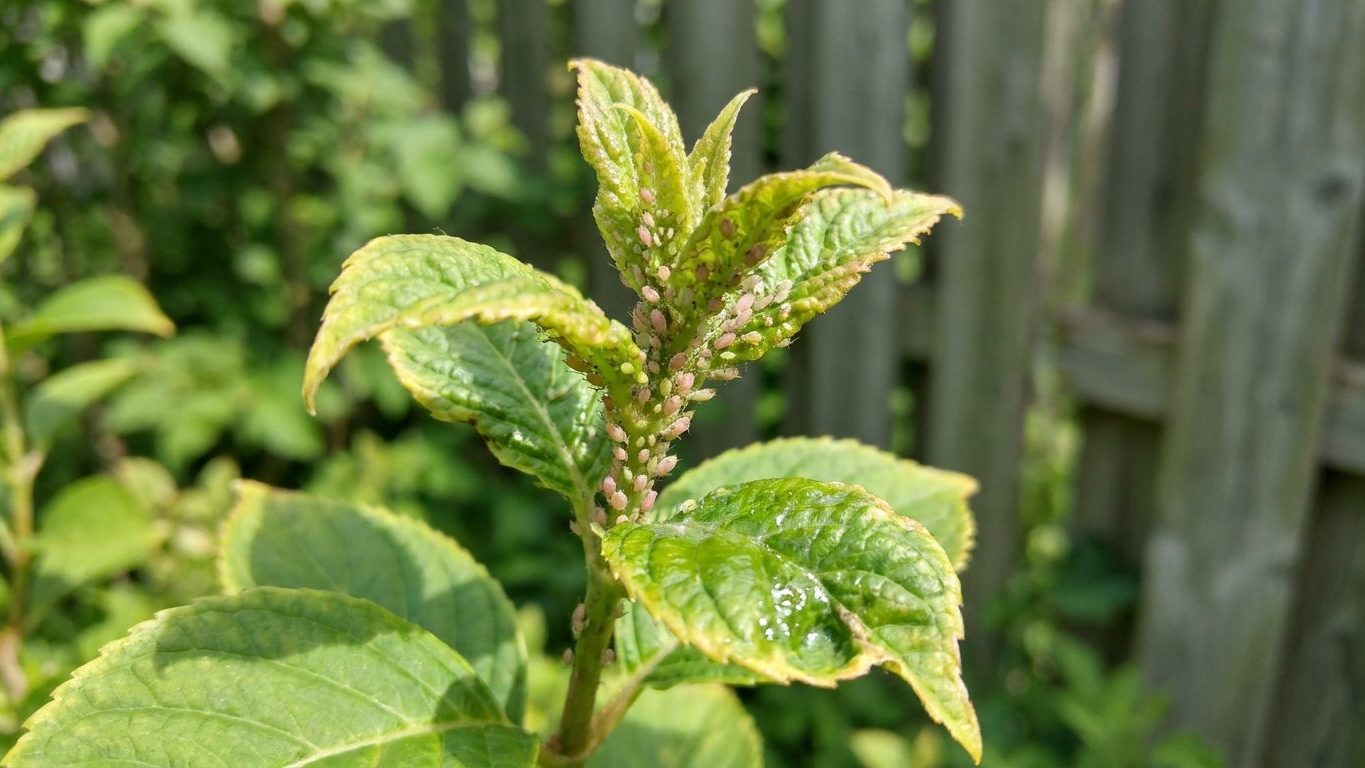

Small clusters of soft-bodied insects crowd the newest leaves and buds, and the growing tip looks twisted, sticky, or slightly deformed. This is almost always aphids, and on a mature hydrangea it’s rarely dangerous. It’s the kind of damage that looks worse than it is, especially once you know what’s actually feeding on the plant and why the new growth is the target.
What the damage looks like
The single detail that separates this from every other insect problem on hydrangeas: aphids show up as a visible, moving cluster. Dozens of tiny pear-shaped bodies, often pale green, pink, or black, packed tightly along the stem just behind the growing tip, on flower buds, or on the underside of the youngest leaves. They’re slow and soft, easy to see with the naked eye, and easy to smear between two fingers if you want confirmation.
Around that cluster, the new leaves are often curled, puckered, or slightly yellowed, because aphids feed by piercing the tissue and drawing out sap, and the tender growth distorts as it tries to expand around the damage. A sticky film, honeydew, coats the leaves below the cluster, and on an older infestation that honeydew turns black with sooty mold, a fungus that grows on the sugary residue rather than on the plant itself. Ants are frequently patrolling the same stems, because they feed on the honeydew and, in a strange bit of insect cooperation, protect the aphids from predators in exchange for it.
What you won’t see with aphids: bumps that don’t move, fine webbing between leaves, or stippled, bronzed foliage. Those belong to other pests entirely. Aphids also tend to concentrate on the newest, softest growth rather than spreading evenly across the whole plant, which is a useful clue on its own. A hydrangea that pushed a lot of tender growth after a hard prune or a heavy feeding is the plant most likely to be carrying a cluster right now.
On an Established, healthy shrub, this is largely cosmetic. The plant has the reserves to shrug off a few curled leaves at the tips. On a young plant, a rooted cutting, or a hydrangea already stressed by drought or Transplant shock, a heavy cluster can slow growth and deform enough new tissue to matter for the season. The response should match the plant, not the insect.
Making sure it is this and not something else
Hydrangeas carry a short list of insect pests, and aphids are the easiest of them to rule in or out because they’re the only one you can watch crawl. The other three named for this plant look nothing like a cluster on new growth once you know what to check.
Scale insects
Scale shows up as small, oval, immobile bumps stuck to stems and the undersides of older leaves. They don’t move, they don’t cluster the way aphids do, and scraping one off with a fingernail takes real pressure because they’re anchored under a waxy shell. If what you’re looking at doesn’t move when you nudge the stem, it isn’t aphids.
Mites
Mites are close to invisible without a hand lens, and the damage they cause is a fine yellow or bronze stippling across the leaf surface rather than a cluster at the tip. The giveaway is fine webbing on the underside of leaves in a heavy infestation, something aphids never produce. Hold a sheet of white paper under a suspect leaf and tap it; mites show up as moving dust specks, not visible bodies.
Nematodes
Nematodes work underground, attacking roots, and the symptom is a slow, unexplained decline in vigor rather than anything visible on the new growth. If the leaves at the tips look normal and the problem is stunted growth across the whole plant instead, the aphid explanation doesn’t fit and the cause is somewhere you can’t see without digging.
When It Shows Up
Aphids follow the softest tissue on the plant, so the trigger is a growth stage, not a date on the calendar. The most vulnerable moment is the spring flush, when new shoots are pushing out fast and the cell walls in that tissue are still thin and easy to pierce. A hydrangea that was cut back hard and responds with a rush of vigorous new stems is offering exactly the kind of soft growth aphids prefer.
Heavy nitrogen feeding creates the same opening. A plant pushed with a lot of fertilizer produces lush, watery growth that’s easier to feed on than tissue that developed more slowly, and that’s true whether the nitrogen came from a bag of fertilizer or a well-meaning gardener’s compost pile. Growth that rebounds after a stress period, drought followed by a good rain, for instance, produces a similar flush of tender new tissue and the same opportunity.
Because bigleaf and mountain hydrangeas set their flower buds on old wood the previous summer, while panicle and smooth types bloom on new wood built the same season, the timing of new growth, and so the timing of aphid risk, differs by which hydrangea is in the ground. A panicle hydrangea cut back hard in late winter will push a long flush of new wood exactly the kind of tissue aphids target, while a bigleaf hydrangea’s most vulnerable new growth appears earlier and briefly before it matures. Whichever type you’re growing, the safe window for pruning is decided by that plant’s own bloom habit and your zone, not by anything in this article.
What to do now
- Knock them off with water. A firm spray from the hose, aimed at the underside of the affected shoots, dislodges most of a light to moderate cluster. Aphids are slow to climb back up, and this costs nothing and harms nothing else on the plant.
- Let natural predators work. Ladybugs, lacewing larvae, and hoverfly larvae all eat aphids in quantity, and a cluster that looks alarming today is often gone within a week or two once predators find it. Resist reaching for a broad-spectrum insecticide at this stage; it kills the predators as effectively as the aphids, and often more so, since the aphids reproduce faster and recolonize before the beneficial insects do.
- Prune out the worst tips. If one or two shoots are carrying most of the cluster, snipping them off and disposing of them removes the bulk of the population in one pass, with no spray involved.
- Insecticidal soap, if the cluster is heavy. A soap spray labeled for aphids on ornamentals kills on contact and breaks down quickly, with minimal residual effect on visiting bees or ladybugs once it dries. Coverage matters more than concentration; the underside of the leaf and the stem behind the growing tip need to be wetted directly.
- Horticultural oil or neem oil, as a second pass. These work similarly to soap, smothering the insects on contact, and are widely available to home gardeners. Apply in cooler conditions and avoid open flowers, since oil sprays can also affect pollinators that land on treated blooms.
- A systemic insecticide only as a last resort. Several products are labeled for home use on ornamentals, but they’re absorbed into the plant tissue and kill a wider range of insects than the aphids alone, including the predators that would otherwise keep the population in check on their own. Some formulations are restricted for use near flowering plants in certain states because of pollinator risk. Read the label for your state before buying, and treat this as the option for an infestation that hasn’t responded to anything gentler.
One practical note if the plant is a bigleaf hydrangea and there are children, pets, or livestock around while you’re pruning out infested growth: the bark, flowers, leaves, and stems of that species are documented toxic if eaten in quantity, causing nausea, stomach pain, vomiting, and sweating. It isn’t a reason to avoid the plant, just a reason to clear pruned material away rather than leave it in a pile within reach.
Stopping it coming back
- Go easy on nitrogen. A hydrangea fed moderately produces sturdier new growth that aphids find less appealing than the soft, fast tissue a heavy feeding schedule creates.
- Check new growth early in its flush, when a small cluster is still easy to hose off or prune out before it builds into something visible from across the yard.
- Keep a broad-spectrum insecticide out of routine use. Ladybugs and lacewings do most of the season’s aphid control for free if they aren’t wiped out by a spray aimed at something else entirely.
- Leave some structure standing over winter. Cutting spent stems back to 12 to 24 inches and letting them stand until they naturally break down gives native bees a place to nest, and a garden with a healthy population of beneficial insects generally runs a smaller aphid problem year over year.
- Manage ants near the base of the shrub if they’re a persistent presence, since ants actively protect aphid colonies from predators to keep Harvesting the honeydew, which lets a cluster persist longer than it otherwise would.
- Match your pruning timing to your actual hydrangea type. Old-wood bloomers and new-wood bloomers respond to a hard cutback very differently, and cutting at the wrong stage for your type can trigger exactly the kind of soft regrowth flush that draws aphids in the first place.
Common questions
Do aphids kill hydrangeas? Rarely, on an established plant. A heavy cluster distorts and weakens new growth for a season, but the shrub’s older wood and root system aren’t affected, and most plants recover fully once the infestation is knocked back.
Are the sticky leaves themselves harmful? The honeydew isn’t toxic to the plant, but the sooty mold that grows on it can block light from the leaf surface if it builds up heavily over a long infestation. Washing the residue off once the aphids are gone clears the mold along with it.
Will ladybugs actually show up on their own? In most home landscapes, yes, particularly if the yard already has some diversity of flowering plants and hasn’t been treated recently with a broad-spectrum insecticide. Buying and releasing ladybugs is popular but often disappointing, since released insects tend to disperse rather than stay put on the infested shrub.
Can I just ignore a small cluster? On a mature, healthy hydrangea, often yes. Monitor it for a week or two; a light cluster on a vigorous plant frequently disappears on its own once predators find it or the tissue matures past the soft stage aphids prefer.