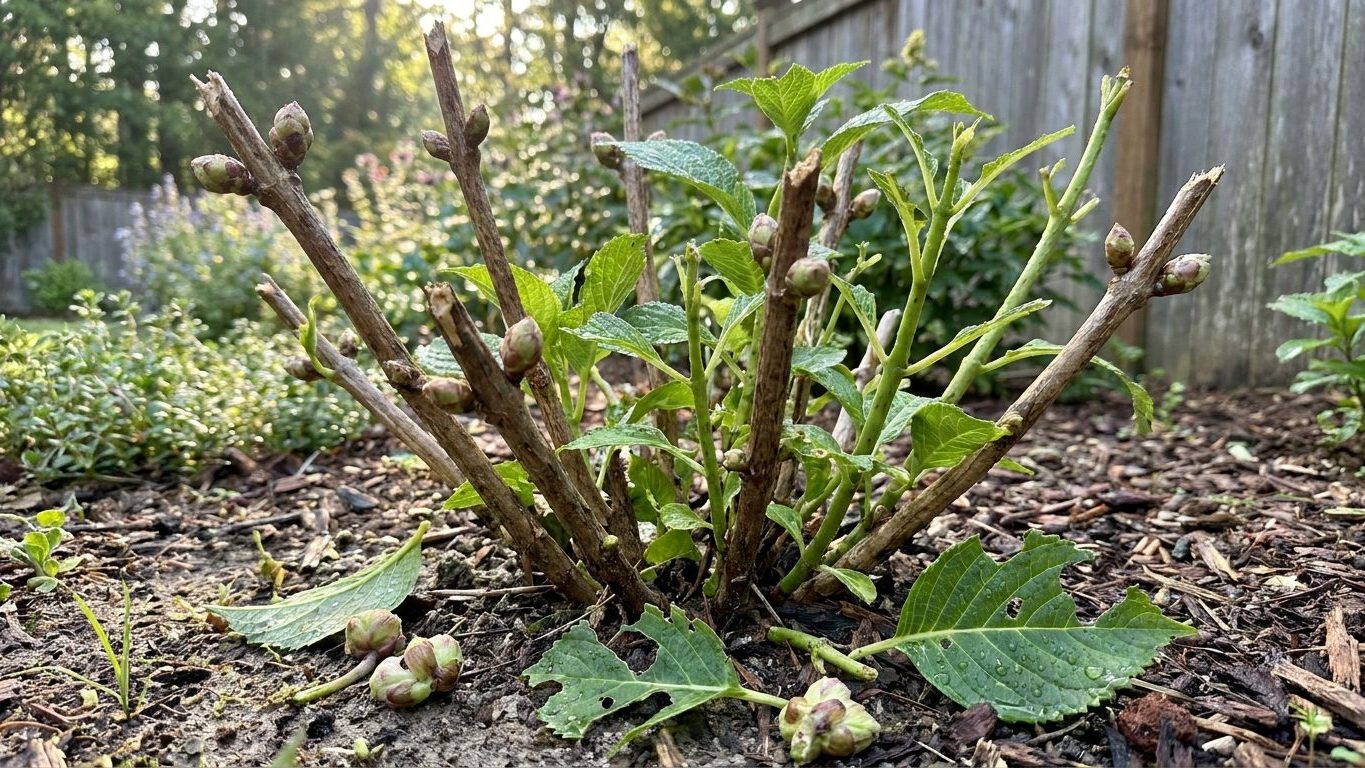

Deer are the biggest threat to Hydrangeas nationwide, followed by aphids, scales, mites and nematodes — though the extension source that tracks these pests calls the insect group “rarely a problem.” The bigger complication: the same nibbled leaf can mean four different things, and each one needs a different response.
Why this matters
Getting the diagnosis wrong wastes a season. Deer damage on an old-wood bloomer (bigleaf, oakleaf, mountain, or climbing hydrangea) removes buds that were already set the previous summer, so a single browsing event can erase every flower that plant would have produced. On a current-season bloomer like panicle or smooth hydrangea, the same bite is a setback, not a wipeout, because new growth still carries new buds. Treating both cases identically means either overreacting on a plant that will recover fine, or underreacting on one that just lost its whole year.
There’s a safety angle too. Only bigleaf hydrangea (H. macrophylla) is documented as toxic, and only when large quantities of bark, flowers, leaves or stems are eaten, the toxic compounds are hydracyanosides, and the symptoms are nausea, stomach pain, vomiting and sweating in people, dogs, cats and horses. That’s worth knowing before you assume a browsing animal will simply move on, and worth mentioning if pets or livestock share the yard.
When to do it
Watch for deer activity around bud swell, whenever that happens for your zone and type, that’s the window where the cost of a bite is highest, because those buds represent an entire flowering cycle on old-wood types. A stripped bud at that stage means no flower there this year, full stop.
Aphids and mites show up on tender new growth, so check the undersides of the newest leaves as soon as a flush appears. Scale insects are easiest to spot once they’ve settled and hardened into small bumps along stems, which takes longer to notice than the soft-bodied pests. Nematodes don’t announce themselves with visible chewing at all, they work underground, so the tell is a plant that’s stunted or slow to recover for no obvious reason, not a damaged leaf you can point to. If a hydrangea looks weak all season with no insects in sight, root-zone pests are worth ruling out before you assume it’s a watering or soil problem.
How to do it
Start by ruling out deer, since their damage has a distinctive look: ragged, torn stem ends rather than a clean cut, because deer lack upper front teeth and rip rather than snip. Damage typically sits two to six feet off the ground, and entire buds, leaf clusters or soft new stems disappear overnight, often several plants at once along a browse line through the yard. If you see clean-cut stems close to the ground instead, you’re likely looking at rabbits or rodents, which is a different problem with a different fix.
Once deer are confirmed, physical exclusion is the most reliable response: netting or fencing tall enough to matter, since taller-growing types like panicle hydrangea (up to 25 feet) and climbing hydrangea (15 feet and more) can eventually put growth within reach even of fencing that worked when the plant was young. Repellents can reduce browsing pressure but performance varies by product and by how hungry the local deer population is in a given season, there’s no universal fix, so expect to combine a barrier with whatever repellent strategy fits your property.
For the insect pests, the source’s own framing matters: aphids, scales, nematodes and mites are listed as rarely a problem on Hydrangeas, so the first move is confirming there’s actually an infestation worth treating.
- Aphids: small, soft-bodied, clustered on new shoots and leaf undersides, often with sticky honeydew residue. A firm spray of water from a garden hose knocks most populations down; insecticidal soap handles the rest.
- Scale: small, immobile bumps along stems, easy to mistake for plant tissue. Light infestations can be scraped off by hand; heavier ones need a targeted horticultural oil application timed to the pest’s life cycle.
- Mites: fine stippling or speckling on leaves, with webbing visible in heavy cases. They favor hot, dry conditions, so consistent watering during a dry stretch reduces pressure as much as any spray does.
- Nematodes: no visible insect at all, just a plant that underperforms. A soil test through a local extension office is the only reliable way to confirm this one.
In every case, treat the mildest option first and escalate only if the plant keeps declining, these pests earned their “rarely a problem” label for a reason.
What goes wrong
The most common mistake is misreading disease as pest damage. Leaf spot, powdery mildew and bacterial wilt (plus rust and bud blight, specific to panicle hydrangea) all leave marks that get blamed on insects or deer, and no amount of fencing or insecticidal soap fixes a fungal or bacterial issue. If the damage looks like discoloration or spotting rather than chewing or missing tissue, you’re probably dealing with disease, not a pest.
The mistake that looks like diligence but isn’t: reaching for a broad insecticide the moment you spot a few aphids. Since these pests are rarely a serious problem, a heavy spray program does more harm than the pests would have, and it puts native bees at risk, bees that nest in the plant’s own dead, hollow stems over winter. Cutting those stems back to 12 to 24 inches and leaving them standing until they naturally break down protects that habitat; spraying indiscriminately undoes it.
A second quiet mistake: responding to plant stress with a high-phosphorus fertilizer. On blue-flowering bigleaf or mountain Hydrangeas, that feeding choice locks up the aluminum the plant needs to stay blue, and the flowers drift toward pink even though nothing about the soil pH actually changed. It’s a feeding decision that shows up looking like a completely separate problem.
Doing it differently
Container-grown hydrangeas face a different risk profile: raised off the ground on a patio, they’re often out of easy deer reach, but the smaller soil volume dries out faster and heats up more in direct sun, which is exactly the condition mites prefer. Watering consistency matters more for container plants than for anything else you’ll do to prevent mite pressure.
The plant’s bloom type changes how much a single deer visit actually costs. On old-wood bloomers, bigleaf, oakleaf, mountain and climbing hydrangea, a browsing event in spring can eliminate the year’s entire flower display, since those buds were set the previous summer and won’t be replaced. On panicle and smooth hydrangea, which flower on the current season’s growth, the same bite is a setback rather than a total loss, because the plant can still push new flowering wood afterward. That difference is worth knowing before deciding how aggressively to fence a given plant.
Raised beds don’t change pest exposure much on their own, but they do make root-zone problems like nematodes easier to diagnose and treat in isolation, since the soil volume is contained and separate from the surrounding yard.
Common questions
Do deer actually eat hydrangeas or just browse them?
Both happen. The source that documents hydrangea pests lists deer as a damage agent, and also notes the genus under general resistance to challenges elsewhere, those two entries don’t fully agree. What’s observed in practice is browsing: deer eat buds, leaves and soft new growth, and the plant is not reliably deer-resistant despite what you may have heard.
Is hydrangea toxic to the deer or pests eating it?
Only bigleaf hydrangea is documented as toxic, and only when large quantities are consumed, producing nausea, stomach pain, vomiting and sweating. There’s no published evidence that this toxicity meaningfully deters deer from browsing the plant.
Do coffee grounds keep pests away or change color?
Coffee grounds and citrus peel are widely believed to acidify soil enough to turn bigleaf or mountain hydrangea flowers blue, but the pH shift from kitchen scraps is very small. What actually drives blue color is available aluminum in acidic soil, which is why kitchen remedies routinely disappoint compared to actual soil acidification. None of this affects deer or insect pests either way.
Which hydrangea type is most resistant to deer damage?
No type in this genus is documented as reliably deer-resistant. The practical difference is in what a browsing event costs: old-wood bloomers lose an entire season’s flowers to spring browsing, while current-season bloomers like panicle and smooth hydrangea recover within the same year since they flower on new growth regardless of what was lost earlier.