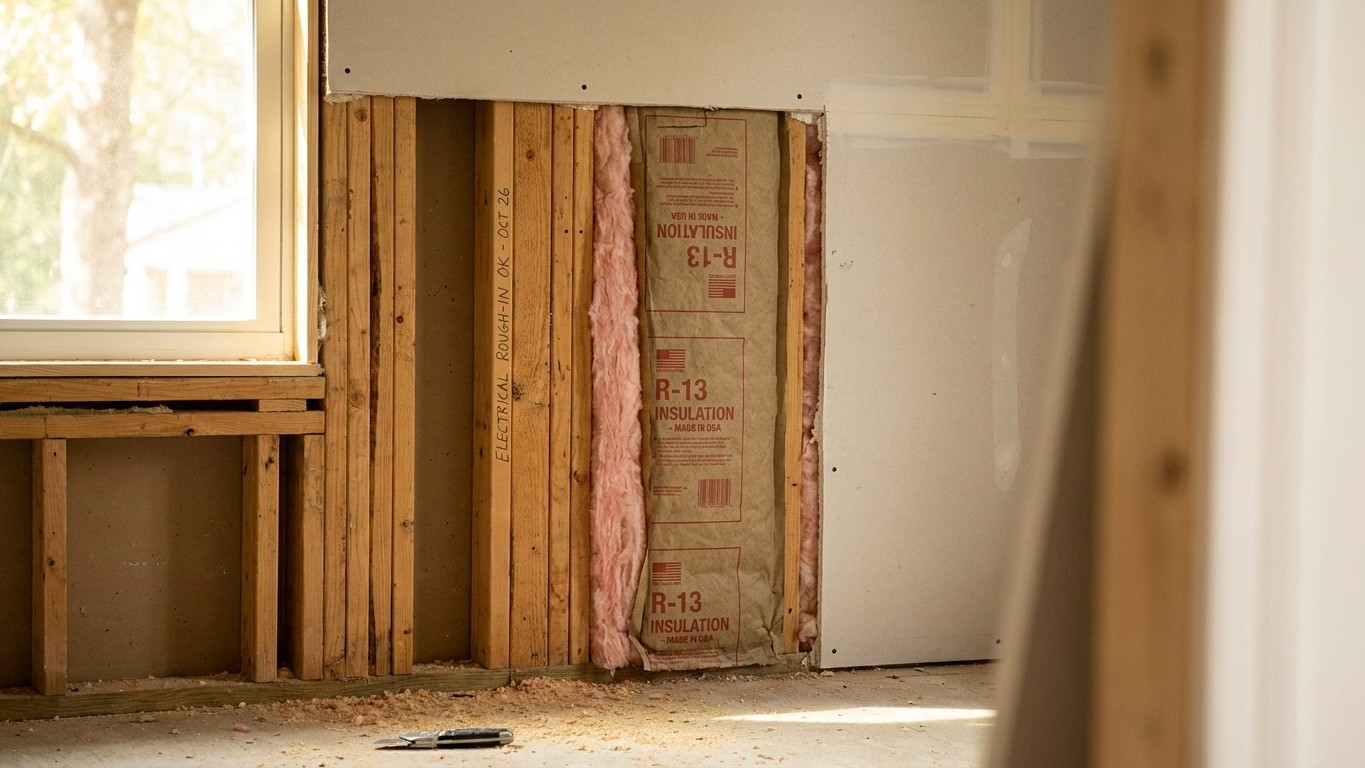

Yes. Connecticut sits entirely within IECC Climate Zone 5A, and under the 2021 International Residential Code, that means a Class-appropriate vapor retarder is required on the interior side of frame walls, per Section R702.7. There’s no county-by-county split to check here, no zone boundary running through the state. The requirement applies statewide, though the class of retarder, and how a local jurisdiction has adopted the code, still matter.
What the code asks for in Connecticut

The 2021 IRC is direct about it: R702.7 states that “a vapor retarder of the class given by Table R702.7(2) shall be provided on the interior side of frame walls.” That’s the model code language, word for word. Connecticut falls under it because the state carries a single IECC climate designation, 5A, with no county exceptions listed in the code’s climate-zone table. A homeowner in Litchfield County and one in Fairfield County are working under the same statewide zone assignment, which is rarer than it sounds. Plenty of states span three or four zones, and a reader there has to look up their own county before the rule even applies to them. Connecticut skips that step.
The code’s own exception list draws the line at Climate Zones 1, 2, and 3, the warm and warm-humid parts of the country. Connecticut isn’t in any of those. So the exception that removes the requirement in the Gulf Coast or peninsular Florida simply doesn’t reach here. That’s not a technicality, it’s the whole mechanism the next section explains.
What “required” actually means
Being required doesn’t mean one specific product. The code names three classes by permeance, not one material, and which class applies depends on the wall assembly, the cladding, and how the local code official has interpreted the table for that zone. A wall built with no vapor control at all, in a zone where one is required, doesn’t fail an inspection loudly. It passes drywall, passes paint, looks finished. The problem shows up years later, when moisture that had nowhere to go has already done its work inside the cavity. That’s the reason this question is worth more than a shrug before drywall goes up, and also the reason this page stops short of telling any one reader what to install. The class and the assembly are a conversation with a local building department, not a blanket answer for a whole state.
Connecticut’s statewide zone assignment is a genuine convenience for anyone trying to figure out where they stand. It removes the county-lookup step that trips up readers in split states. It does not remove the need to confirm, locally, which code edition and which amendments are actually in force.
Why the answer is the opposite in a warm climate
The reason Connecticut’s answer is “required” while a Gulf Coast state’s answer is “not required” comes down to which direction the water vapor is traveling, not which state has stricter rules. In a cold climate like Connecticut’s, the warm, moisture-laden air sits inside the house all winter. Without a vapor retarder, that indoor humidity migrates through the wall assembly toward the cold sheathing, condenses there, and soaks the framing from the inside out over a heating season that, as the next section shows, runs long here. The retarder on the interior face stops that vapor before it reaches the cold surface.
Flip the climate, and the physics flips with it. In a warm-humid zone, the moisture load arrives from the outside, not the inside. The U.S. Department of Energy’s Building America program lays out exactly what happens if a builder installs the same Class I retarder anyway: “If the wall contains a vapor retarder on the interior side of the insulation, the water vapor will condense on this cool, impermeable surface.” The interior sheet that protects a Connecticut wall becomes, in Houston or Miami, the cold surface that traps outside humidity against itself. The DOE names the outcome plainly: “ruined insulation, mold, and structural rot of framing members.”
That’s the whole disagreement in one sentence. It isn’t that southern building departments care less about moisture damage. It’s that the water is moving the other way, and a barrier built to stop a northbound problem becomes the cause of a southbound one. The code’s zone-by-zone table exists because of that direction, not because of some regional preference for paperwork.
The three classes, and why the word matters
Connecticut’s requirement doesn’t specify one product. It points to a table of three classes, sorted by how much moisture they let through, measured in perms. The lower the perm rating, the less vapor gets past it.
| Class | Example materials | Permeance |
|---|---|---|
| Class I | Sheet polyethylene, nonperforated aluminum foil | 0.1 perm or less |
| Class II | Kraft-faced fiberglass batts, vapor retarder paint | Above 0.1, up to 1.0 perm |
| Class III | Latex or enamel paint | Above 1.0, up to 10.0 perm |
Notice what’s on that last line. Ordinary latex paint on drywall is, by the code’s own definition, a Class III vapor retarder. Most homeowners have one on their walls right now without knowing it counts as anything at all. That’s worth sitting with, because it means the gap between “no vapor retarder” and “a vapor retarder is present” can be as thin as a coat of paint already on the wall, or as thick as a continuous polyethylene sheet stapled behind the drywall.
This is also why calling polyethylene “a vapor barrier” without qualification muddies the real conversation. It’s Class I, the tightest of the three, and appropriate for some assemblies and climates and not others. The disagreement between a builder working in Connecticut’s Zone 5A and one working in Zone 2 isn’t about whether to bother with a retarder. It’s about which class belongs in which wall, and that’s a decision the code ties to climate and assembly, not to habit.
One more distinction worth keeping straight: a vapor retarder and an air barrier do different jobs, even though the same sheet of material sometimes does both. A vapor retarder slows moisture diffusion through a material. An air barrier stops bulk air movement, which carries far more moisture, far faster, through gaps and penetrations. Confusing the two is common and worth avoiding, but it’s a separate topic from the class table above.
Where the rule stops
The 2021 IRC lists four situations where R702.7’s requirement doesn’t apply, regardless of climate zone:
- Basement walls
- The below-grade portion of any wall
- Construction where accumulation, condensation, or freezing of moisture will not damage the materials
- Climate Zones 1, 2, and 3, where a vapor retarder isn’t required at all
Connecticut’s Zone 5A designation means that fourth exception doesn’t apply here, but the first two are the ones a Connecticut homeowner is actually likely to run into, because most Connecticut houses have a basement.
The basement exception exists for a straightforward reason. A poured concrete or block foundation wall holds and releases moisture for years after the pour, sometimes decades, and it sits partly or fully below grade where groundwater and soil moisture are constant neighbors. That wall assembly needs a path to dry inward, toward the conditioned space, because it has nowhere else to send the moisture. Install an impermeable interior vapor retarder on a basement wall and that drying path closes, trapping moisture against the framing and finish materials instead of letting it escape. This is a different assembly with a different exception, and it deserves its own careful look, which is exactly what the basement wall guide on this site walks through.
Who actually decides, in Connecticut
The IRC is a model code. Connecticut, like every state, adopts its own edition, sometimes with amendments, sometimes on a delay behind the model code’s release cycle. The rule described above reflects the 2021 IRC as written. Whether that’s the exact edition your town has adopted, and whether any local amendment changes a detail, is a question only the local building department can answer for a specific address and permit.
That local check carries real weight in Connecticut because of how much winter the state actually carries. At Bridgeport, a reference station for the state, the National Weather Service’s 1991-2020 climate normals put annual heating degree days at about 5,140, against roughly 955 cooling degree days. Heating degree days measure demand, not temperature: each day’s shortfall below 65°F adds to the yearly total, and 5,140 is a season that leans long and cold rather than short and mild. That’s the backdrop against which R702.7’s requirement makes sense here, a heating season substantial enough that interior moisture reaching cold sheathing is a routine risk, not an edge case.
None of that changes the basic guidance. This page describes what the code says and what it depends on, not what belongs in any one wall. A vapor retarder installed in the wrong class, or omitted where the local code requires one, doesn’t announce the mistake at final inspection. It shows up years later, in framing that’s already rotted from the inside, which is the whole reason the local building department, working from the code edition actually adopted in that town, is the only authority that can answer for a specific house.