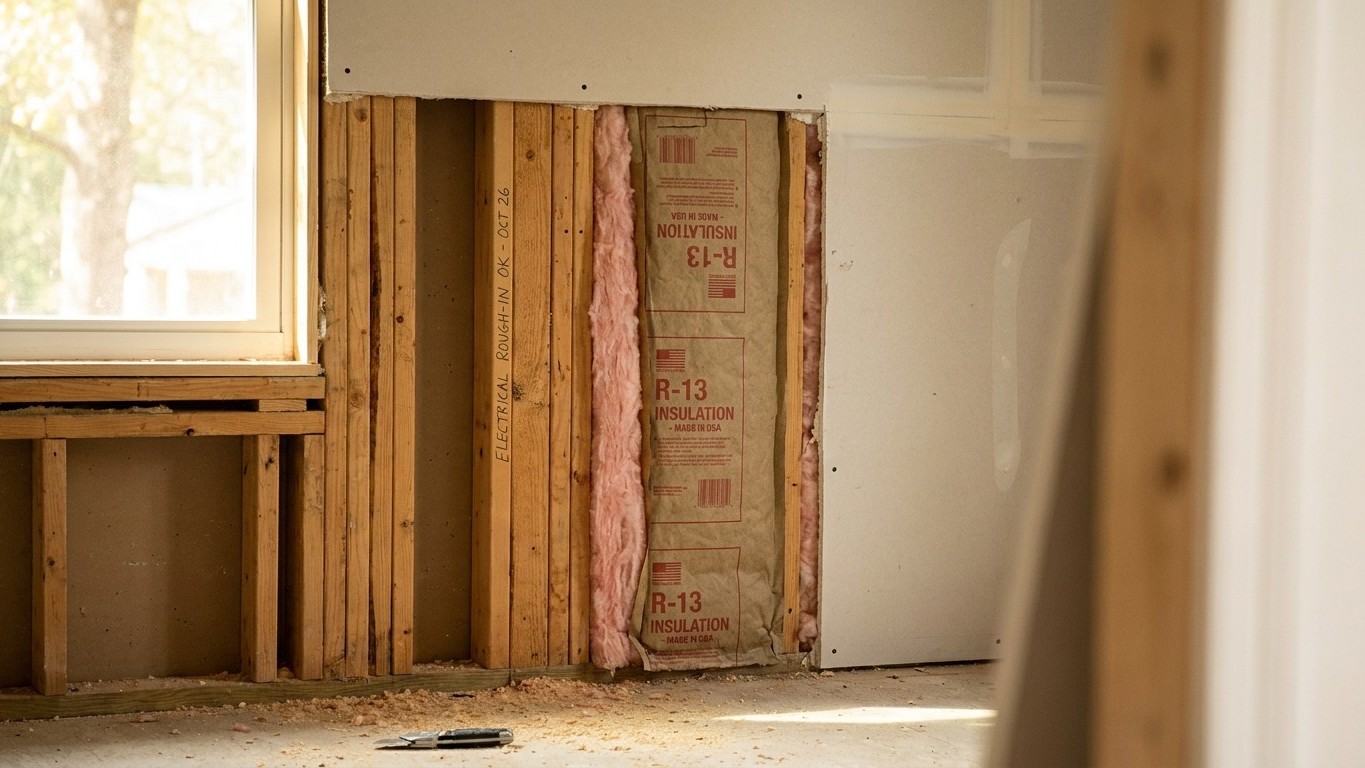

Yes. Wyoming’s 23 counties fall entirely within IECC Climate Zones 6B, 7, and 5B, none of which qualifies for the code’s warm-climate exception. Under the 2021 International Residential Code, that means an interior-side vapor retarder is required on frame walls across the whole state, from Cheyenne to the mountain counties around Jackson. The class of retarder, and where the rule stops applying, is where the real detail lives.
What the code asks for in Wyoming

The 2021 International Residential Code, Section R702.7, states that a vapor retarder of the class listed in Table R702.7(2) “shall be provided on the interior side of frame walls.” The code then carves out four exceptions, and the one that flips the answer for warmer states is this: “A vapor retarder shall not be required in Climate Zones 1, 2 and 3.” Everywhere else, the base requirement stands.
Wyoming’s 23 counties sort into three zones: 17 counties in zone 6B, 3 counties in zone 7, and 3 counties in zone 5B, according to the IECC’s Table R301.1. All three are cold, dry-climate zones. None of them is zone 1, 2, or 3, so the exception built into R702.7 simply doesn’t reach Wyoming. A county in zone 7, up in the higher, colder ground, and a county in zone 5B sit on different rows of the state’s insulation and moisture tables, but on this specific question, both land on the same side of the line as the 6B counties in between.
That’s worth sitting with for a second, because it’s not the pattern this whole content silo keeps running into. States that straddle zones 3 and 4, for instance, really do have a split answer, with one part of the state exempt and another part not. Wyoming’s split is real on the map, but it doesn’t produce a split answer on the vapor retarder question, because the requirement’s boundary and the state’s zone boundary don’t cross each other here.
None of this amounts to a ban on anything, in either direction. “Not required” in a warm zone means the obligation is lifted, not that the material is prohibited. And “required” in Wyoming doesn’t mean any one product is mandated, it means a retarder of the correct class, which is a distinction the next section covers in detail. What this page can’t do is tell an individual homeowner in Sheridan or Rock Springs exactly what to install in their own wall. The code in force is whatever edition and amendments the local jurisdiction has adopted, not the model IRC text quoted here, and that’s a conversation for the local building department. A wall assembled with the wrong vapor control doesn’t announce the mistake. It sits there looking fine, and the damage shows up as rot inside the framing years down the line, long after the drywall is painted and the house has changed hands.
Why the answer is the opposite in a warm climate
The reason Wyoming’s answer differs from a Gulf Coast state’s answer isn’t regional preference or a stricter set of inspectors. It’s which direction the water vapor is moving through the wall for most of the year.
In a cold climate like Wyoming’s, the warm, damp air lives inside the house. A furnace runs for a long heating season, indoor humidity from cooking, showers, and breathing pushes against the wall cavity, and that vapor wants to travel outward, toward the cold sheathing where it would otherwise condense. An interior vapor retarder intercepts it before it gets there, keeping the moisture on the warm, forgiving side of the insulation.
Flip the climate, and the physics flips with it. In a warm, humid zone, the outdoor air carries the moisture load, and it’s pushing inward against an air-conditioned interior. If that wall still has an impermeable retarder on its interior face, the cool surface the vapor hits isn’t the exterior sheathing anymore, it’s that interior layer. The U.S. Department of Energy’s Building America program describes exactly what happens next: “If the wall contains a vapor retarder on the interior side of the insulation, the water vapor will condense on this cool, impermeable surface,” and the result is “ruined insulation, mold, and structural rot of framing members.” Same material, same placement, opposite climate, and it goes from doing its job to causing the exact damage it was meant to prevent.
That’s the mechanism behind the zone-by-zone rule, and it’s worth saying plainly: this isn’t bureaucratic inconsistency dressed up as building code. The code changes by zone because the water is traveling in different directions in different climates, and a single national rule would get half the country wrong. Wyoming’s cold, dry zones put it firmly on the side where the interior retarder is doing useful work, holding indoor moisture back from a cold sheathing layer that would otherwise be a condensation surface all winter long.
The three classes, and why the word matters
Requiring “a vapor retarder” doesn’t mean requiring one specific material. The code sorts vapor retarders into three classes by how much moisture they let pass, measured in perms, and Table R702.7(2) lays them out clearly.
| Class | Example materials | Perm rating |
|---|---|---|
| Class I | Sheet polyethylene, nonperforated aluminum foil | 0.1 perm or less |
| Class II | Kraft-faced fiberglass batts, vapor retarder paint | Above 0.1 up to 1.0 perm |
| Class III | Latex or enamel paint | Above 1.0 up to 10.0 perm |
Sheet polyethylene is a genuine vapor retarder, but calling it “the vapor barrier” without qualifying it is misleading. It’s specifically a Class I retarder, the least permeable of the three, and that’s precisely why it’s the one the DOE warns against installing on the interior of a wall in a warm-humid zone. The disagreement between a builder in a cold zone and a builder in a warm zone was never really about whether to have a vapor retarder at all. It’s about which class belongs where.
Class III is the one most homeowners already own without realizing it. Ordinary latex or enamel wall paint falls squarely in the Class III range, which means a couple of coats on interior drywall are, technically, already functioning as a vapor retarder in a lot of houses, cold-climate or otherwise. That’s a far cry from the impermeable sheet goods people usually picture when they hear the phrase.
One more distinction worth keeping straight: a vapor retarder and an air barrier are not the same thing, even though they’re frequently confused and sometimes handled by the same layer of material. A vapor retarder controls moisture diffusion through the wall assembly over time. An air barrier stops bulk air movement, drafts, through gaps and seams. A product can do one job, the other, or occasionally both, but they’re different problems with different failure modes.
Where the rule stops
R702.7’s interior vapor retarder requirement doesn’t apply everywhere in a house, even in a cold zone like Wyoming’s. The code lists exceptions, and three of them apply regardless of climate zone:
- Basement walls
- The below-grade portion of any wall
- Construction where the accumulation, condensation, or freezing of moisture will not damage the materials
The fourth exception is the climate-zone one covered above, and it doesn’t touch Wyoming, but the first two show up in nearly every Wyoming basement, and they’re the ones a homeowner is most likely to run into directly.
The basement wall exception exists because concrete behaves nothing like a stud-framed wall. A poured or block foundation wall holds groundwater and releases it slowly, sometimes over years, and that moisture needs a path to dry inward, toward the conditioned space, because it has nowhere else to go once the exterior is backfilled. An impermeable sheet on the interior face of a basement wall blocks that drying path entirely, trapping moisture against the concrete and, often, against whatever framing or insulation sits between the concrete and the retarder. It’s the same mechanism as the warm-climate problem above, just triggered by a different moisture source. For the specific materials and assembly choices that apply below grade, the basement wall guide on this site covers that case in more detail.
The third exception, for assemblies where trapped moisture won’t damage anything, is narrower and more situational, covering things like certain unfinished or non-moisture-sensitive construction rather than a typical finished living space.
Who actually decides, in Wyoming
The 2021 IRC text quoted throughout this page is a model code. It’s not automatically the law in any specific Wyoming county or municipality until that jurisdiction adopts it, and adoption happens state by state, sometimes with local amendments, sometimes on a lag of several code cycles behind the current edition. The only body that can say which vapor retarder rule applies to a specific address in Wyoming is that address’s local building department.
The stakes are higher here than in a lot of the country, because Wyoming carries a serious heating season. Cheyenne averages about 6,959 heating degree days a year against roughly 398 cooling degree days, a lopsided split that reflects a long, demanding winter rather than a handful of cold snaps. Heating degree days measure demand, not a single temperature reading, adding up how far the daily average falls below 65°F across the entire year. A ratio like that is the reason the interior vapor retarder question carries real weight in Wyoming: the wall spends most of its life managing indoor heat pushing outward against cold sheathing, not the reverse.
That said, this page can’t tell an individual reader what to install in their own wall, and it shouldn’t try to. What it can do is point to the shape of the rule: the requirement applies across Wyoming’s zones, the class of retarder matters as much as its presence, and the exceptions for basement and below-grade walls are worth knowing before a project starts, not after. The local building department knows which code edition is in force and what, if anything, has been amended locally. That’s the conversation that settles the question for a specific house, because a mistake made here doesn’t show up on a walkthrough. It shows up as rot in the framing, discovered long after the wall’s been closed up and forgotten.