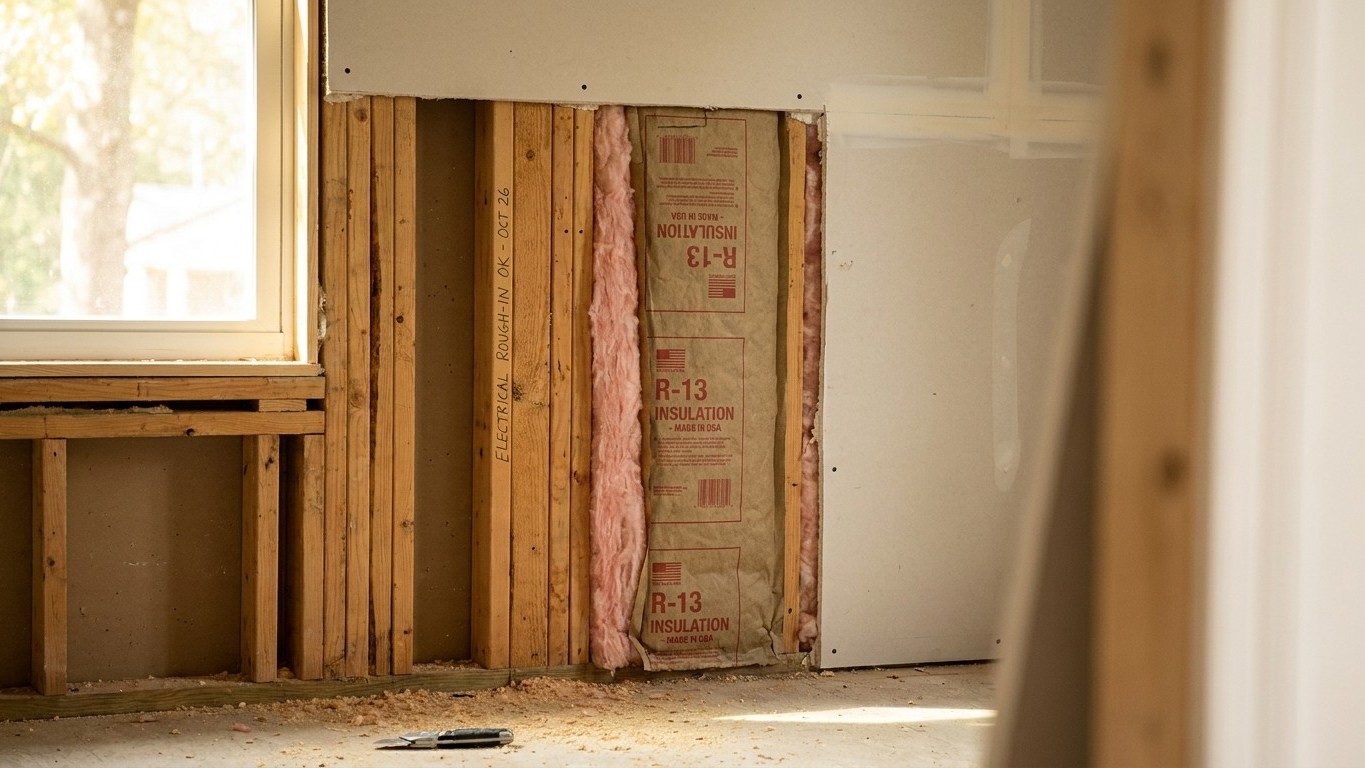

Kentucky sits entirely inside IECC climate zone 4A, and that single fact settles the question: the 2021 International Residential Code’s exception for zones 1, 2 and 3 does not reach here, so a vapor retarder is required on the interior side of frame walls statewide. No county in Kentucky escapes this rule the way counties in warmer states do.
What the code asks for in Kentucky

Yes, a wall in Kentucky needs a vapor retarder on the interior side of frame construction. That’s the rule under Section R702.7 of the 2021 International Residential Code, and it applies because Table R301.1 of the IECC lists Kentucky as “4A (all),” with no county-by-county exceptions. Every jurisdiction in the state reads from the same row of the climate table, which is rarer than it sounds. Plenty of states straddle two or three zones, which means the answer changes at a county line. Kentucky doesn’t have that complication.
The code’s exact wording matters here. R702.7 says a vapor retarder of the class named in Table R702.7(2) “shall be provided on the interior side of frame walls,” and then it lists four exceptions: basement walls, the below-grade portion of any wall, construction where moisture buildup won’t damage the materials, and, critically, “a vapor retarder shall not be required in Climate Zones 1, 2 and 3.” Kentucky’s 4A designation puts it outside that carve-out, which is why the requirement stands.
Worth being precise about what “not required” means for those other zones, since it gets misread. The exception removes an obligation in zones 1 through 3. It doesn’t ban a vapor retarder there, and it doesn’t make one illegal. Kentucky just isn’t in that group, so the point is moot here anyway, but readers comparing this page against a Gulf Coast state should know the difference between “not required” and “forbidden.”
None of this tells an individual homeowner what to install in their own wall. The model code sets a baseline; the state or local jurisdiction adopts a specific edition, sometimes with amendments, and the local building department is the only authority that can confirm what’s currently enforced on a given permit. A wall assembled with the wrong vapor control doesn’t announce the mistake. It looks fine for years, then the sheathing or framing starts rotting from moisture trapped where it can’t escape, and the damage surfaces only when someone opens the wall.
Why the answer is the opposite in a warm climate
The reason Kentucky’s answer flips for a state like Florida or southern Texas comes down to which direction the moisture is traveling. In a cold climate, the water vapor problem starts indoors: heated, humid indoor air pushes outward through the wall cavity in winter, and if it reaches cold sheathing, it condenses there. An interior vapor retarder stops that vapor before it gets that far, which is exactly the job Kentucky’s 4A designation assigns it.
Flip the climate and the moisture source flips too. In a warm, humid climate, the outdoor air carries the load, pushing damp air inward through the wall during long stretches of hot, muggy weather. If that wall has an impermeable layer on the interior side, the vapor doesn’t stop at the sheathing, because the sheathing isn’t the cold surface anymore. The interior retarder becomes the cool, impermeable surface instead, and the U.S. Department of Energy’s Building America program spells out what happens next: “the water vapor will condense on this cool, impermeable surface,” resulting in “ruined insulation, mold, and structural rot of framing members.”
That’s not a bureaucratic quirk buried in a code book. It’s the code tracking the physical direction water is moving through the wall assembly, and writing a different rule for a different mechanism. A retarder that protects a wall in Louisville can actively damage a wall in Miami, because the same sheet of material sits on the wrong side of the moisture flow. That’s the entire logic behind climate-zone-specific rules, and it’s why a single national answer would be wrong for roughly half the country.
Kentucky’s 3,936 heating degree days a year at Louisville, against 1,742 cooling degree days, tells the same story in numbers. The heating load here is more than double the cooling load, which is consistent with a state where the interior-vapor-retarder logic, not the warm-humid exception, is the one that applies.
The three classes, and why the word matters
Once a vapor retarder is required, the code doesn’t leave the material up to guesswork. It sorts retarders into three classes by how much water vapor they let through, measured in perms, and the class assigned in Table R702.7(2) is what actually governs, not the generic phrase “vapor barrier.”
| Class | Example materials | Permeance |
|---|---|---|
| Class I | Sheet polyethylene, nonperforated aluminum foil | 0.1 perm or less |
| Class II | Kraft-faced fiberglass batts, vapor retarder paint | Above 0.1 up to 1.0 perm |
| Class III | Latex or enamel paint | Above 1.0 up to 10.0 perm |
Sheet polyethylene is Class I, not just “a vapor barrier” in general. That distinction is the whole disagreement between a builder working in Kentucky and one working in a warm-humid zone. Both may need a retarder somewhere in the assembly, but which class belongs where depends on the climate and the wall’s ability to dry in one direction or the other.
Most Kentucky homeowners already have a Class III retarder on their walls without realizing it. Ordinary latex paint falls in that permeance range, which means a couple of coats on interior drywall is doing retarder-level work even in a house where nobody thought about vapor control during construction.
One more distinction worth keeping straight: a vapor retarder is not an air barrier. They solve different problems, vapor diffusion versus bulk air movement, and while some products are built to do both jobs at once, being rated for one doesn’t automatically mean a material handles the other.
Where the rule stops
R702.7 doesn’t apply everywhere in a house, and the exceptions matter as much as the rule itself:
- Basement walls
- The below-grade portion of any wall
- Construction where accumulation, condensation, or freezing of moisture will not damage the materials
The basement exception is the one most Kentucky homeowners actually run into. A poured concrete or block foundation wall holds groundwater moisture for years and slowly releases it, which means that assembly needs to dry toward the interior. Sealing it with an impermeable sheet on the inside blocks that drying path entirely, trapping moisture against the concrete and against any framing built up against it. That’s the opposite problem from a warm-humid above-grade wall, but the underlying lesson is the same: block the direction water needs to move, and the wall pays for it later.
Anyone dealing with a basement specifically should look at the basement wall guide on this site, since that assembly follows its own logic separate from above-grade framing.
The third exception, moisture that won’t damage the materials, covers cases like unheated storage buildings or assemblies built entirely from materials indifferent to moisture cycling. It’s a narrow exception, decided case by case rather than by a blanket rule, and it’s exactly the kind of judgment call a local inspector, not a general guide, is positioned to make.
Who actually decides, in Kentucky
The 2021 IRC is a model code. States and local jurisdictions adopt it, sometimes with amendments, sometimes on a delay, and the version enforced on a given building permit is whatever that jurisdiction has formally adopted, not whatever edition happens to be current nationally. That gap is the reason this page can describe the rule but can’t tell any individual reader what to put in their own wall.
Kentucky’s 3,936 heating degree days a year at Louisville measure demand, not a temperature reading. It’s the running total of how far below 65 F the average daily temperature sits, added up across the year, and it’s the figure that turns a climate into a heating bill. A state with double that number burns roughly double the fuel to hold a house at the same indoor temperature. Kentucky’s number puts it solidly in heating-dominated territory, which is exactly why the interior vapor retarder question carries real weight here rather than being an academic footnote.
None of that substitutes for a phone call to the local building department. They know which code edition and which amendments apply to a specific address, and they’re the only source that can confirm it. A wall built with the wrong vapor control doesn’t fail on move-in day. It fails quietly, over years, as trapped moisture works on the framing from the inside, and the first sign is usually a problem that’s already expensive to fix.