
Rhode Island sits entirely in IECC climate zone 5A, with no county carved out into a different zone. That single fact settles the question: under the 2021 International Residential Code, a vapor retarder is required on the interior side of frame walls here, statewide. The class of that retarder, and where the requirement stops, is where the real detail lives.
What the code asks for in Rhode Island

The 2021 International Residential Code, Section R702.7, states plainly: a vapor retarder of the class given by Table R702.7(2) shall be provided on the interior side of frame walls. That’s the baseline rule, and it applies across most of the country in some form. The code then carves out four exceptions, one of which reads: “A vapor retarder shall not be required in Climate Zones 1, 2 and 3.” Rhode Island is zone 5A. It doesn’t fall in that exempted group, so the general rule stands: frame walls here are expected to carry an interior vapor retarder of the appropriate class.
This is one of the rare cases where a state doesn’t force a reader to look up their own county first. The IECC’s climate zone table lists Rhode Island as “5A (all),” meaning every part of the state, from the coastal towns around Newport to the inland communities near the Connecticut border, sits in the same zone. Compare that to a state split across three or four zones, where a homeowner two counties apart from another could be under a completely different set of expectations. Rhode Island doesn’t have that problem. The answer here is uniform.
What zone 5A does mean, practically, is that the state’s winters push enough moisture-laden indoor air toward cold sheathing that the code writers decided an interior retarder earns its keep. That’s the general picture. It is not, however, a blank check to install whatever material comes to mind first. The code specifies classes, precisely because not every retarder behaves the same way, and getting the class wrong can cause the same kind of damage the rule was written to prevent.
It’s also worth being clear about what “required” doesn’t mean. The exception for zones 1, 2 and 3 removes an obligation for builders in those warmer regions. It does not make vapor retarders illegal there, and it doesn’t mean Rhode Island’s requirement is some kind of penalty either. It’s simply the rule that applies to this climate.
None of this settles what should go into a specific wall in a specific town. The International Residential Code is a model code. States and municipalities adopt their own edition, sometimes with amendments, sometimes years behind the national cycle. The rule that actually governs a Rhode Island project is whatever the local building department has adopted and is enforcing right now, not necessarily the 2021 edition referenced here. A wall built with the wrong vapor control doesn’t fail an inspection on the spot. It fails quietly, over years, as moisture works into framing nobody’s looking at.
Why the answer is the opposite in a warm climate
The reason zones 1, 2 and 3 get an exception isn’t bureaucratic tidiness. It’s about which direction the water is moving. In a cold climate like Rhode Island’s, the warm, damp air generated inside a house (from cooking, showers, breathing) pushes outward through the wall assembly during winter. If nothing stops it, that vapor travels until it hits cold sheathing near the exterior, condenses, and soaks the framing. An interior vapor retarder intercepts that vapor before it gets there. That’s the whole logic of R702.7 as it applies here.
Flip the climate and the physics flip with it. In a warm, humid region, the outdoor air is often more saturated with moisture than the conditioned air inside the house, especially with air conditioning running most of the year. The vapor drive reverses: damp air pushes inward, from outside toward the cooler interior. If a builder in that climate installs the same kind of impermeable interior retarder that makes sense in Rhode Island, that layer becomes the coldest, most impermeable surface the incoming vapor meets. The U.S. Department of Energy’s Building America program describes exactly what happens next: “If the wall contains a vapor retarder on the interior side of the Insulation, the water vapor will condense on this cool, impermeable surface,” resulting in “ruined insulation, mold, and structural rot of framing members.”
That’s not a minor footnote. It’s the reason the code doesn’t apply one rule to the entire country. A vapor retarder that protects a wall in Providence would actively damage a wall in a Gulf Coast city, because the moisture is arriving from a different side. The code’s climate-zone exception isn’t a loophole or an oversight. It’s a direct response to which way the water is traveling in a given region, and Rhode Island’s winters put it firmly on the side that needs the interior retarder.
This is also why a rule copied from a builder’s experience in Florida, or from a general contractor who worked mostly in the Southeast, doesn’t transfer cleanly to a Rhode Island project. The assumptions baked into “always install a poly sheet” or “never install a vapor barrier” both come from real, well-documented climate conditions, just not the same one.
The three classes, and why the word matters
Table R702.7(2) doesn’t just say “install a vapor retarder.” It names three classes, defined by how much moisture vapor they let through, measured in perms. The lower the number, the less vapor passes.
| Class | Example materials | Perm rating |
|---|---|---|
| Class I | Sheet polyethylene, nonperforated aluminum foil | 0.1 perm or less |
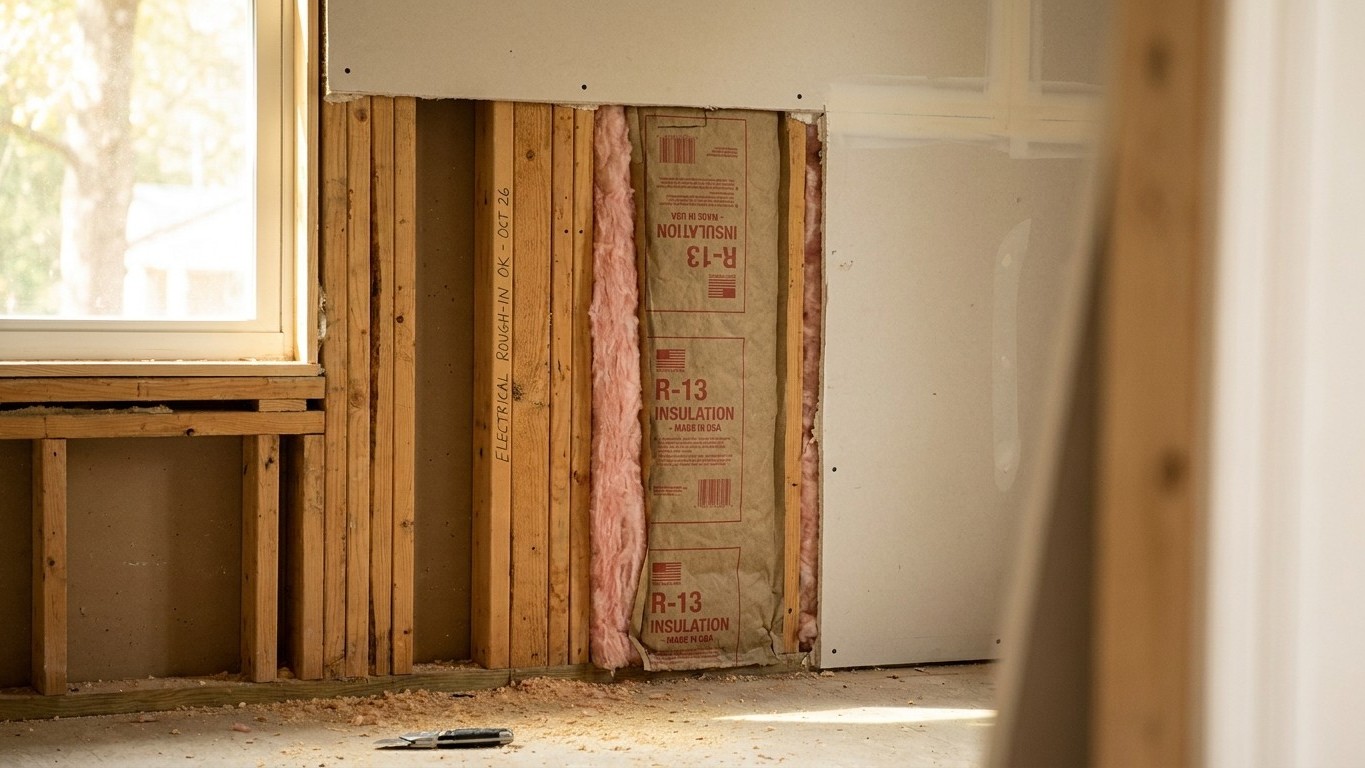
| Class II | Kraft-faced fiberglass batts, vapor retarder paint | Above 0.1 up to 1.0 perm |
| Class III | Latex or enamel paint | Above 1.0 up to 10.0 perm |
The word “vapor barrier” gets used loosely in everyday conversation, usually to mean sheet polyethylene. But polyethylene is specifically a Class I retarder, the most restrictive of the three, and Class I is not automatically the right choice everywhere the code requires a retarder at all. A builder who calls for “a vapor barrier” without specifying class is skipping the part of the rule that actually determines whether the assembly performs well or traps moisture. The disagreement between a contractor working in one region and one working in another usually isn’t about whether to include a retarder. It’s about which class belongs in that particular wall assembly, given the insulation, the sheathing, and the climate.
Here’s a detail most homeowners don’t realize: ordinary latex or enamel wall paint qualifies as a Class III vapor retarder. Anyone who has painted an interior wall with a standard latex product already has a vapor retarder on that surface, whether they intended one or not. That’s a far cry from sheet polyethylene, but it technically satisfies the lower end of the code’s three-class system in some assemblies.
One more distinction worth keeping straight: a vapor retarder and an air barrier are not the same thing. A vapor retarder slows the diffusion of water vapor molecules through a material. An air barrier stops bulk air movement, which carries far more moisture than diffusion ever does. Some products (certain sheet membranes) do both jobs at once. Many don’t. Confusing the two is common, and it’s a separate topic from the class table above.
Where the rule stops
R702.7 lists exceptions to the general requirement, and in a zone 5A state like Rhode Island, where the climate-zone exception for zones 1, 2 and 3 doesn’t apply, three of those exceptions are the ones that actually matter for a Rhode Island project:
- Basement walls
- The below-grade portion of any wall
- Construction where the accumulation, condensation, or freezing of moisture will not damage the materials
The basement exception is the one most Rhode Island homeowners actually run into, since basements are common throughout the state. A poured concrete or block foundation wall behaves nothing like a framed wall above grade. Concrete holds groundwater and releases it slowly, sometimes over years, and that moisture needs a path to dry inward toward the conditioned space. Seal that wall with an impermeable interior vapor retarder and the moisture has nowhere to go. It builds up behind the sheet instead, which is precisely the outcome the above-grade rule was designed to prevent, just relocated to a different assembly. That’s why the code exempts basement walls from the same requirement it applies to framed walls upstairs.
The below-grade exception extends that same logic to any wall section sitting underground, regardless of whether it’s technically part of a basement. And the third exception, moisture that won’t damage the materials, covers assemblies engineered or detailed in a way that sidesteps the concern entirely, which is a judgment call made case by case rather than a blanket category.
For the specifics of how that plays out in a below-grade assembly, the basement wall guide on this site covers the drying direction and material choices in more detail than fits here.
Who actually decides, in Rhode Island
Everything above describes the 2021 International Residential Code as written and how it applies to a state sitting in a single climate zone. What it doesn’t describe is the exact edition, amendments, or enforcement details in force in any particular Rhode Island city or town, because that’s set locally, not by the model code itself. States adopt building codes on their own schedule, sometimes with state-specific amendments, sometimes a cycle or two behind the national version. The only way to know which edition governs a specific project, and how the local building department interprets the class requirement for a given wall assembly, is to ask that department directly.
This matters more in Rhode Island than the climate-zone convenience might suggest. The state carries about 5,478 heating degree days a year at the Providence reference station, a figure that measures how much heating demand accumulates over the year, not a temperature reading. That’s a substantial heating load, the kind that keeps interior humidity and vapor drive pushing outward through walls for a large share of the year, and it’s part of why the code treats this region the way it does. Against that, the same station logs about 812 cooling degree days annually, a much smaller cooling demand by comparison. The winter side of the ledger dominates here, which is exactly the condition under which an interior vapor retarder does its job.
None of that changes the basic guidance: this page describes the rule and what it depends on, not what belongs in any individual reader’s wall. A local building department can confirm the adopted code edition, the class expected for a particular assembly, and any local amendment that shifts the details. A wall assembled with the wrong vapor control doesn’t announce the problem right away. It shows up years later, in framing that’s already rotted before anyone notices.