
Yes, in most cases: West Virginia’s 55 counties sit entirely in IECC Climate Zones 4A and 5A, and the 2021 International Residential Code requires an interior vapor retarder in every zone except 1, 2 and 3. Since no West Virginia county falls into those warm zones, the general rule applies statewide. But which class of retarder, and how the exceptions apply, still depends on the wall and the local code adopted.
What the code asks for in West Virginia

Section R702.7 of the 2021 IRC is direct about it: a vapor retarder of the class named in Table R702.7(2) shall be provided on the interior side of frame walls. That’s the baseline rule, and it applies almost everywhere in the country with one carve-out written into the same section: “A vapor retarder shall not be required in Climate Zones 1, 2 and 3.” Those are the hot, humid and desert zones, mostly Florida, the Gulf Coast, southern Texas and parts of the Southwest.
West Virginia doesn’t touch any of that. Its 55 counties split between two zones only: 36 counties sit in Zone 4A, and 19 counties sit in Zone 5A. Both are mixed-to-cold zones with a moist moisture regime, and neither one is 1, 2 or 3. That means the exception that removes the requirement in warm climates simply doesn’t apply anywhere within the state’s borders. Every county, whether it’s a 4A county along the Ohio River or a 5A county up in the higher elevations, falls under the general rule: an interior vapor retarder is called for on frame walls.
Why the two-zone split still matters
Here’s the nuance worth catching. The zone split between 4A and 5A doesn’t change whether a retarder is required in West Virginia, since both zones sit outside the 1-2-3 exception. What it can change is which class of material Table R702.7(2) points to for a given wall assembly and which Insulation levels the rest of the energy code expects alongside it. A house in a 5A county carries a longer, colder heating season than one in a 4A county, and the code writers built that difference into related tables even when the vapor retarder answer itself doesn’t flip.
This is also the point where “required” gets misread as “mandatory in one specific form.” The code doesn’t say every wall needs a sheet of plastic. It says a retarder of an appropriate class needs to be there, and three classes exist precisely because different materials, and different perm ratings, are appropriate for different assemblies. A wall built with the wrong class for its situation doesn’t fail an inspection and get flagged on the spot, it can pass, and then take on moisture for years before anyone notices a problem.
Why the answer is the opposite in a warm climate
None of this is arbitrary. The reason the code drops the requirement in Zones 1, 2 and 3 comes down to which direction the water vapor is actually moving through the wall, and that direction depends on the climate outside.
In a cold climate like most of West Virginia, the warm, damp air sits inside the house. Heating season pushes that indoor humidity toward the walls, and if it reaches a cold sheathing layer in January, it condenses there. An interior vapor retarder stops that moisture before it gets that far, keeping the insulation dry and the framing sound. That’s the logic behind R702.7’s general rule, and it’s why West Virginia’s climate zones, 4A and 5A both, keep the requirement in place.
Flip the climate, and the physics flips with it. In a warm-humid zone, the humid air is outside for most of the year, and the U.S. Department of Energy’s Building America program lays out exactly what happens if a builder installs the same impermeable interior layer anyway: “If the wall contains a vapor retarder on the interior side of the insulation, the water vapor will condense on this cool, impermeable surface.” The air conditioning keeps the interior side cool, the vapor barrier gives outdoor moisture nowhere to go, and it condenses right there inside the wall cavity. The DOE names the result plainly: “ruined insulation, mold, and structural rot of framing members.”
That single sentence is the reason the code doesn’t apply one rule nationwide. It’s not a regional quirk or a paperwork inconsistency between jurisdictions. The direction water vapor travels through a wall assembly depends on which side of that wall is warmer and more humid for most of the year, and that reverses between a Charleston, West Virginia winter and a Charleston, South Carolina summer. A retarder that protects a wall in one climate can rot the same wall in another. West Virginia’s position in Zones 4A and 5A puts it firmly on the side where the interior retarder is doing its intended job, not undermining it.
The three classes, and why the word matters
“Vapor retarder” isn’t one material. The code splits it into three classes by permeance, and those numbers, not the generic term, are what actually govern a given wall.
| Class | Example materials | Perm rating |
|---|---|---|
| Class I | Sheet polyethylene, nonperforated aluminum foil | 0.1 perm or less |
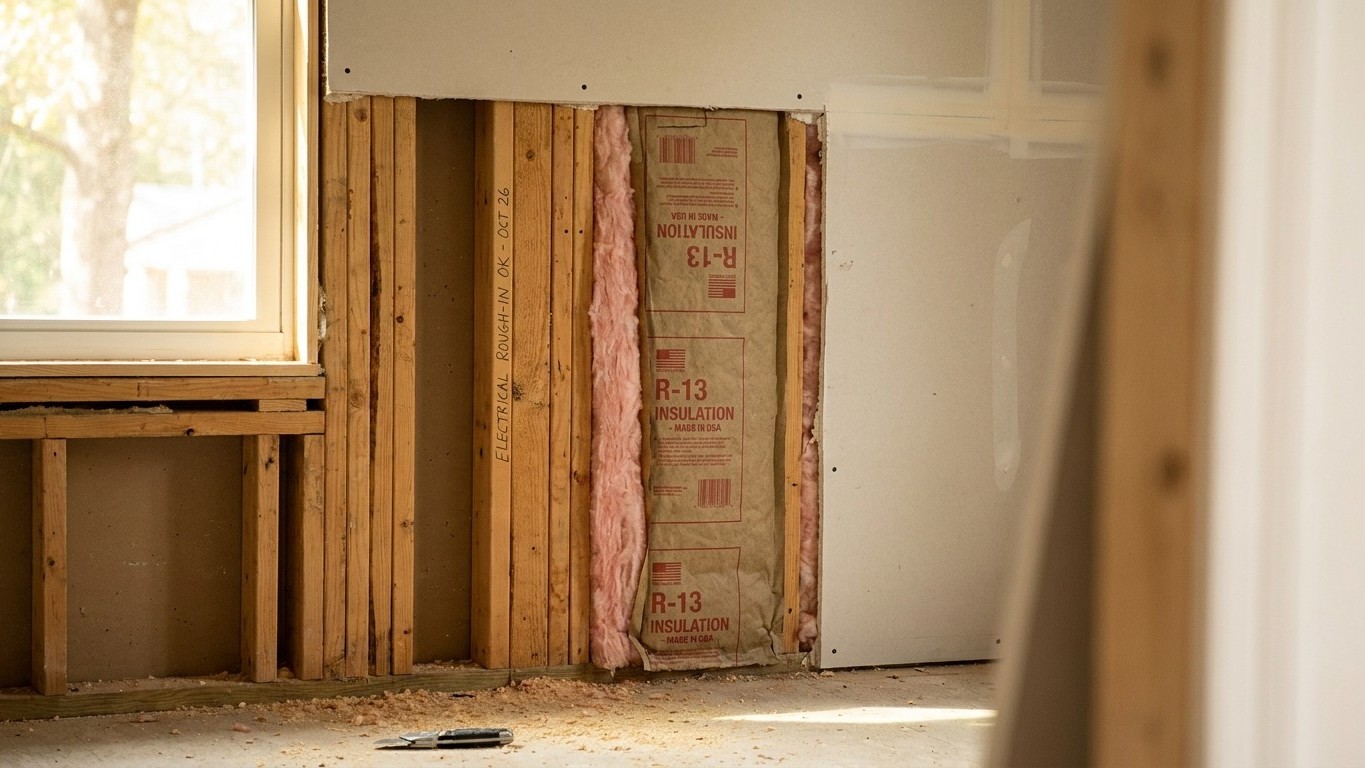
| Class II | Kraft-faced fiberglass batts, vapor retarder paint | Above 0.1, up to 1.0 perm |
| Class III | Latex or enamel paint | Above 1.0, up to 10.0 perm |
Sheet polyethylene is what most people picture when they hear “vapor barrier,” and it does belong in the discussion, but only as one option: Class I. Calling any Class I material simply “a vapor barrier” without naming its class is where a lot of confusion between builders starts. The disagreement between someone building in a cold mountain county and someone building along the Gulf Coast was never really about whether to include a retarder at all. It’s about which class fits the direction the moisture is moving.
Class III is the one homeowners rarely think about, because most already own one. Ordinary latex or enamel paint on interior drywall qualifies as a Class III vapor retarder, sitting somewhere between 1.0 and 10.0 perm. A can of wall paint from the hardware store is doing retarder duty every day in millions of houses, West Virginia included, without anyone treating it as a building code component.
Retarder and air barrier are not the same job
One more distinction worth keeping straight: a vapor retarder slows moisture diffusion through a material, while an air barrier stops bulk air movement, drafts carrying both heat and moisture, through gaps and seams. The two jobs sometimes get handled by the same sheet of material, which is part of why the terms get blurred, but they’re solving different problems and a wall can have one without the other.
Where the rule stops
R702.7 lists four situations where the general requirement doesn’t apply, and reading past just the climate-zone exception matters, because most West Virginia readers won’t be dealing with that one anyway.
- Basement walls
- The below-grade portion of any wall
- Construction where accumulation, condensation or freezing of moisture will not damage the materials
- Climate Zones 1, 2 and 3 (not applicable to any West Virginia county)
The basement exception is the one most homeowners actually run into, because so many West Virginia houses sit on foundations built into a slope or a hillside. A poured concrete or block wall behaves nothing like a wood-framed wall: it holds groundwater and releases it slowly, over years, and that moisture needs a path to dry toward the interior. Wrap that concrete in an impermeable interior sheet and the wall has nowhere to send the moisture it’s already carrying, which is exactly the trapped-condensation problem the DOE describes for warm climates, just triggered by a different source of water. This is also the exception people misread as “basements don’t need any moisture control,” which isn’t what it says either. It says the same interior vapor retarder rule that governs a wood-framed wall doesn’t apply the same way to a foundation wall, because the physics of a concrete wall are different from the physics of a stud cavity. Anyone dealing with a basement specifically should look at the basement wall guide on this site for the detail that applies to that assembly.
Who actually decides, in West Virginia
The 2021 IRC is a model code, and West Virginia’s local building departments are the ones who adopt, amend and enforce whatever edition applies in a given jurisdiction, sometimes a newer version, sometimes an older one still on the books. That’s not a technicality. It’s the reason two counties in the same climate zone can end up under slightly different requirements depending on when their jurisdiction last updated its code, and it’s why this page can lay out the rule and the reasoning behind it, but can’t tell an individual homeowner what to nail up in their own wall. That answer comes from the local building department, and from the specific code edition that jurisdiction has adopted.
The weight behind that question in West Virginia comes down to how much winter the state actually carries. At Charleston Yeager Airport, the National Weather Service reference station for the state, the annual normal runs about 4,353 heating degree days against roughly 1,162 cooling degree days, base 65 F. Heating degree days measure demand, not temperature, adding up how far below 65 F the daily average sits, day after day, across the year. A number that size describes a long heating season and a comparatively short, mild cooling season, which lines up with why West Virginia’s counties sit in Zones 4A and 5A rather than anywhere near the warm-climate exception. That’s also a single reference-city figure; a higher-elevation county in the same state can run considerably colder through the winter months.
A vapor retarder installed with the wrong class, or skipped where the local code calls for one, doesn’t show up as a visible defect at closing or even at the five-year mark. It shows up as rot inside a wall cavity that nobody opens up until there’s already a problem to fix. Checking with the local building department before framing is finished costs nothing and settles a question this page can only frame, not answer for any one house.