
Yes. Maine’s counties fall inside IECC Climate Zones 6A and 7, and the 2021 International Residential Code requires an interior vapor retarder on frame walls in both zones. The exception that removes this requirement only reaches Climate Zones 1, 2 and 3, so it never touches Maine. What changes from county to county is not whether a retarder is needed, but which class, and how the rest of the wall assembly is built around it.
What the code asks for in Maine

The 2021 International Residential Code, Section R702.7, states it plainly: a vapor retarder of the class given by Table R702.7(2) shall be provided on the interior side of frame walls. That’s the baseline rule for the whole country, before any exception is applied.
The code then lists four exceptions, and one of them removes the obligation entirely in warm climates: “A vapor retarder shall not be required in Climate Zones 1, 2 and 3.” Maine doesn’t qualify for that exception. According to the 2021 IECC’s climate zone table, 15 of the state’s 16 counties sit in Zone 6A, and one county sits in Zone 7. Neither number is anywhere near the 1-2-3 range the exception covers.
That’s worth sitting with for a moment, because in a lot of states this section of the code splits the readership in two: a homeowner in one county needs the retarder, a homeowner two counties south does not. Maine doesn’t have that split. Whether a house sits in the 15-county Zone 6A group or the single Zone 7 county, the interior vapor retarder requirement applies. The difference between those two zones shows up elsewhere in the code, in the insulation R-values the ENERGY STAR and IECC tables assign by zone, not in whether a retarder is called for.
What this means in practice is that Maine builders and homeowners are working under one of the more consistent versions of this rule in the country. But “consistent” doesn’t mean “simple.” The retarder still has to be the right class for the assembly, installed on the correct side, and it still has to work with the rest of the wall rather than against it. A wall built with the wrong vapor control doesn’t announce the mistake. It looks fine for years. The moisture problem shows up inside the cavity, against the sheathing or the framing, long before anyone sees a stain on drywall.
That’s also why this page stops short of telling any individual reader what to install in their own wall. The code in force for a given address is whatever edition and amendments the local jurisdiction has adopted, and that’s not always identical to the base IRC language quoted above. The right next move for a specific project is a call to the local building department, not a generic answer pulled from a national code book.
Why the answer is the opposite in a warm climate
The reason Zones 1, 2 and 3 get an exception, and Maine doesn’t, comes down to which direction the water vapor is traveling, not to some regional preference or a bureaucratic carve-out.
In a cold climate like Maine’s, the warm, moisture-laden air lives inside the house. Heating systems run for months, indoor humidity from cooking, showers and breathing stays elevated, and that damp air constantly presses outward through the wall assembly toward the cold sheathing. An interior vapor retarder is there to stop that indoor moisture from reaching the cold surface and condensing inside the wall cavity, where it would soak insulation and framing without anyone noticing until the damage is done.
In a warm, humid climate, the physics run in reverse. The moisture load comes from outside: humid air pushes inward through the wall toward the air-conditioned interior, which is now the cool side of the assembly. If that wall has a Class I vapor retarder on the interior, the U.S. Department of Energy’s Building America program describes exactly what happens next: “If the wall contains a vapor retarder on the interior side of the insulation, the water vapor will condense on this cool, impermeable surface,” and the result is “ruined insulation, mold, and structural rot of framing members.” The same material that protects a Maine wall becomes the thing that destroys a Florida or Gulf Coast wall, because it traps condensation on the wrong side of the assembly.
That’s the whole logic behind the zone-based exception. It isn’t the code hedging its bets or splitting the difference between regional building lobbies. It’s a direct response to which way the water is moving in a given climate. Cold-climate walls need to stop indoor moisture from migrating out to a cold surface. Warm-humid walls need to let moisture that arrives from outside dry back out, and a sealed interior surface blocks that path. Maine’s heating-dominated climate puts it squarely on the side of the equation where the interior retarder does its job as intended.
The three classes, and why the word matters
“Vapor barrier” gets used loosely, but the code doesn’t work in absolutes. It defines three classes by how much moisture they let pass, measured in perms, and the class matters far more than the plain-language label.
| Class | Example materials | Permeance |
|---|---|---|
| Class I | Sheet polyethylene, nonperforated aluminum foil | 0.1 perm or less |
| Class II | Kraft-faced fiberglass batts, vapor retarder paint | Above 0.1 up to 1.0 perm |
| Class III | Latex or enamel paint | Above 1.0 up to 10.0 perm |
Polyethylene sheeting is what most people picture when they hear “vapor barrier,” and it earns that reputation honestly: it’s Class I, close to impermeable. But calling it “a vapor barrier” without naming the class hides the actual disagreement in this whole topic. Nobody in the code world is arguing over whether a wall needs vapor control in general. The argument, when there is one, is over which class belongs in which climate, because a Class I sheet that’s correct in a cold-climate wall is the same material the DOE warns against in a warm-humid one.
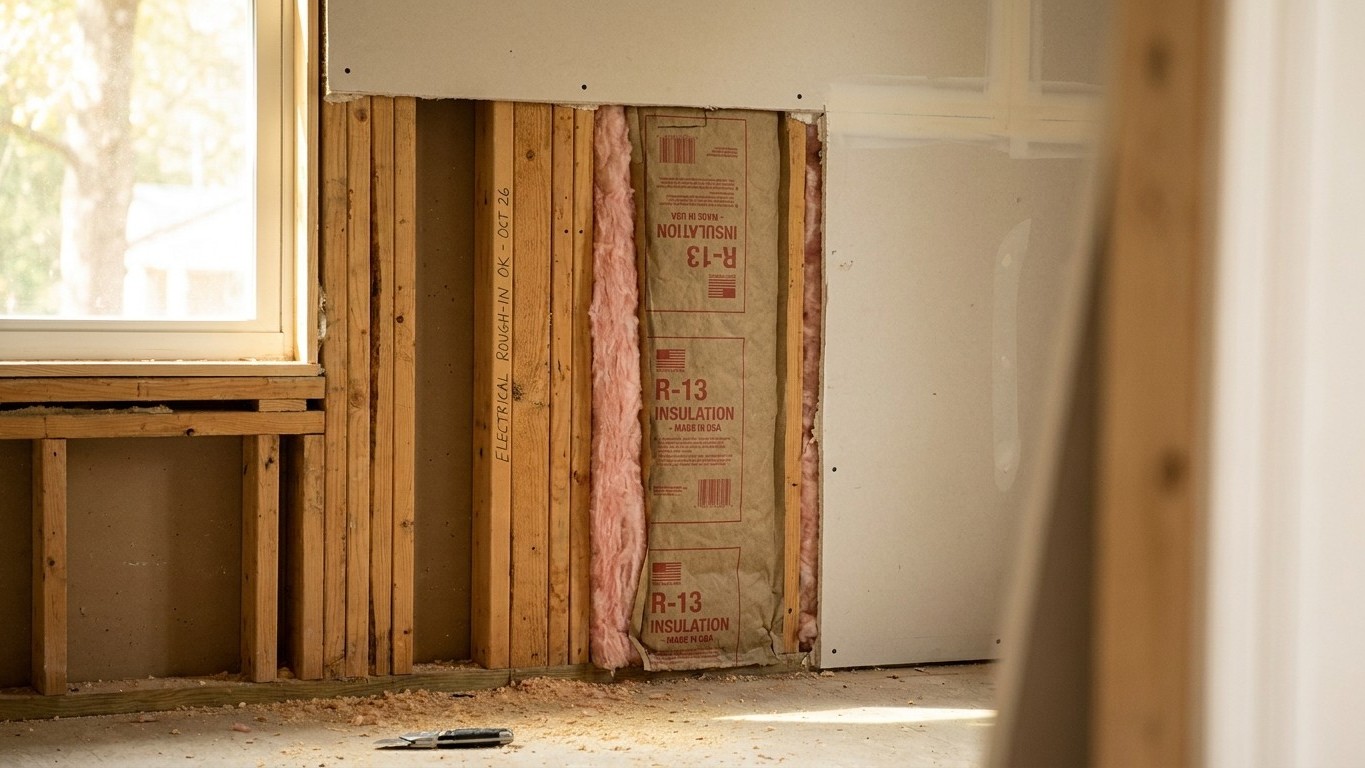
Here’s a detail most homeowners never realize: ordinary latex paint on interior drywall is a Class III vapor retarder. It’s not a decorative afterthought in this system, it’s the lightest tier of retarder the code recognizes, and plenty of walls meet their vapor retarder requirement with nothing more exotic than a coat of interior paint, provided the rest of the assembly is built to work with that level of permeance.
One more distinction worth keeping straight: a vapor retarder is not an air barrier. They solve different problems, one slowing the diffusion of water vapor through a material, the other blocking the bulk movement of air (and everything the air carries) through gaps and seams. Some products do both jobs on the same sheet, but the code, and the physics, treat them as separate requirements.
Where the rule stops
The requirement in R702.7 isn’t universal even within a cold-climate state like Maine. The code carves out three situations where the interior vapor retarder isn’t called for, regardless of zone:
- Basement walls
- The below-grade portion of any wall
- Construction where accumulation, condensation or freezing of moisture will not damage the materials
The basement exception is the one most Maine homeowners actually run into, because so many houses here have full or partial basements. A poured concrete or block foundation wall behaves nothing like a wood-framed wall exposed to open air. Concrete holds groundwater moisture and releases it slowly, sometimes for years after the pour, and that assembly needs a drying path inward, toward the conditioned basement space, rather than a sealed interior surface locking moisture inside the wall. Put a Class I retarder against a basement wall the way you would in an above-grade frame wall, and you can trap moisture that has nowhere left to go, which is the opposite of what the retarder is supposed to prevent.
This is exactly why basement walls get their own separate treatment in this state guide series rather than a footnote here. If a project involves a foundation wall, the rules diverge enough from the above-grade frame wall discussion that it deserves its own answer, not a shortcut borrowed from this page.
The third exception, covering assemblies where moisture won’t damage the materials, is the broadest and the most case-specific. It’s written to cover unusual constructions rather than typical stick-framed exterior walls, and it’s the kind of call a local code official is positioned to make on a specific plan set, not something to self-apply from a general description.
Who actually decides, in Maine
Everything above comes from the model code, the 2021 IRC, and from where Maine’s counties land on the IECC’s climate zone map. Neither of those documents is automatically the law on any specific property. States and municipalities adopt code editions on their own schedule, sometimes with local amendments, sometimes years behind the version cited here. The only source that can answer for a particular house is the building department with jurisdiction over that address, working from the edition it has actually adopted.
That gap between model code and adopted code matters more in a state like Maine than in places with a shorter, milder heating season. At the Portland International Jetport, the NOAA 1991-2020 climate normal for heating degree days runs about 6,795 a year, against roughly 447 cooling degree days. Heating degree days measure demand, not temperature: each one represents one degree that the day’s mean temperature sat below 65°F, added up across the year. A number in the high 6,000s describes a long, sustained heating season, and it’s the reason wall assemblies here spend most of the year with warm, humid indoor air pressing against cold sheathing, exactly the scenario the interior vapor retarder is built to manage.
None of that changes the basic advice: this page states the rule, explains what it depends on, and stops there. It doesn’t tell an individual reader what to install in their own wall, because the code in force is whatever edition and amendment their town or city has adopted, not the model code quoted above. A wall built with the wrong vapor control won’t announce itself at the final inspection. It fails quietly, inside the cavity, and the owner usually finds out years later, when the damage is already done.